Getting your development project off the ground in Ontario starts with one critical, often underestimated document: the Site Grading and Drainage Plan. In the world of land development, precision isn’t just a goal: it’s a requirement. A single miscalculation in your surface slopes or a failure to account for a neighbor’s runoff can lead to costly municipal rejections, delayed building permits, and expensive field corrections.
At Reliance Engineering, we specialize in moving projects from concept to construction quickly. We don’t just draw lines; we design solutions that meet the rigorous standards of Ontario municipalities. If you want to secure your approval in one submission, this guide is your roadmap.
Why Site Grading is the Foundation of Your Project
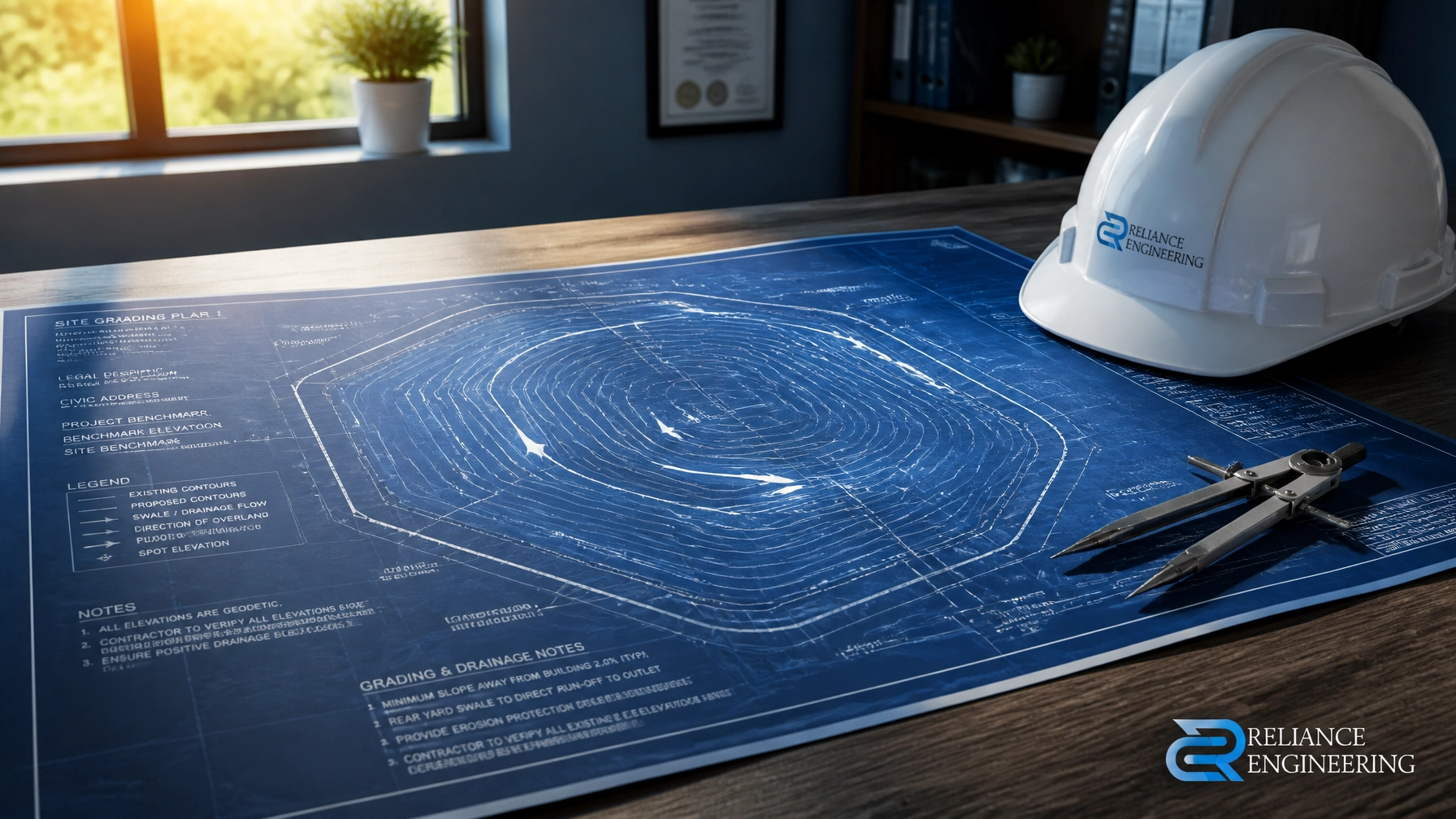
Site grading is the process of adjusting the slope and elevation of the land to ensure proper drainage and provide a level area for construction. In Ontario, this is governed by the Ontario Building Code (OBC) and specific municipal bylaws. The primary objective is simple: keep water away from the building and ensure it doesn't cause problems for your neighbors.
However, the execution is complex. A professional grading plan must balance the architectural vision with technical constraints like soil permeability, existing topography, and municipal storm infrastructure. When you get it right, you protect the property's longevity. When you get it wrong, you face basement flooding, foundation damage, and legal disputes.

The Core Principles of Ontario Drainage
To succeed in a municipal submission, your plan must adhere to three core principles:
- Positive Drainage: Water must always flow away from the building foundation. Typically, this means a minimum 2% to 5% slope for the first few meters around the perimeter.
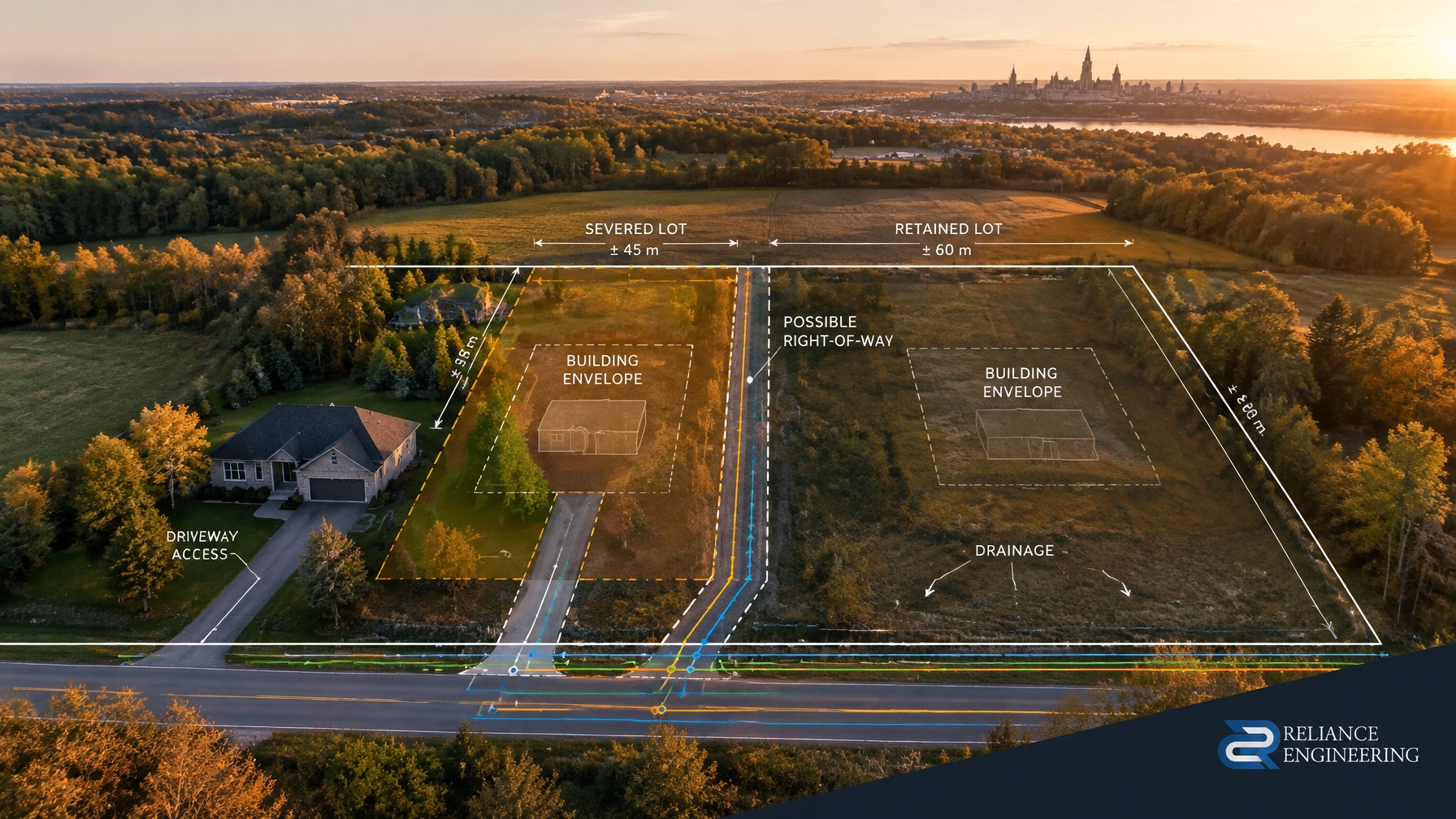
- No Adverse Impact: You cannot change your grading in a way that directs more water onto an adjacent property. This is a common cause for rejection. We often use swales: shallow channels: to catch and redirect runoff safely to the street or a rear-yard catchbasin.
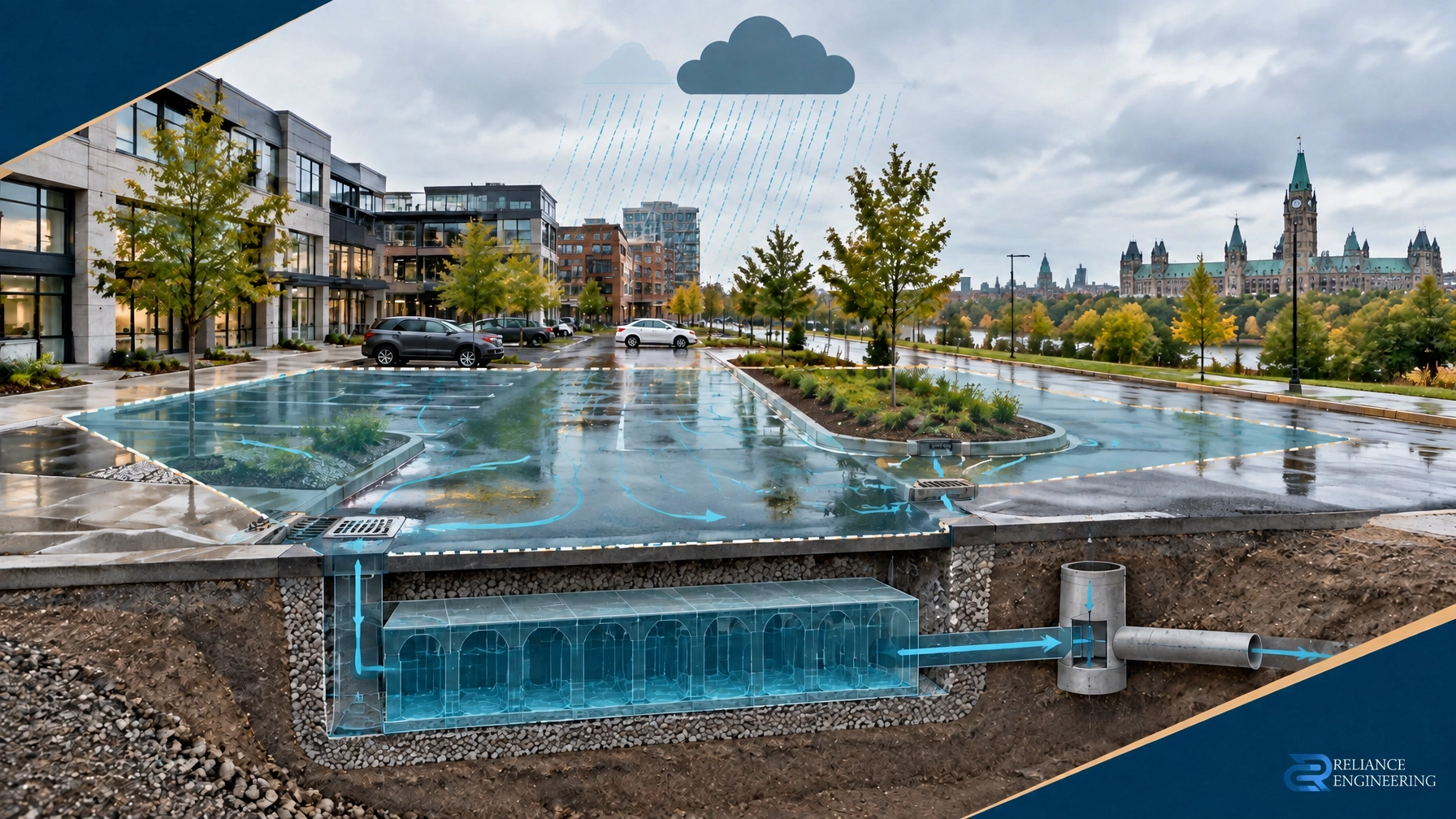
- Self-Containment: Many municipalities now require that you manage as much stormwater as possible on-site through Sustainable Stormwater Management solutions.
Technical Standards You Must Know
Across Ontario, while minor details vary, the benchmarks remain consistent:
- Minimum Swale Slopes: Usually 1.5% to 2% to ensure water actually moves and doesn't pond.
- Driveway Slopes: Must stay within a range (often 2% to 8%) to ensure safety during Ontario’s icy winters.
- Foundation Clearance: Ensuring the top of the foundation is high enough above the finished grade to prevent water ingress.
The "One Submission" Strategy: A Checklist for Success
Most developers lose weeks or months in the "comment-and-resubmit" cycle. At Reliance Engineering, we aim for first-time approval. How? By treating the municipal checklist as the minimum requirement, not the final goal.
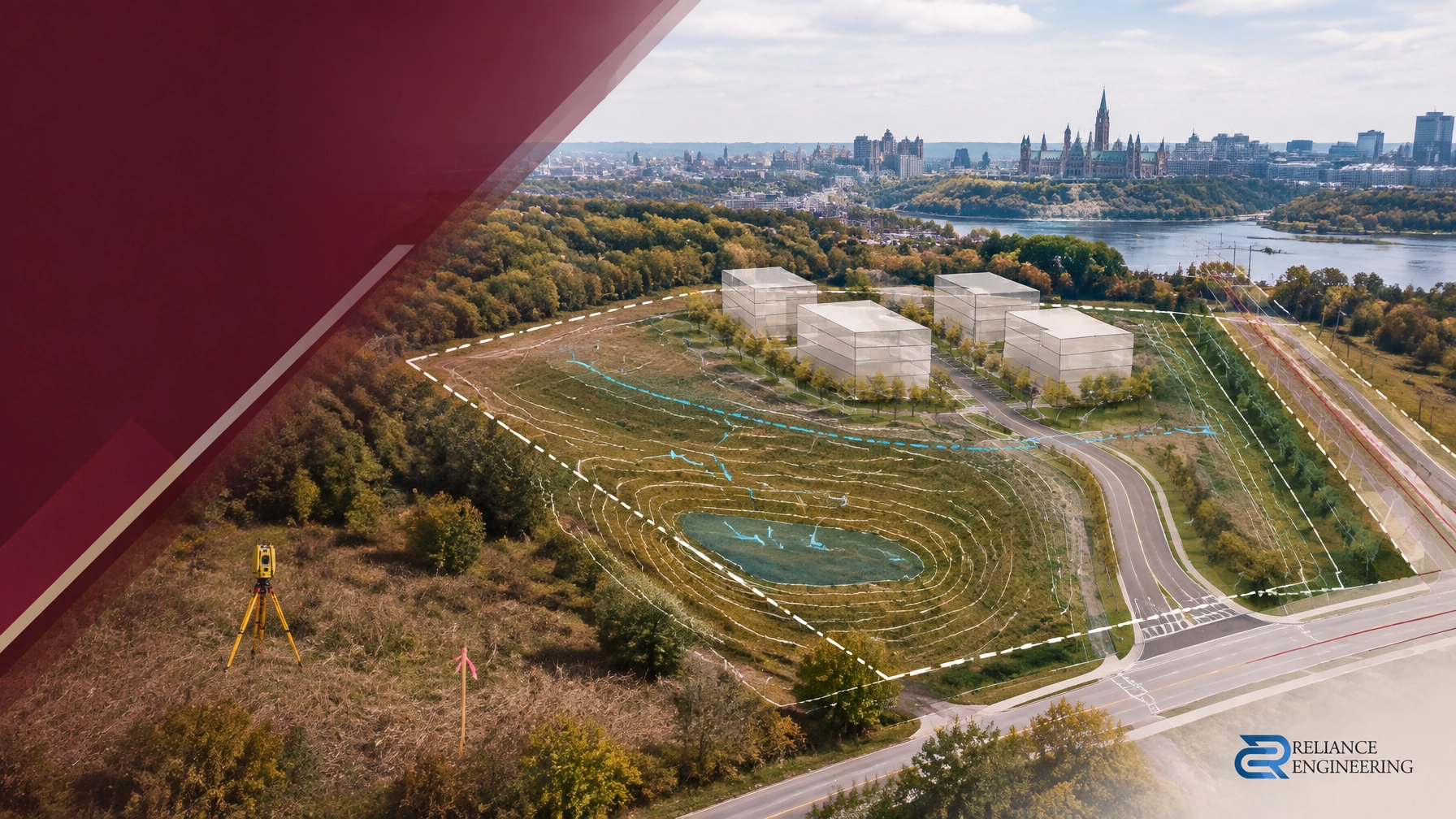
1. Start with a Precision Survey
You cannot design a grading plan on guesswork. A high-quality topographic survey showing existing elevations, trees, and neighboring structures is the only way to begin. Without accurate base data, your proposed grades will fail in the field.
2. Coordinate with Architecture and Servicing
Your grading plan doesn't exist in a vacuum. It must be perfectly synchronized with your Site Servicing Plans. If the water main is at a certain depth, your grading must accommodate the necessary cover. If the architect designed a walk-out basement, the grading must provide the necessary relief without creating a "bowl" that traps water.
3. Use Clear Visual Communication
Reviewers at the City of Mississauga, Toronto, or Brampton handle hundreds of files. If your plan is cluttered or confusing, it will be flagged. We use clean, professional technical drafting that clearly shows:
- Existing vs. Proposed spot elevations.
- Flow direction arrows.
- Detailed cross-sections of swales and retaining walls.

Common Pitfalls: Why Plans Get Rejected
Over the last 20+ years, Naresh Ochani and our team have seen every possible reason for a "Returned for Revision" notice. Here are the top three mistakes to avoid:
- Ignoring the Master Grading Plan: If you are building in a newer subdivision, there is likely already a Master Grading Plan on file. If your individual lot plan deviates from this without a massive technical justification, it will be rejected instantly.
- Insufficient Detail on Retaining Walls: If your site has significant elevation changes, you might need retaining walls. Simply drawing a line isn't enough; you must show the top and bottom of the wall (TOW/BOW) elevations and ensure they don't block regional drainage paths.
- Failure to Account for LID (Low Impact Development): Modern Ontario standards often require infiltration galleries or soakaway pits. If you haven't included these or the required Functional Servicing Report, your building permit will be stalled.

The Role of the Professional Engineer (P.Eng.)
In Ontario, a Site Grading and Drainage Plan for a building permit must be stamped by a Professional Engineer (P.Eng.) or an Ontario Land Surveyor (OLS). But the stamp is just the beginning.
You need a partner who understands the nuance of local regulations. For example, the requirements for a Multi-Unit Conversion in an established neighborhood are vastly different from a new custom home build. We take full ownership of the process, acting as your mentor and advocate with municipal staff.
Conclusion: Get Your Designs Approved Faster
Site grading is where the rubber meets the road. It is the bridge between a theoretical architectural design and a functional, safe, and legal building. Don't let poor engineering slow down your project.
Whether you are an architect, a developer, or a homeowner, Reliance Engineering provides the technical precision and municipal insight required to navigate the Ontario approval landscape. We focus on the details so you can focus on the build.

Ready to secure your building permit?
Contact us today for a consultation. We provide comprehensive civil engineering services, including Site Grading, Site Servicing, and Stormwater Management Reports across Ontario.
Reliance Engineering
Address: 6850 Millcreek Dr, Mississauga, ON L5N 2H4
Phone: 647-385-6418
Email: [email protected]
Contact: Naresh Ochani, P.Eng. M.Eng.
Office Hours:
- Saturday: 12:00 PM – 2:00 PM
- Sunday: Closed