Article type: Compliance and project-delivery guide
Topic: Stormwater management approvals, EASR registration and post-construction responsibility
Service area: Ontario
Prepared and reviewed by: Naresh Ochani, P.Eng., M.Eng. PEO Certificate of Authorization 100548882
A stormwater management report can support planning approvals, environmental registration and construction, but approval of the report does not automatically settle who will inspect, clean and maintain the facility years later.
For developers, builders and property owners, the key is to treat the report as part of a wider compliance and ownership plan. This guide explains how a report connects to municipal approvals, where Ontario’s EASR requirements fit, and what to confirm before construction begins.

An SWM report is a compliance document, not just a design deliverable
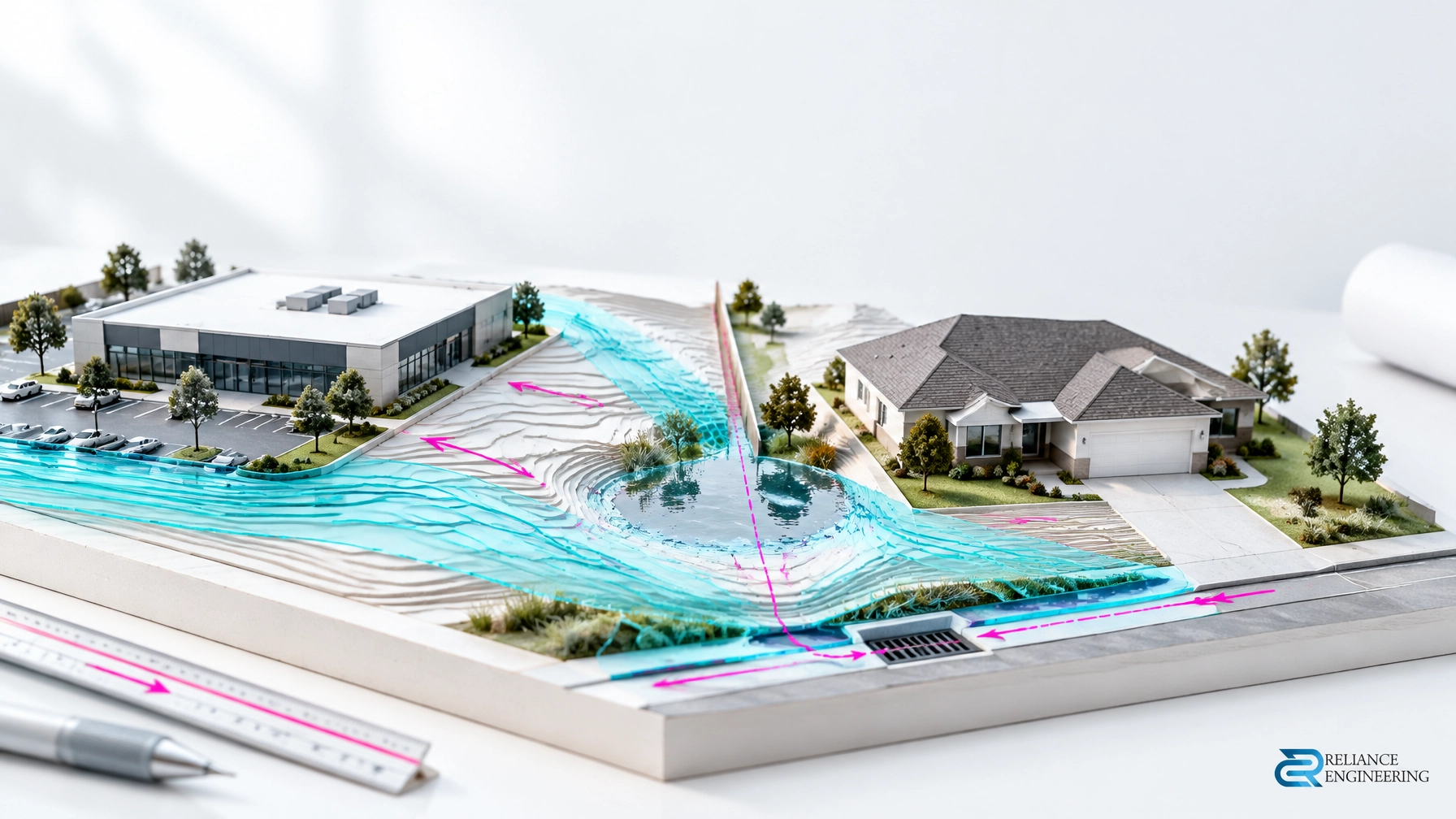
A stormwater management report explains how a site will manage runoff, including the design criteria, calculations, storage and treatment approach, and discharge route. It supports a coordinated design with grading, servicing and construction measures.
A clear report also helps define what must happen after construction. Depending on the project and approval path, it may describe operating procedures, inspections, repairs and sediment removal. Under Ontario’s EASR requirements, the report for eligible registered works must include an operations and maintenance manual and an erosion and sediment control plan.
The practical test is not only whether the calculations demonstrate a design solution. The report and drawings should also make the system understandable, buildable and maintainable.
The approvals the report feeds
Municipal requirements vary. Confirm the submission requirements and design criteria with the local approval authority rather than assuming one municipality’s process applies across Ontario.
- Site plan control: The municipality may review the SWM approach as part of site plan approval, including drainage, servicing and related drawings or reports.
- Plan of subdivision: For subdivision proposals, stormwater facilities and their connections may be reviewed alongside the proposed layout and infrastructure. Conditions may be carried into the subdivision agreement.
- Subdivision agreement conditions: The agreement can set out construction, inspection, maintenance, security, handover and assumption requirements. Review these conditions early; they are central to assigning responsibilities before and after municipal assumption.
- Conservation Authority review: Where a watercourse, floodplain or regulated area is involved, separate Conservation Authority review or a permit may be relevant. Confirm the applicable requirements with the Authority. Municipal planning approval does not, by itself, establish that any separate permit has been obtained.
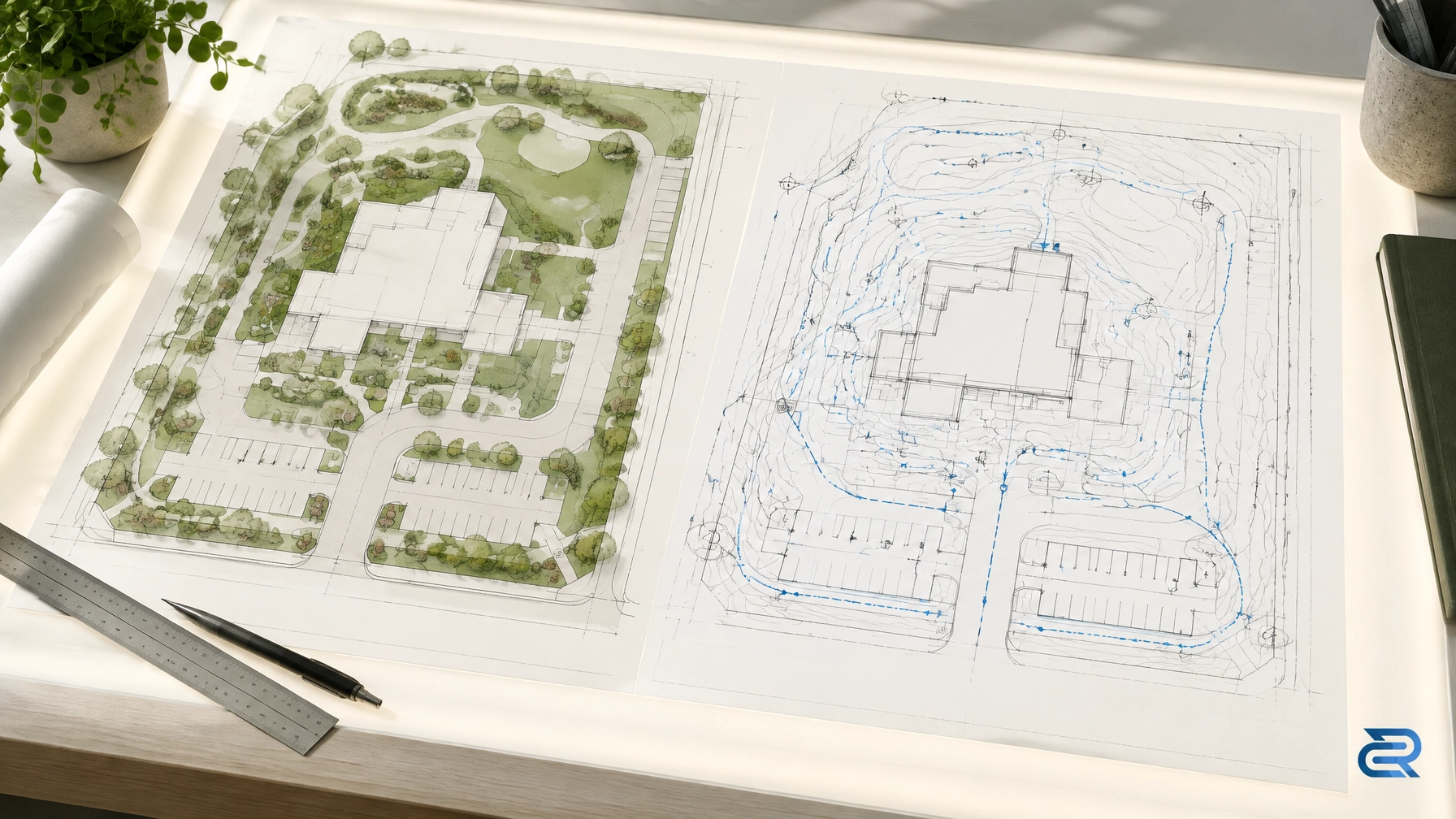
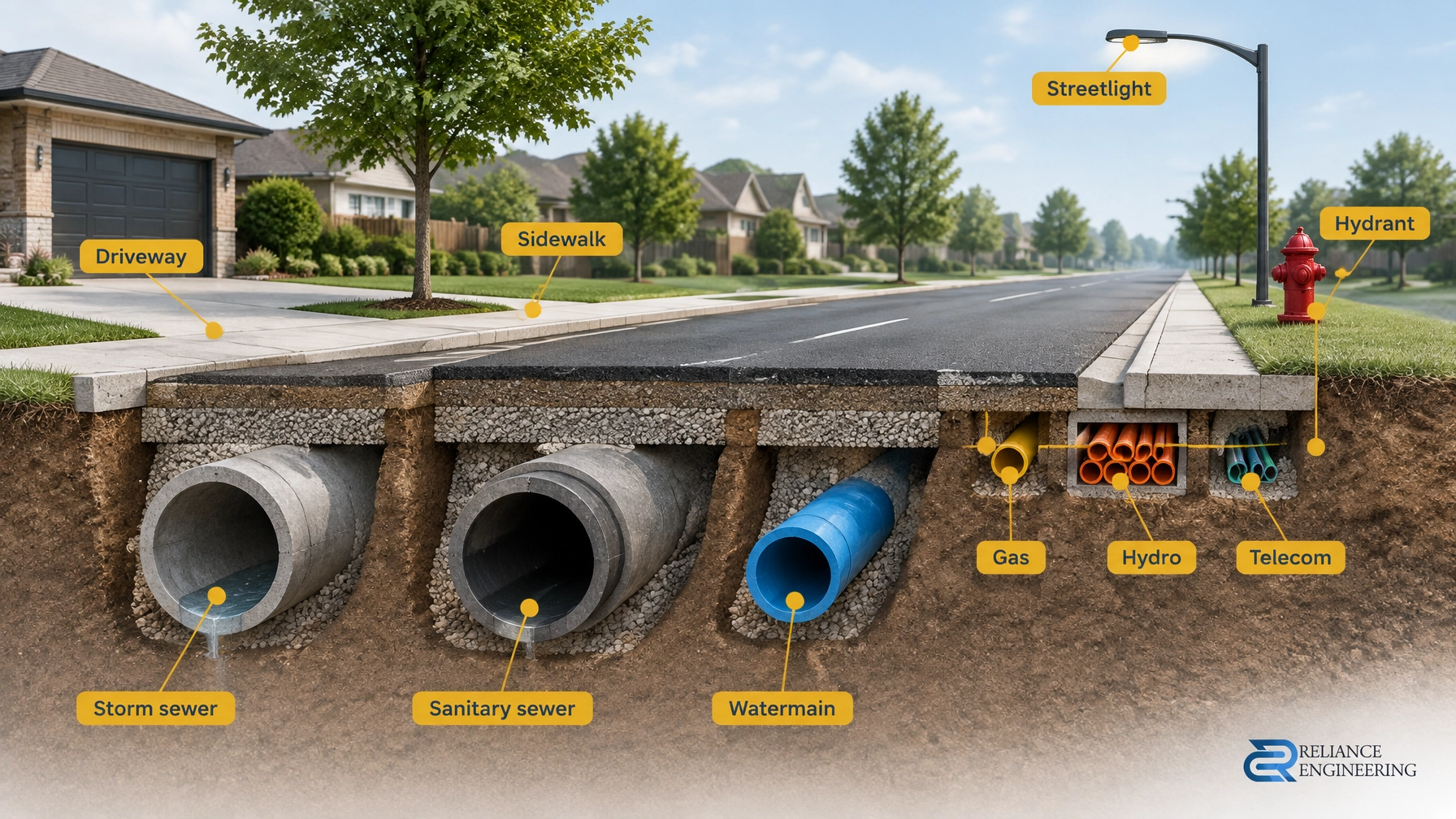
Coordination is essential. A functional servicing report can address infrastructure context, while site servicing plans show connections and routing. Align those documents with grading, stormwater controls and the erosion and sediment control plan. Clean layouts, clear calculations and constructible routing help reviewers and contractors understand how the pieces work together.
The EASR layer under O. Reg. 137/25
Ontario Regulation 137/25 creates an Environmental Activity and Sector Registry (EASR) pathway for certain prescribed stormwater management works. For eligible activities, registration can be used instead of proceeding through a ministry-level environmental compliance approval (ECA) process for those works.
This is an additional environmental compliance layer, not a replacement for municipal site plan, subdivision or servicing approvals. Eligibility depends on the regulation’s criteria and exclusions. For example, the regulation excludes certain sites and activities, and its prescribed-activity criteria do not apply to works owned by a municipality or intended for transfer to one under a qualifying agreement. Project teams should check the details of the regulation and confirm requirements with the relevant authorities.
For eligible works, the process has important steps before construction:
- A licensed engineering practitioner conducts a site assessment of the catchment area.
- That practitioner prepares the SWM report, taking the assessment into account, and signs and seals it.
- The report is filed with the EASR registration.
- The owner or operator provides complete and accurate information, and the required registration is completed before construction begins.
The regulation defines a licensed engineering practitioner as someone holding a licence, limited licence or temporary licence under the Professional Engineers Act. Ontario’s report-preparation guidance describes required report sections, including general information, design, monitoring assessment, operations and maintenance, and erosion and sediment control. Read the full O. Reg. 137/25 to assess how it applies to the proposed works.

After registration, the activity must be carried out in accordance with the report and the regulation. The report is therefore not just an application attachment: it sets out practices that owners and operators must implement. Confirm which approvals and registrations apply to the specific project before work starts.
After construction: maintenance and ownership
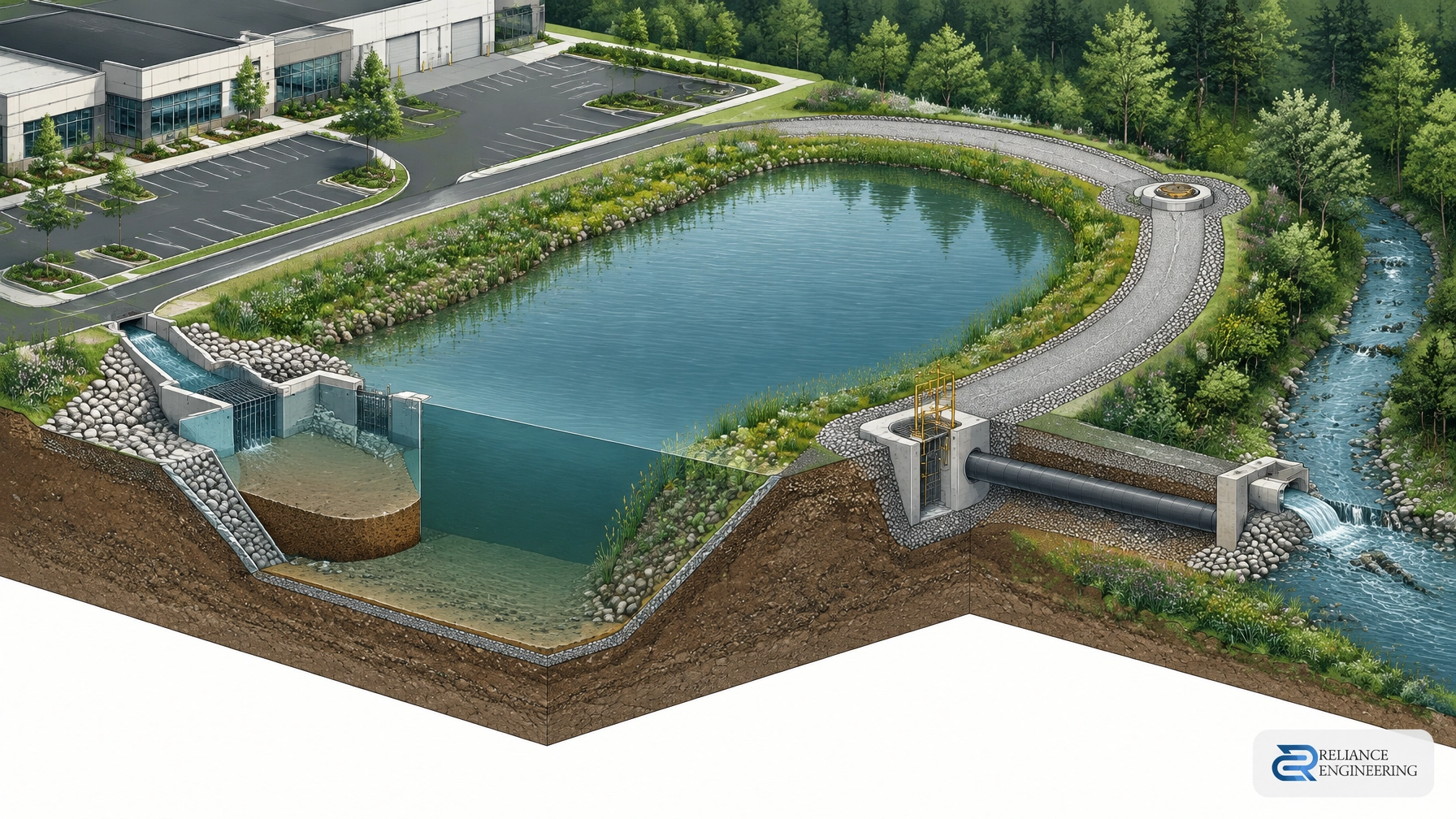
A stormwater facility needs routine attention. Depending on its design, that can include inspections, clearing inlets and outlets, removing debris or excessive vegetation, and monitoring sediment accumulation. Sediment can reduce available storage or affect treatment, so the report should explain how to identify when cleanout is needed, and how crews can safely reach the area.
For EASR-regulated works, Ontario’s guidance requires an O&M manual with inspection and maintenance procedures. Inspections must occur at least annually and as soon as practicable after a significant storm event, defined in the regulation as 25 millimetres or more of rain in a 24-hour period.
Responsibility also depends on ownership:
- Before municipal assumption: The developer or other responsible owner typically has obligations set by the applicable approvals and agreements. Those can include maintaining the facility, correcting deficiencies and providing records or security required for handover.
- After assumption: If the municipality formally assumes a facility, long-term ownership and maintenance responsibilities may transfer according to the agreement and municipal process. Assumption is not automatic just because construction is complete. Confirm the conditions, timing and scope in writing.
- Private facilities: Where a facility remains privately owned, the owner or operator needs to keep the maintenance plan, access rights, inspection records and funding arrangements in place.
An important EASR distinction: works that are municipally owned or are to be transferred to a municipality under a qualifying agreement are excluded from the regulation’s prescribed-activity criteria. Do not assume that every privately designed facility follows the same EASR route, or that municipal assumption automatically transfers every responsibility. Confirm the ownership structure and applicable approvals for the specific works.
A design that cannot be accessed, inspected or cleaned creates problems well after the approval stage. Maintenance access, cleanout space and clear responsibility should be considered during design, not left to resolve at handover.
Owner checklist: confirm before construction
Before mobilizing, confirm that:
- The municipal approval path, applicable conditions and any Conservation Authority requirements are identified.
- The SWM design, site servicing and grading documents are coordinated.
- EASR eligibility has been checked, and registration is completed before construction where required.
- The required site assessment, signed and sealed report, and supporting information are in place for an EASR registration.
- The O&M plan identifies inspection tasks, frequency, cleanout triggers and the party responsible.
- Sediment cleanout and maintenance access are shown and can be used in practice.
- The ESC plan is coordinated with construction staging and drainage, and can be implemented and maintained on site.
- Agreement conditions clearly identify pre-assumption responsibilities, handover requirements and the intended long-term owner.
Common compliance gaps
A report can be approved while important operating details remain unresolved. Common gaps include an O&M plan that was never prepared or assigned to an operator; no practical access for sediment cleanout; unclear ownership or maintenance responsibility at assumption; and an ESC plan that does not match the SWM design or construction sequence.
These issues are easier to resolve before construction. A coordinated design should connect report requirements to drawings, agreement conditions and the people responsible for implementation.
Key takeaways
- Treat an SWM report as an ongoing compliance document, not only a design submission.
- Confirm municipal and Conservation Authority requirements for the site; do not assume uniform thresholds or processes.
- Check whether O. Reg. 137/25 applies before selecting an environmental approval route.
- For eligible EASR works, complete the required assessment, report and registration steps before construction.
- Make maintenance access, sediment management and inspection procedures practical and clear.
- Put pre-assumption duties and post-assumption ownership in writing.
- Coordinate SWM, servicing, grading and ESC documents before construction starts.
For support with stormwater management reports in Ontario, approvals coordination or related civil drawings, contact Reliance Engineering to discuss your project and approval path.
Contact and professional credentials
Naresh Ochani, P.Eng., M.Eng.
Principal Engineer
Reliance Engineering Canada Limited
PEO Certificate of Authorization: 100548882
6850 Millcreek Dr, Mississauga, ON L5N 2H4
647-385-6418 · [email protected]
Office hours: Monday–Friday, 9:00 AM–5:00 PM; Saturday, 12:00 PM–2:00 PM; Sunday, Closed.