For developers and builders operating in the Greater Toronto Area (GTA), navigating the complexities of municipal approvals is often the most significant hurdle in a project’s timeline. Central to this process is the Stormwater Management Plan (SWM). Whether you are developing a boutique townhouse complex in Toronto or a commercial plaza in Vaughan, how you manage runoff can mean the difference between a swift building permit approval and months of costly revisions.
As urban intensification increases and climate patterns shift, municipalities and conservation authorities: such as the Toronto and Region Conservation Authority (TRCA) and Credit Valley Conservation (CVC): have tightened their requirements. The core debate for most modern projects comes down to two primary strategies: traditional Detention Tanks versus Low Impact Development (LID).
At Reliance Engineering, we have spent over 20 years drafting Stormwater Management Reports that balance regulatory compliance with site-specific constraints. In this guide, we compare these two strategies to help you decide which is best for your next land development project.
The Fundamentals of Stormwater Management in the GTA
Before diving into the comparison, it is essential to understand the "why" behind these systems. A Stormwater Management Report is a technical document required by the city to prove that your development will not overwhelm the existing municipal infrastructure or cause downstream erosion and flooding.
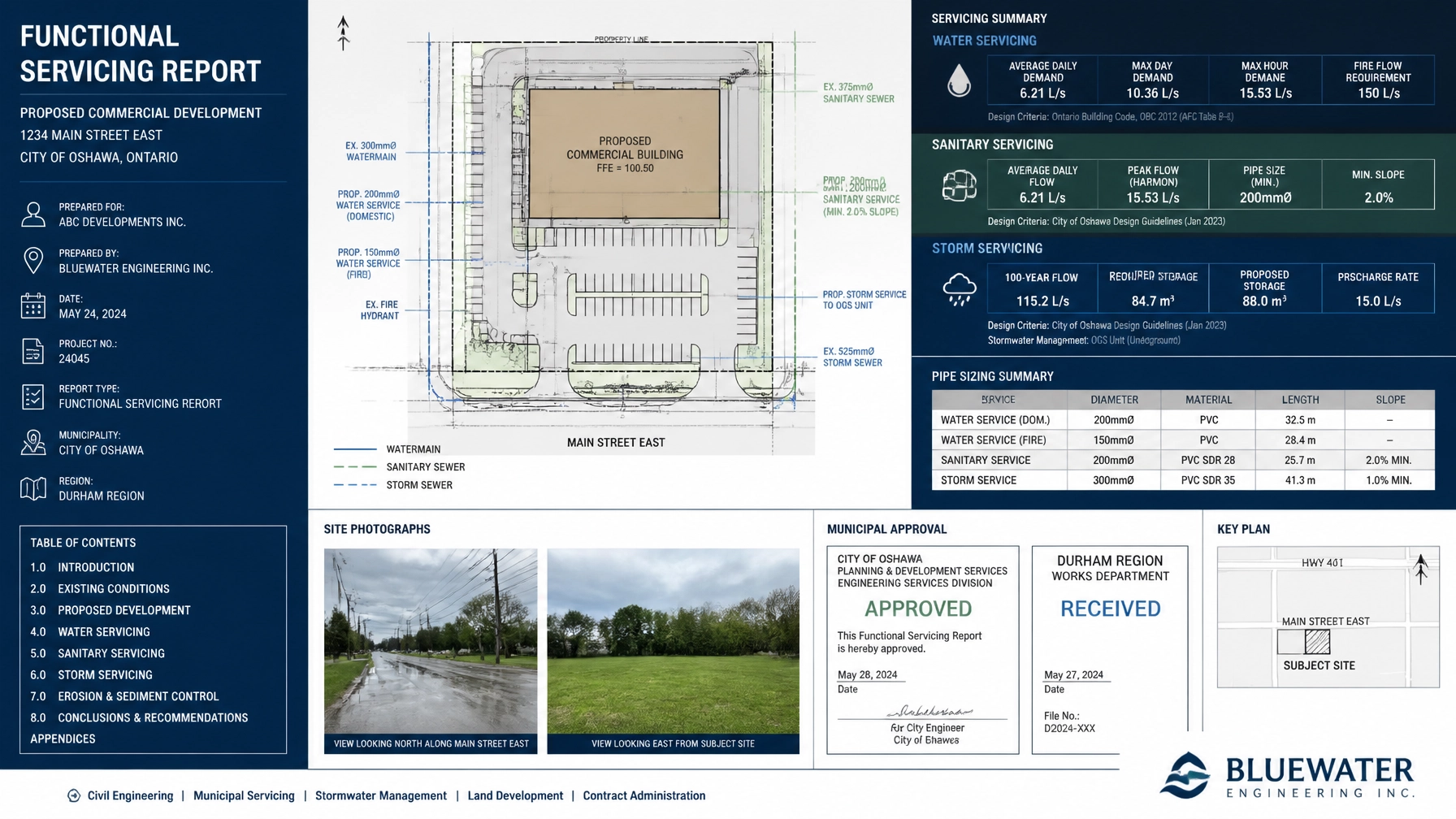
This report is typically part of a larger Functional Servicing Report (FSR) and is supported by a Site Servicing Plan. The goal is three-fold:
- Quantity Control: Managing the volume and peak flow of water leaving the site.
- Quality Control: Removing pollutants and TSS (Total Suspended Solids) from runoff.
- Water Balance: Recharging the groundwater to mimic pre-development conditions.
Strategy 1: Detention Tanks (The Engineered Approach)
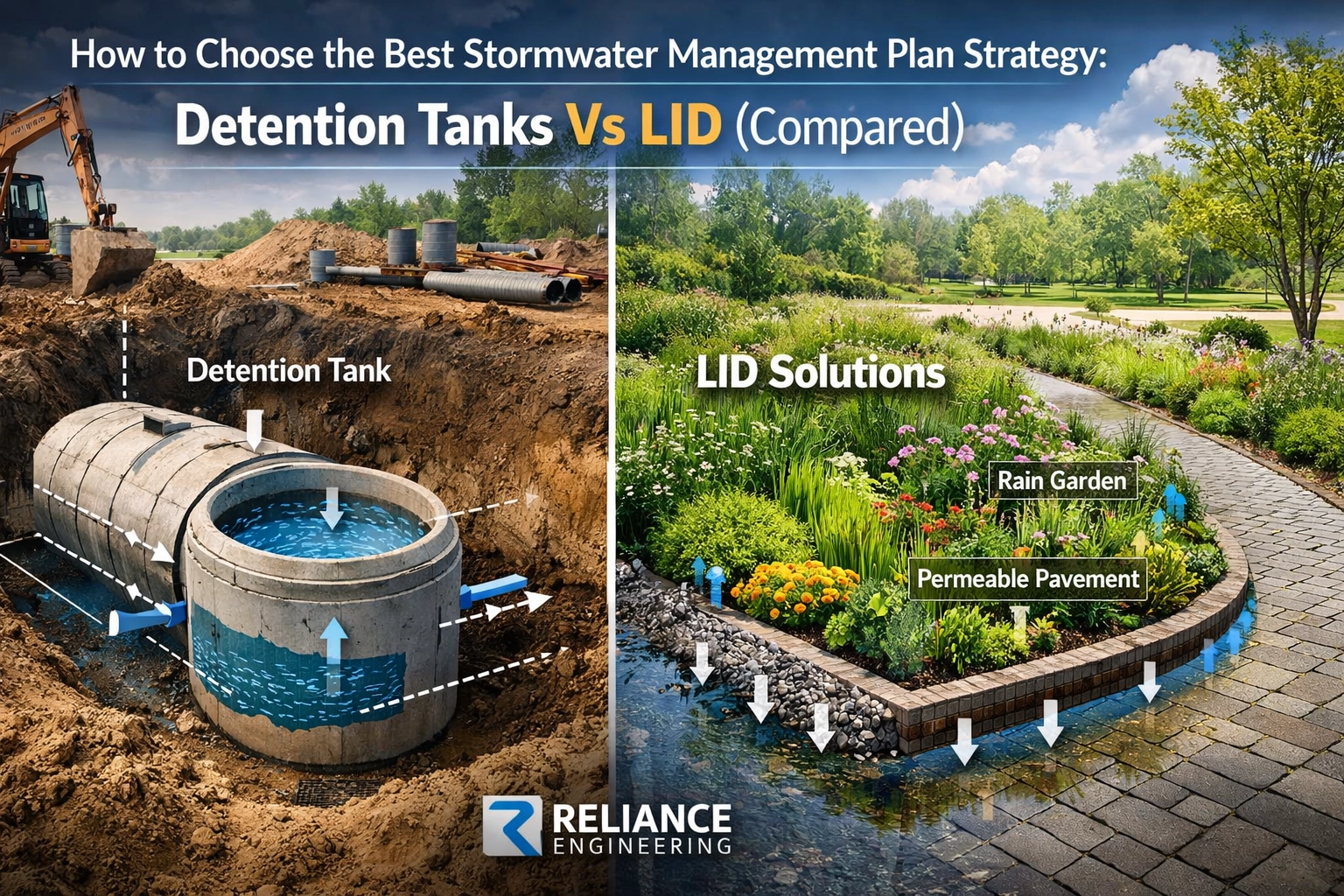
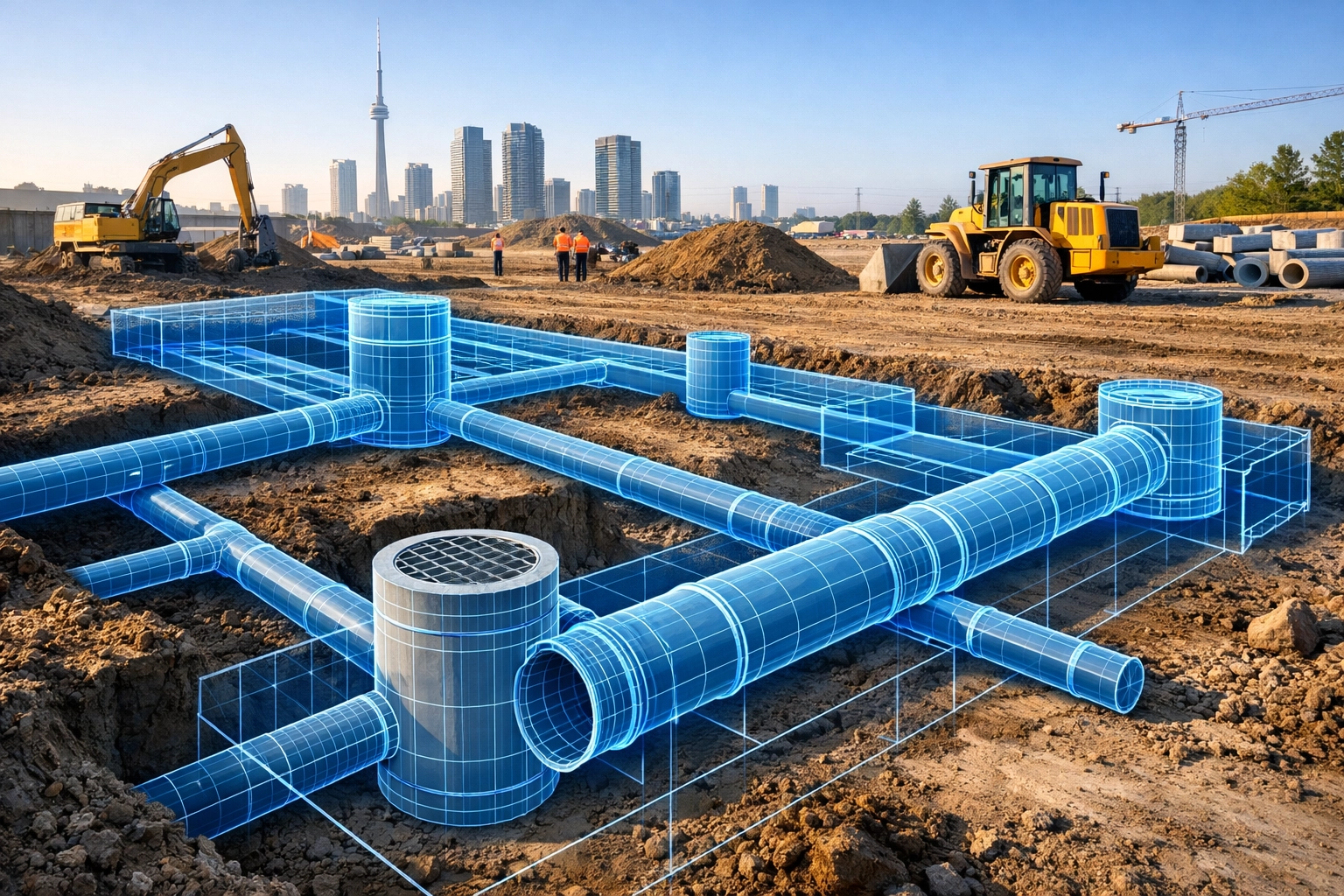
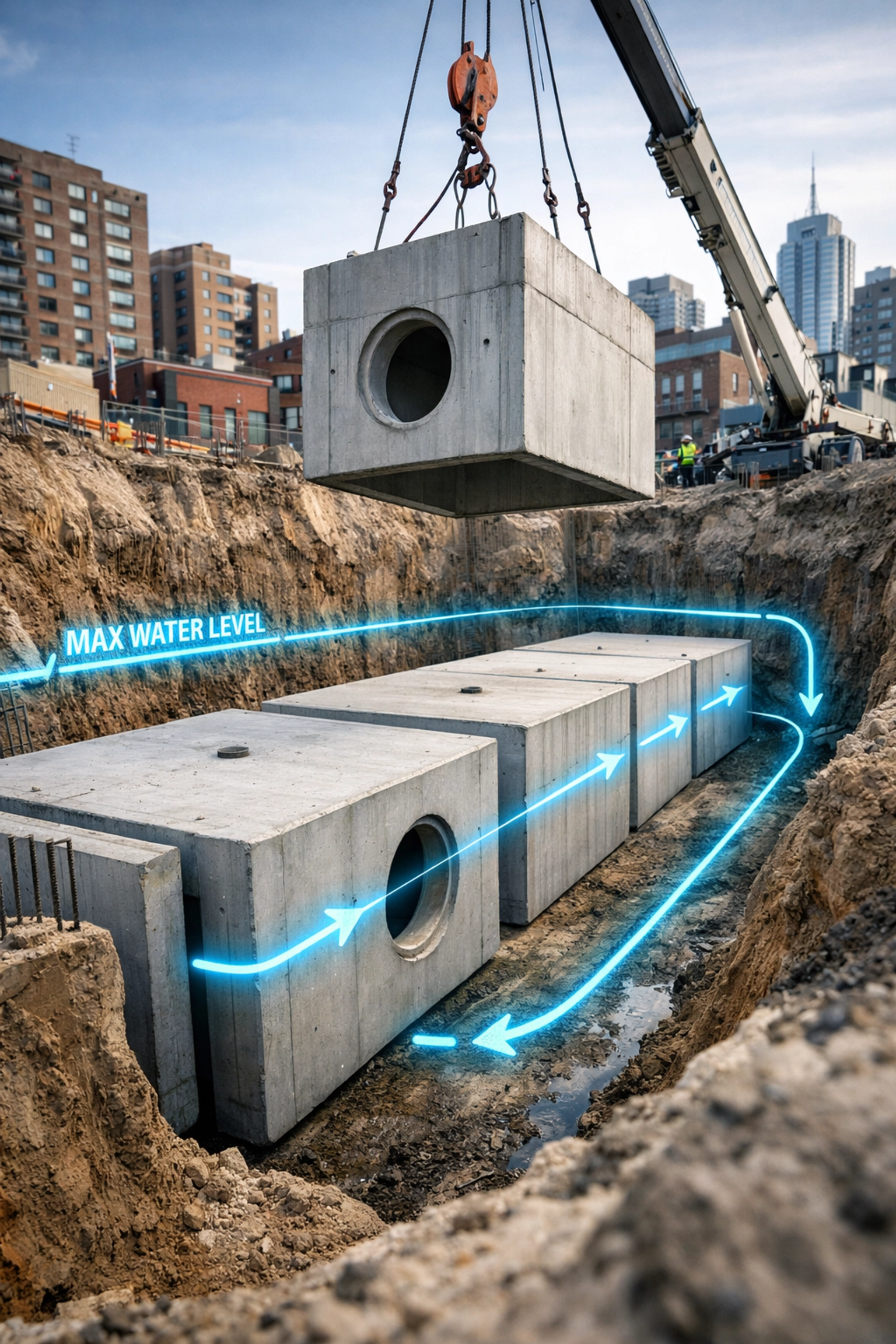
Detention tanks are subsurface structures designed to temporarily hold stormwater during a rain event and release it at a controlled rate into the municipal sewer system. These are typically constructed from concrete, large-diameter pipes, or modular plastic crates (often referred to as "milk crates").
The Pros:
- Space Efficiency: In high-density urban environments like downtown Toronto or Etobicoke, surface space is a premium. Detention tanks are buried underground, allowing the surface to be used for parking, landscaping, or building footprints. This was a critical factor in projects like the 35 Wabash Avenue Townhomes.
- Predictability: Engineers can precisely calculate the storage volume and discharge rates using orifice plates. This makes it easier to meet the strict "allowable release rates" set by municipal site servicing standards.
- Durability: Concrete detention tanks have a long lifespan and are resistant to the freeze-thaw cycles common in Ontario.
The Cons:
- Capital Cost: The initial cost of excavation, materials, and installation for a large underground tank can be significant.
- Maintenance: Over time, sediment settles at the bottom of the tank. If not maintained, this reduces storage capacity and can lead to clogs.
- Limited "Water Balance" Support: On their own, detention tanks do not help with groundwater recharge unless they are specifically designed as "Infiltration Tanks."
Strategy 2: Low Impact Development (LID) (The Nature-Based Approach)
LID is a land planning and engineering design approach that manages stormwater runoff as close to its source as possible. Instead of funneling water into a pipe and a tank, LID utilizes natural processes like infiltration, evaporation, and transpiration. Common examples include bioswales, rain gardens, permeable pavers, and green roofs.
The Pros:
- Regulatory Preference: Conservation authorities like the TRCA and CVC heavily favor LID strategies. In many GTA jurisdictions, proving you have explored LID options is now a mandatory requirement of the Stormwater Management Plan.
- Water Quality and Balance: LIDs are excellent at filtering pollutants and recharging the water table, helping developers meet "Water Balance" targets that traditional tanks often miss.
- Aesthetics: Features like rain gardens and bioswales can enhance the visual appeal of a property, potentially increasing its market value.
The Cons:
- Land Requirement: LIDs often require surface area. For a small urban lot, dedicating 10% of the land to a bioswale may not be economically feasible.
- Soil Sensitivity: The success of an LID system depends heavily on the native soil’s infiltration rate. If your site is sitting on heavy clay (common in parts of Vaughan and Brampton), LID systems may require expensive sub-drains and engineered soil media.
- Maintenance Complexity: Unlike a tank that just needs a vacuum truck once every few years, LIDs require specialized landscaping maintenance to ensure plants are healthy and the soil surface isn't clogged with fine silt.
Key Comparison Factors for GTA Developers
When we consult with our clients at Reliance Engineering, we evaluate the following criteria to determine the optimal Stormwater Management strategy.
1. Site Constraints and Topography
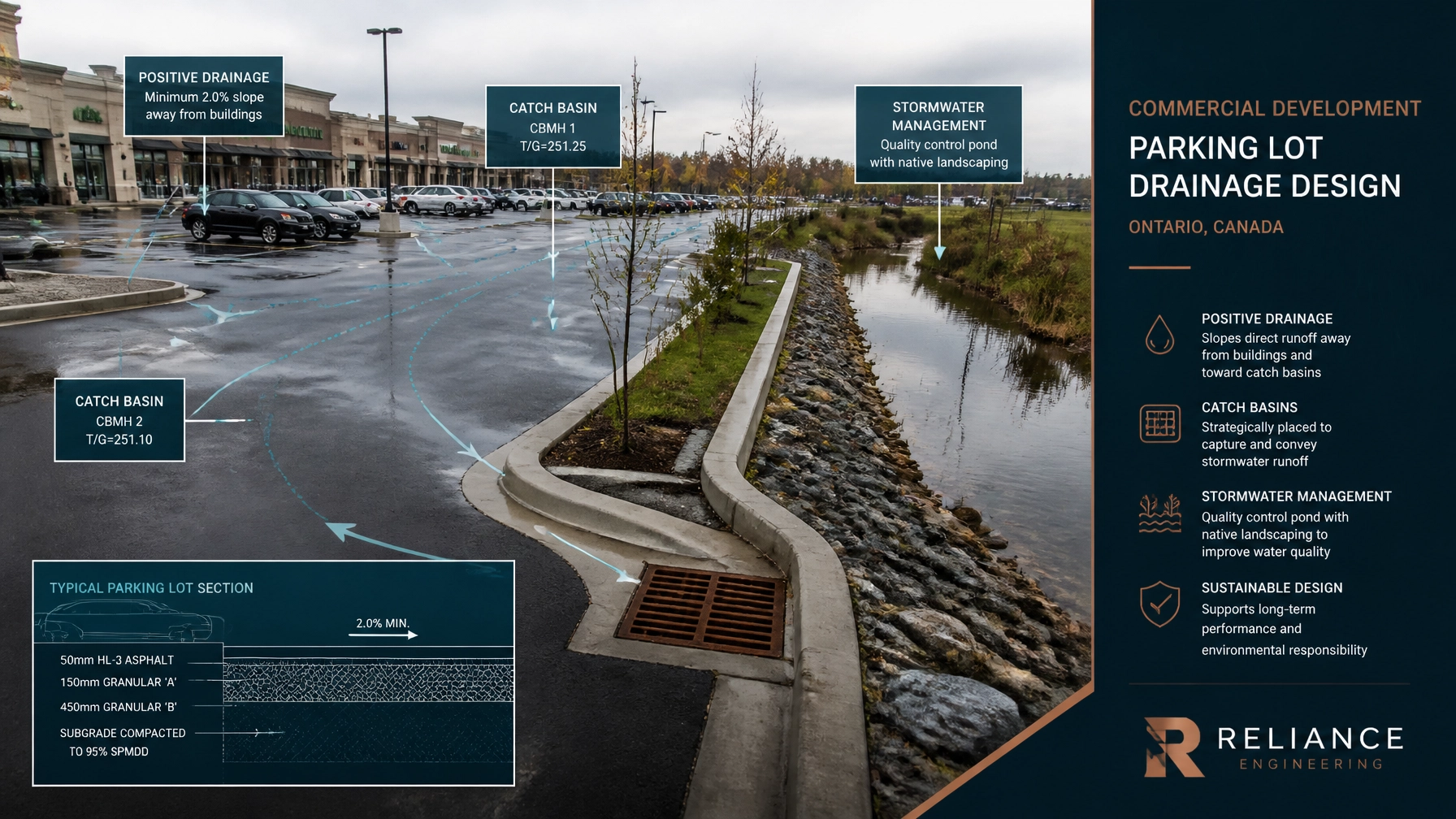
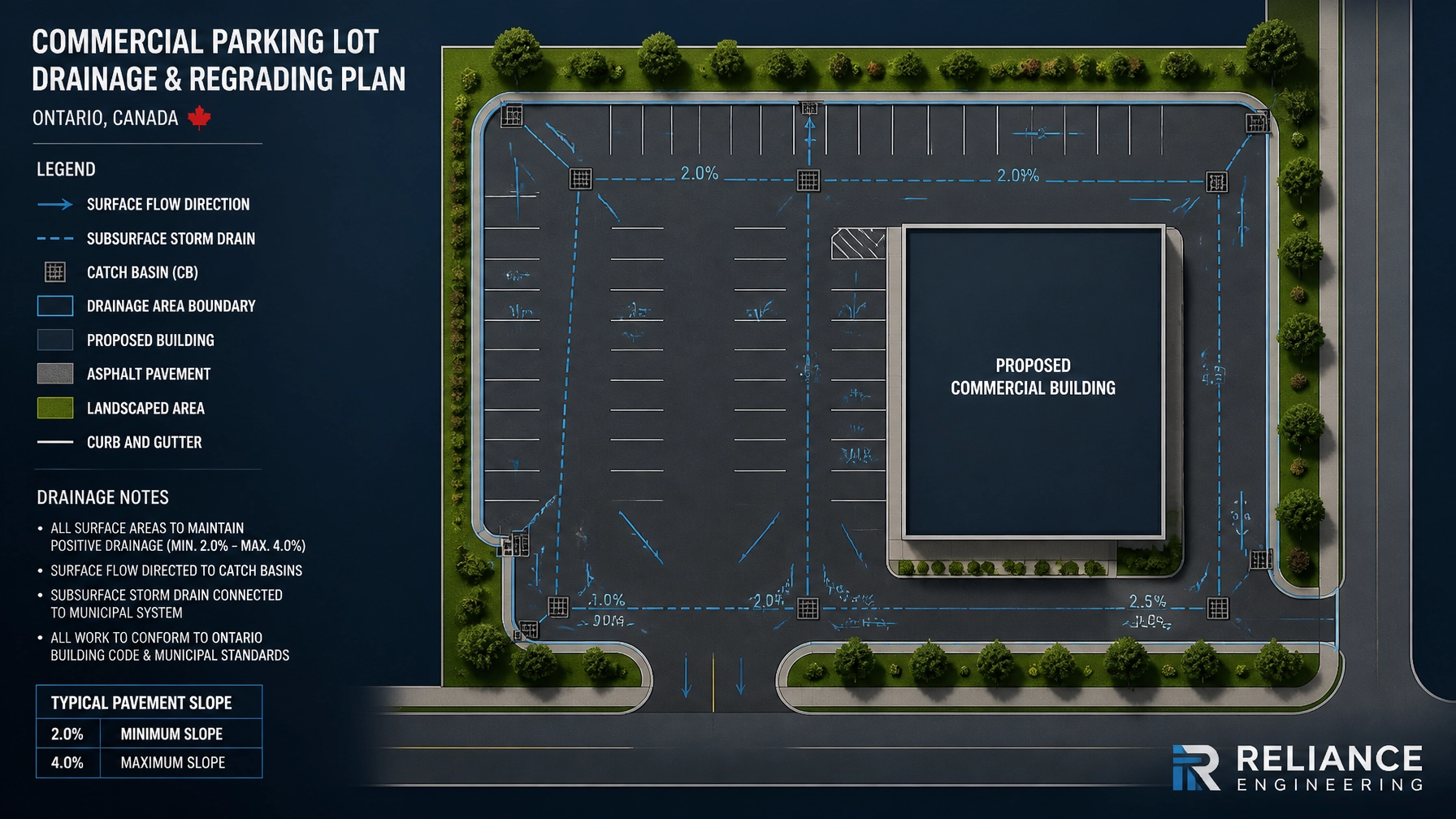
The Site Grading Plan dictates how water moves across your lot. If the site is flat, a detention tank might be necessary because there isn't enough "fall" to move water through an LID treatment train. Conversely, if the site has a high water table, underground tanks may face buoyancy issues, making surface-level LID more attractive.
2. Municipal and Agency Preferences
Different cities have different "personalities."
- Toronto: Generally accepts detention tanks due to the extreme density, but strictly enforces quality control (often requiring Oil-Grit Separators).
- Mississauga & Brampton: Have robust LID credits and often require developers to implement "Source Controls" before looking at "End-of-Pipe" solutions.
- TRCA/CVC Jurisdictions: Will often push for LID to protect local watersheds from erosion and thermal impacts.
3. Long-Term Maintenance and Liability
Developers who plan to turn the property over to a condo board or a REIT must consider the long-term maintenance burden. A single underground tank is often viewed as a "simpler" asset to manage than a distributed network of permeable pavers and rain gardens that require specialized care.
Why a Professional Stormwater Management Report is Essential
Choosing between a tank and LID isn't just a design choice: it's a financial and legal one. An oversized system wastes money; an undersized system leads to flooding and municipal lawsuits.
At Reliance Engineering, our approach is rooted in 20+ years of principal-led experience. We don't just provide a cookie-cutter report. We look at your Site Servicing Plan and Sanitary Sewer Design holistically to find the "sweet spot" where compliance meets cost-efficiency.
For example, on projects like the redevelopment of Etobicoke General Hospital, the scale of the project required a sophisticated integration of multiple stormwater strategies to satisfy both the City of Toronto and the healthcare facility's operational needs.
Conclusion: Which is Better?
The "best" strategy is rarely one or the other; it is often a hybrid approach. Many of our most successful Stormwater Management Reports utilize LID features for initial water quality and balance, backed up by a detention tank for 100-year storm event quantity control.
By integrating LID where possible and using tanks where necessary, developers can satisfy conservation authorities while maximizing their developable area.
How Reliance Engineering Can Help
If you are in the planning stages of a GTA development, don't leave your stormwater strategy to chance. A poorly designed Functional Servicing Report can result in months of "back-and-forth" with city reviewers.
Our team specializes in:
- Comprehensive Stormwater Management Reports (SWM).
- Detailed Site Servicing Plans.
- Expert Lot Grading and Drainage Design.
- Direct liaison with TRCA, CVC, and municipal engineering departments.
We pride ourselves on getting approvals in one submission, saving you time and money. With two decades of experience in Toronto, Mississauga, Vaughan, and beyond, we understand the local nuances that make a project successful.
Ready to start your next project?
Contact Reliance Engineering Today for a consultation on your Stormwater Management needs.
Corporate Profile: Reliance Engineering
- Principal Engineer: Naresh Ochani, P.Eng.
- Experience: 20+ Years in GTA Land Development.
- Services: Civil Engineering, Site Servicing, Stormwater Management, Construction Administration.
- Office Hours: Monday – Friday, 9:00 AM – 5:00 PM.
- Website: www.relianceengineering.ca