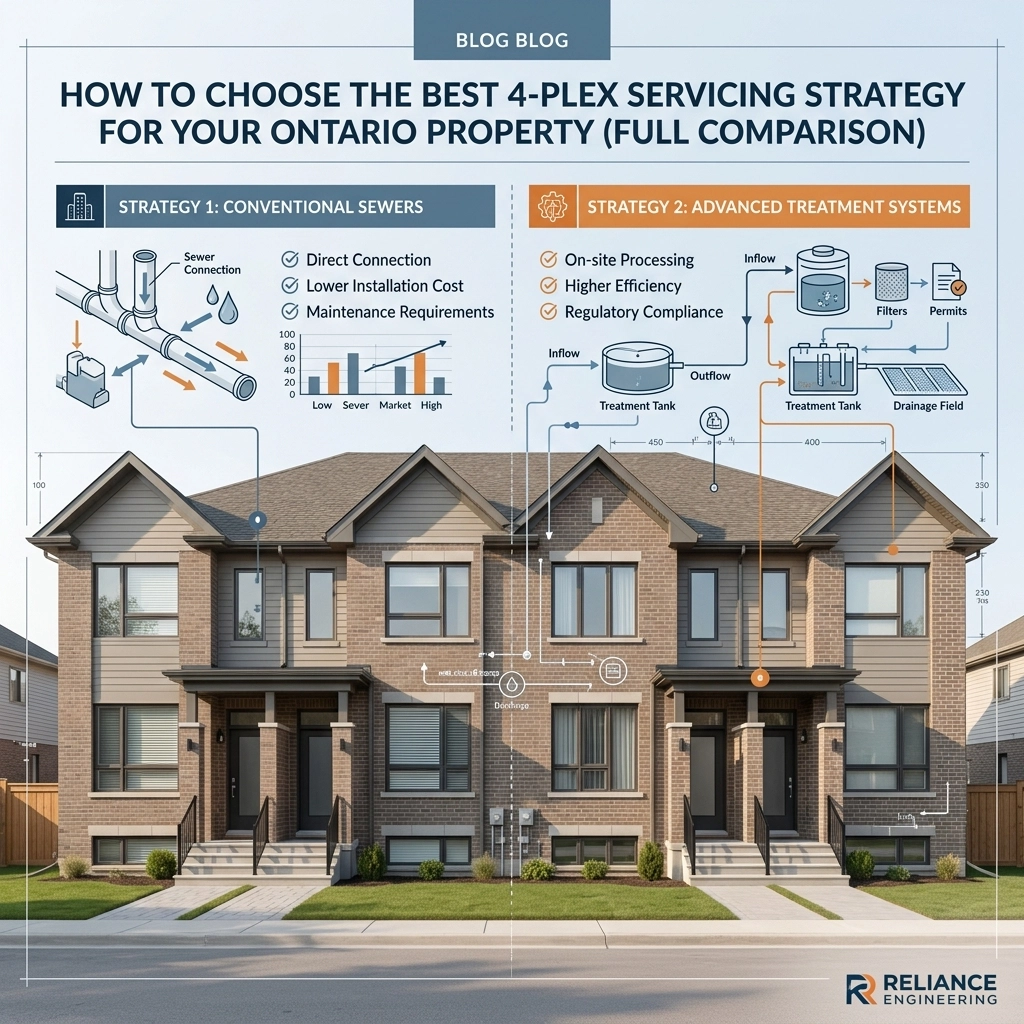
Ontario is undergoing a massive shift in residential density. With the province pushing for more "missing middle" housing, the 4-plex has emerged as the gold standard for property owners looking to maximize land value. Whether you are converting an existing single-family home or building from the ground up, the most critical: and often most expensive: decision you will make is your site servicing strategy.
At Reliance Engineering, with over 20 years of expertise in civil engineering and land development across Ontario, we have seen how poor servicing planning can derail a project. Choosing the wrong strategy can lead to tens of thousands of dollars in wasted municipal fees, unnecessary excavation, and long-term maintenance headaches.
This guide compares the three primary 4-plex servicing strategies to help you navigate the Ontario regulatory landscape and secure your Site Plan Approval or Building Permit efficiently.
Why Servicing Strategy Matters for 4-Plexes
When you move from a single-family dwelling to a 4-plex, your water demand, sanitary discharge, and stormwater runoff profile change significantly. The City of Toronto, Mississauga, Brampton, and other Ontario municipalities have strict standards for how these units connect to the municipal infrastructure.
You aren't just building four walls; you are building four independent living environments. How you deliver water, manage sewage, and handle rain determines your project's viability.

Strategy 1: The Single Bulk Service Connection
This is the most common approach for smaller conversion projects or tight urban lots where space in the municipal right-of-way is limited.
How it works:
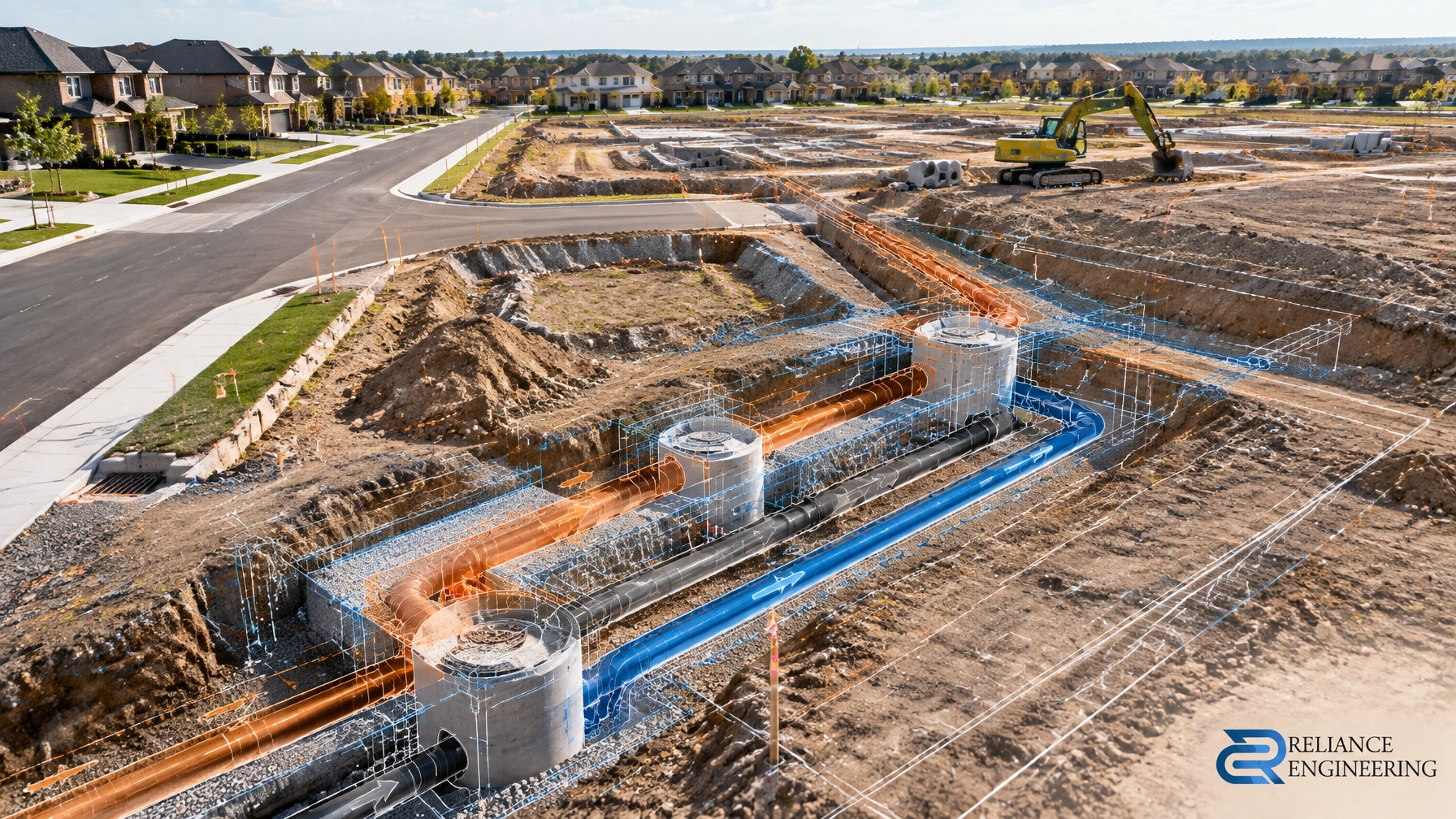
A single, larger-diameter water service and a single sanitary lateral are brought from the municipal main to the property line. Once inside the property, these services enter a mechanical room where they may be split or remain as a single "bulk" system.
Pros:
- Lower Municipal Fees: You typically pay for only one set of connection permits and one tap into the main.
- Reduced Excavation: Less digging in the street means lower construction costs and shorter timelines.
- Simpler Site Servicing Plan: Easier to get approval for a Site Servicing Plan when you aren't crowding the boulevard with four sets of pipes.
Cons:
- Billing Complexity: Unless you install private sub-meters, the property owner receives one massive utility bill. This is difficult for long-term rentals.
- Valuation: If you ever intend to sever the units or create a standard condominium, a single service line will likely need to be replaced.
Strategy 2: Individual Service Connections
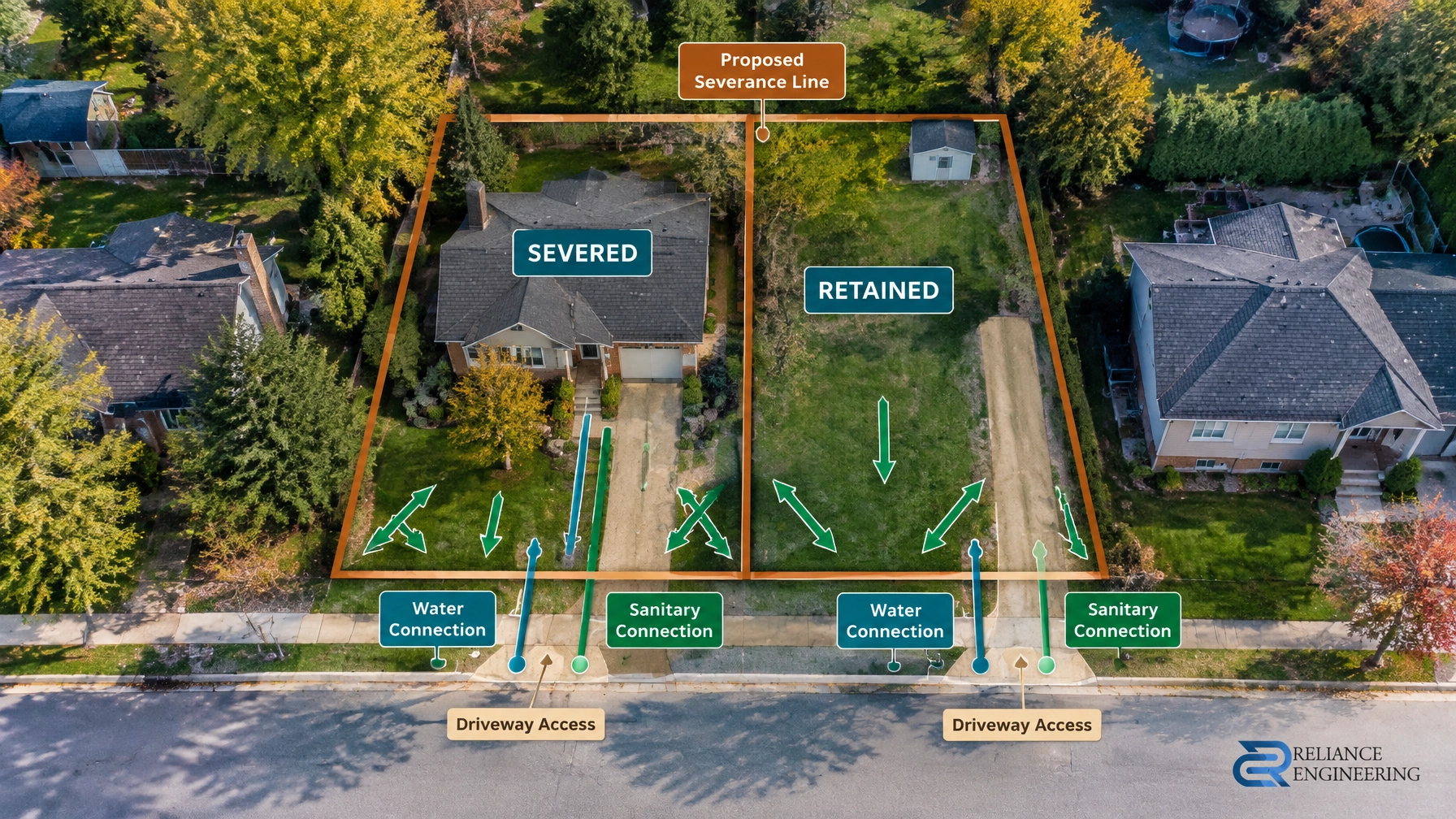
In this strategy, each of the four units has its own dedicated water and sanitary line connecting directly to the municipal mains.
How it works:
Four separate water curb stops and four separate sanitary cleanouts are installed at the property line. Each unit is independently metered by the municipality.
Pros:
- Direct Billing: Each tenant is responsible for their own utility account. This reduces the landlord’s overhead and liability.
- Highest Resale Value: This configuration is preferred for "plex-style" condominiums or properties intended for individual unit sales.
- Maintenance: A clog in Unit A’s sanitary line won’t affect Unit D.
Cons:
- High Initial Cost: You pay for four separate connections, four sets of meters, and significant trenching work.
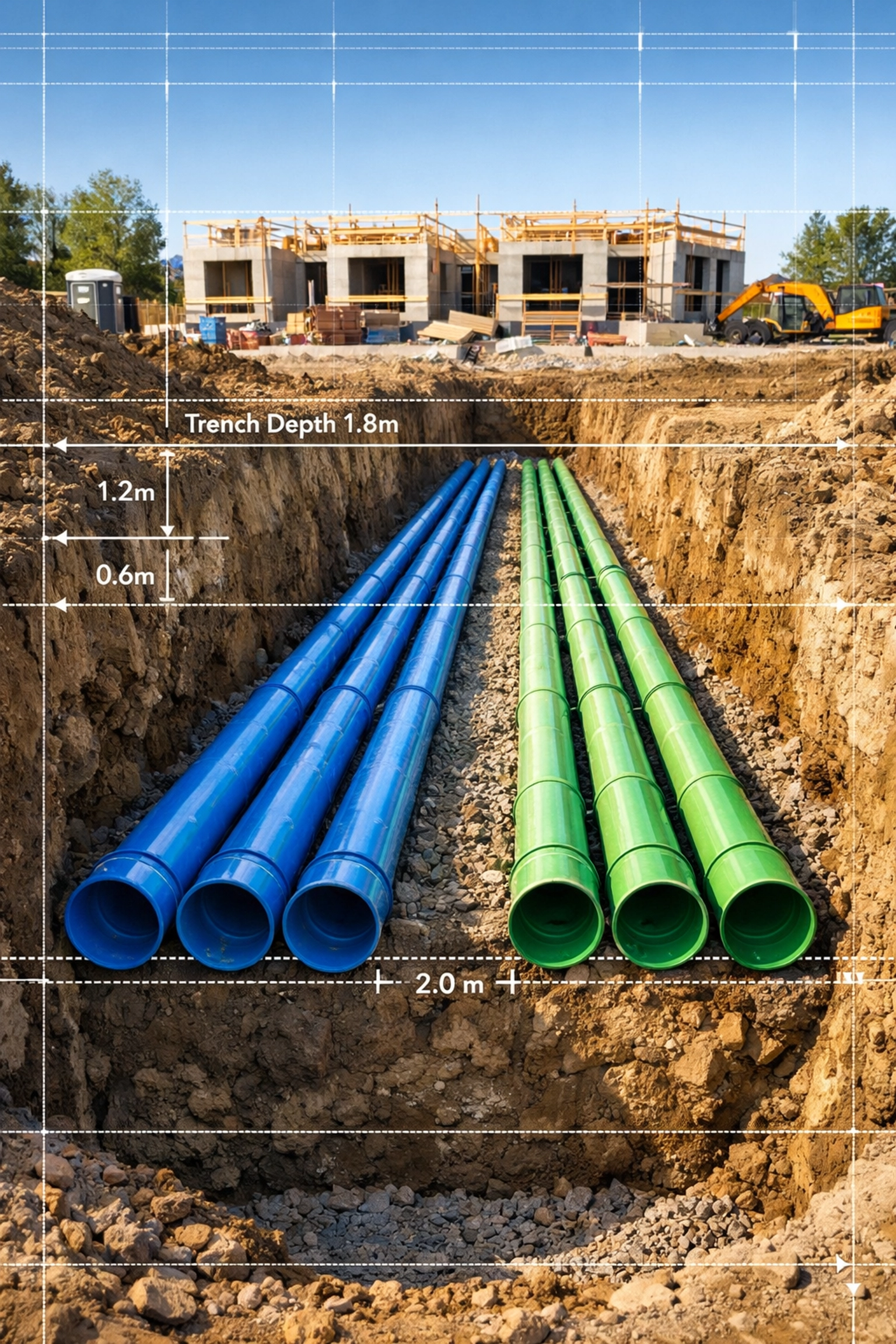
- Utility Crowding: Many Ontario municipalities have "minimum clearance" rules. Fitting four water lines and four sewer lines into a narrow lot frontage can be a technical nightmare for your sanitary sewer design.
Strategy 3: The Hybrid (Internal Manifold) Approach
The hybrid approach is often the "sweet spot" for modern Ontario 4-plex developments.
How it works:
One large "Master" service line is brought from the street to a central mechanical room. Inside, a manifold splits the service into four separate lines, each with its own meter. Depending on the municipality, these may be city-owned meters or private sub-meters.
Why choose this?
It offers the construction efficiency of Strategy 1 with the billing benefits of Strategy 2. However, it requires a very detailed Functional Servicing Report (FSR) to prove to the city that the single connection has enough pressure and capacity to serve four high-demand units simultaneously (e.g., four showers running at 7:00 AM).
Technical Requirements Across Ontario
Regardless of the strategy you choose, the Ontario Building Code (OBC) and local municipal standards dictate specific technical requirements:
1. Water Pressure and Fire Flow
A 4-plex often requires a larger water service (typically 1.5" or 2" instead of the standard 1" for houses) to ensure adequate pressure. If your property is in an area with low municipal pressure, you may need to design for a booster pump.
2. Backflow Prevention
Ontario regulations are strict about protecting the public water supply. A 4-plex is often categorized as a multi-residential building requiring a Premise Isolation Backflow Preventer.
3. Stormwater Management (SWM)
Increasing a property from a single home to a 4-plex usually increases the "impermeable" surface area (more roof, more parking). You must demonstrate how you will manage this extra runoff. At Reliance Engineering, we specialize in Stormwater Management Reports that utilize low-impact development (LID) features like soakaway pits or permeable pavers to meet Ontario standards.
4. Site Grading
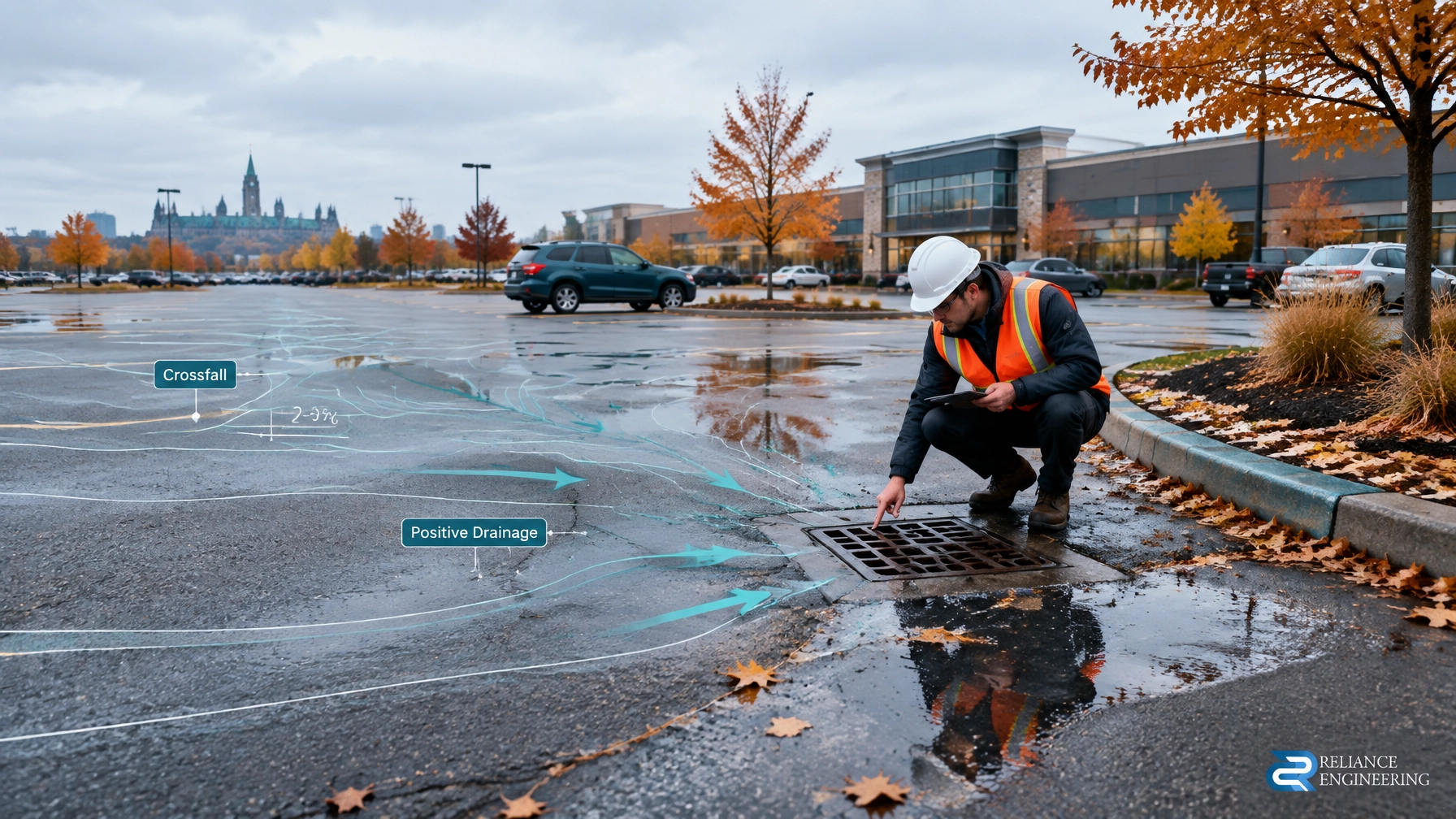
Proper drainage is non-negotiable. Your Site Grading Plan must ensure that water flows away from the new 4-plex and doesn't flood your neighbors: a common cause of litigation in Ontario land development.
Comparison Table: 4-Plex Servicing Strategies
| Feature | Single Bulk Service | Individual Connections | Hybrid (Internal Split) |
|---|---|---|---|
| Upfront Cost | Lowest | Highest | Medium |
| Municipal Fees | Low | High | Low/Medium |
| Maintenance | Owner's Responsibility | Individual/Municipal | Mixed |
| Resale Value | Standard | Premium | High |
| Regulatory Ease | Simple | Complex (Frontage issues) | Moderate |

How Reliance Engineering Can Help
Navigating the transition to a 4-plex requires more than just a plumber; it requires a professional civil engineering partner who understands the Ontario landscape. From 35 Wabash Avenue to Davis Drive in Newmarket, our team has handled complex urban servicing for decades.
We provide:
- Functional Servicing Reports (FSR): To prove your 4-plex is viable to the city.
- Site Servicing & Grading Plans: Detailed drawings for your Building Permit application.
- Stormwater Management (SWM): Innovative solutions to handle runoff on small lots.
- Permit Coordination: We handle the back-and-forth with municipal engineering departments.
Don't guess on your servicing strategy. A mistake in the design phase can lead to a "Notice of Non-Compliance" from the city, stalling your project for months.
Contact Information
Ready to start your 4-plex project? Contact us today for expert guidance.
Naresh Ochani, P.Eng. M.Eng.
Founder and Principal
Reliance Engineering
- Address: 6850 Millcreek Dr, Mississauga, ON L5N 2H4
- Phone: 647-385-6418
- Email: [email protected]
- Website: www.relianceengineering.ca
Office Hours
- Saturday: 12:00 PM – 2:00 PM
- Sunday: Closed
- Monday – Friday: 9:00 AM – 5:00 PM
Summary Checklist for Ontario Developers
- Check Municipal Capacity: Before designing, ensure the street mains can handle the 4-plex load.
- Evaluate Frontage: Does your lot have enough width for four separate trenches?
- Confirm Billing Goals: Do you want the simplicity of one bill or the freedom of individual tenant billing?
- Hire a P.Eng: Ensure your Site Servicing Plan is stamped by a licensed Ontario Professional Engineer.
Reliance Engineering: 20+ Years of Excellence in Site Servicing, Grading, and Land Development across Ontario.