Published: November 1, 2026
Article type: Winter construction guidance
Prepared by: Naresh Ochani, P.Eng., M.Eng.
Professional credentials: PEO Certificate of Authorization 100548882, Reliance Engineering Canada Limited
Winter changes the runoff problem
Winter does not pause erosion. Freeze-thaw cycles, rain on frozen ground, and snowmelt can turn a partly dormant construction site into a rapid runoff source. Frozen or saturated soil absorbs less water, while exposed soil and accumulated sediment are ready to move.
The Toronto and Region Conservation Authority’s Erosion and Sediment Control Guide for Urban Construction identifies late-winter and early-spring runoff over frozen soils as a significant erosion risk. It also notes that disturbed winter soils can be difficult to stabilize and vulnerable during spring thaw.
That combination can put pressure on perimeter controls, catch basins, drainage routes, and receiving areas at the same time. A winter-ready erosion and sediment control Ontario plan must account for these conditions before temperatures drop, not simply rely on measures designed for mild weather.
Why common controls lose performance

Silt fencing can lose ground contact
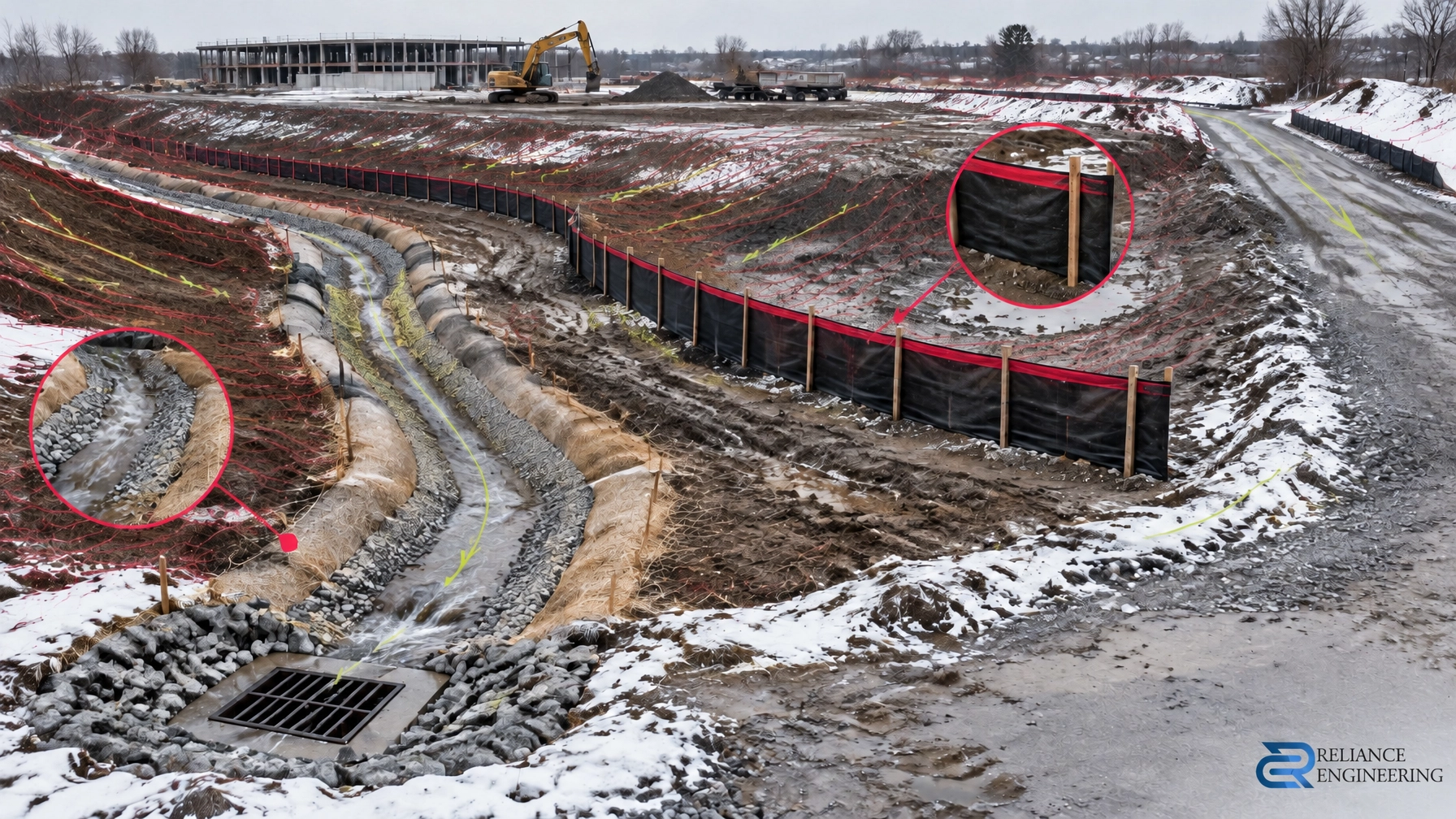
Silt fence is intended to manage sediment-laden sheet flow, not concentrated runoff. When ground is frozen, conventional trenching and staking may be difficult or ineffective. During thaw, saturated soil can loosen around posts, while water may undermine the fabric, pass beneath it, or flow around its ends.
Snow and ice can add loading, conceal damage, or redirect water along the fence. Where it is not practical to install a standard fence detail in frozen ground, consider a suitable alternative, such as filter socks or natural-fibre logs, only where appropriate for the flow and consistent with the approved ESC plan and local requirements. The TRCA guide describes natural-fibre logs as an option where frozen conditions prevent sediment fence trenching.
Check dams can be bypassed or undermined
Check dams in temporary swales slow flow and help sediment settle. Freeze-thaw can loosen stone, shift a filter log, or leave gaps where runoff bypasses the control. A check dam is not a substitute for a stabilized channel: when flow concentrates around or over a weak point, it can erode the swale or its outlet.
The practical response is to keep the whole conveyance route stable, provide a controlled overflow path, and choose a check-dam type suited to expected flow and site conditions. Do not use a temporary check dam in a natural watercourse unless the design and required approvals specifically allow it.
Stabilized entrances can become sediment sources
A construction entrance can lose stone, rut, or collect muddy runoff as vehicles travel over thawing ground. Snowplows can push sediment and aggregate toward road drains. If the entrance drains toward the public road or a catch basin, it can transfer site sediment directly into municipal infrastructure.
Keep the entrance connected to the internal drainage plan. Before winter, confirm the stone surface is intact and runoff from it reaches a stable treatment area rather than the street.
Inlet protection can clog, ice up, or cause ponding
Inlet protection helps prevent sediment from entering storm sewers, but snow, ice, and sediment can block flow. A blocked inlet may cause water to pond in an unsafe area or find an uncontrolled route around the protection.
Select a device suitable for the inlet and site conditions. Ensure the surrounding grading provides a safe overflow route and does not direct runoff toward buildings, adjacent properties, or unprotected areas.
Reinforce the site before freeze-up
A short pre-winter review can identify weak links before they are buried by snow or become difficult to repair. Focus on how water will move across the site during melt and rain-on-frozen-ground conditions.
- Stabilize exposed ground. Reduce the area of bare soil and protect inactive slopes and work areas with a suitable temporary cover. Vegetation may not establish reliably during dormant or frozen conditions, so do not rely on seeding alone where the schedule leaves soil exposed.
- Protect stockpiles. Cover or stabilize soil stockpiles and secure the cover against wind and runoff. Add perimeter controls where sediment could travel toward a catch basin, property line, or natural feature.
- Secure perimeter measures. Check fence fabric, posts, ground contact, ends, and connections. Where frozen ground prevents the planned installation detail, confirm a workable alternative rather than leaving an incomplete barrier.
- Stabilize swales and outlets. Provide erosion-resistant conveyance and protect discharge points. A drainage-focused approach should keep clean water separate from exposed soil and direct construction runoff through suitable treatment.
- Protect inlets and the road edge. Confirm inlet devices are installed as specified and that the construction entrance will not send muddy water or tracked sediment to the public street.
- Keep overland flow routes open. Snow storage, temporary material piles, and winter access routes can block intended flow paths. Preserve positive drainage and prevent snow piles from directing meltwater through ESC controls or toward neighbouring lands.

Snow storage is part of the site’s drainage plan. Snow piled beside a catch basin can release a concentrated pulse of sediment-laden meltwater as it thaws. Place snow where meltwater can be conveyed to a stable, approved route. Avoid piling snow against perimeter controls, over inlets, or in locations where runoff can bypass treatment.
Choose stabilization for cold conditions
Erosion-control blankets and matting can protect soil from runoff, but product and installation choices matter. Match the product to the slope, expected flow, duration of exposure, and site requirements. The surface should be prepared so the material makes good contact with the soil; overlaps, edges, and anchoring must follow the product instructions and approved details.
For temporary winter protection, select materials and fastening systems suited to the expected cold and moisture conditions. On longer-duration or higher-flow areas, a more robust mat may be appropriate than a light blanket. Where plastic netting is part of a product, consider whether biodegradable or other specified netting is required for the site, particularly near natural features. Confirm product suitability with the designer, supplier, and applicable authority rather than assuming one product fits every condition.
Stabilization timing is also important. Complete permanent stabilization while suitable conditions remain, where practical. If final vegetation cannot establish before winter, use a temporary measure that protects the soil through thaw and can remain in place until vegetation is established. Do not remove temporary controls simply because snow covers the ground.

Schedule winter work around drainage
Schedule pressure can encourage teams to leave more soil exposed or continue grading without a clear winter-over strategy. Before proceeding, identify which areas can be completed and stabilized, which should remain undisturbed, and how water will pass through the site during temporary conditions.
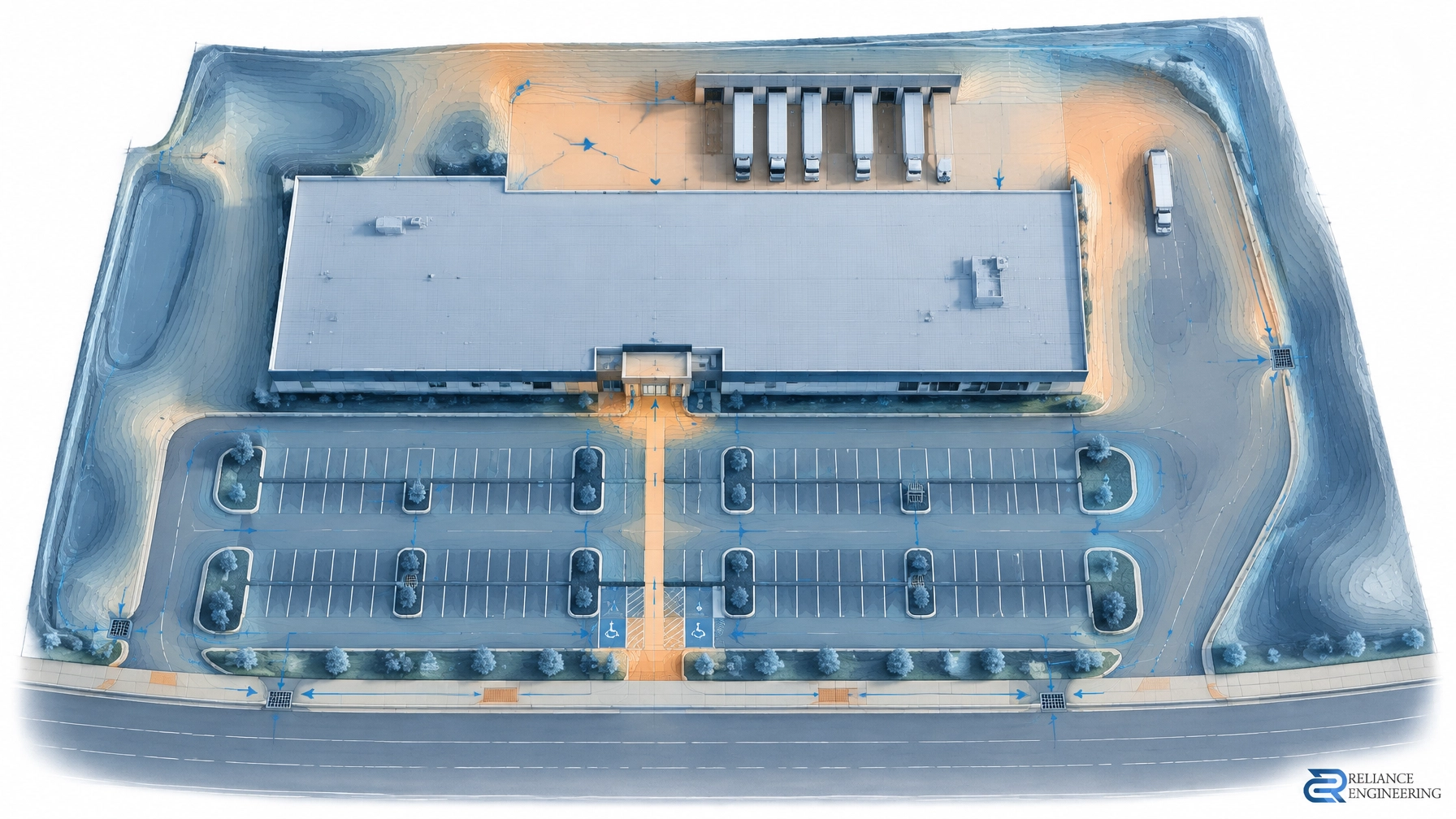
A buildable grading design can help keep drainage paths legible as the site changes. Coordinate proposed grades, temporary swales, site entrances, stockpiles, and inlet locations so construction runoff has a controlled route. Where winter work changes drainage patterns, the ESC measures may need to change with them.
An ESC plan winter should show practical controls that can be installed and maintained in the field. It should be coordinated with Site Grading Plans and, where applicable, Stormwater Management Reports. Together, clear drawings, buildable grading, and a coordinated design can reduce gaps between runoff routes and sediment controls.
Confirm local requirements before work continues
Municipal requirements and Conservation Authority requirements vary across Ontario and depend on the site, proposed work, and applicable approvals. Where a Conservation Authority’s regulated area or permit conditions apply, confirm the required ESC measures and any winter-specific conditions with the relevant authority. Do not assume that a detail accepted in one municipality or watershed will automatically be accepted elsewhere.
The TRCA guide is a useful technical reference, but it does not replace the approved project drawings, municipal standards, or site-specific permit conditions. Keep permit-ready drawings aligned with field conditions and seek review if winter work or changed grades affect the approved drainage and control strategy.
Hold the line through thaw
The most consequential sediment releases can occur when meltwater and rainfall meet frozen or saturated ground. Controls that have shifted, become buried, or lost ground contact may fail just as runoff increases. Preparing before freeze-up (stabilizing exposed areas, protecting stockpiles and inlets, securing perimeter controls, and keeping snowmelt routes clear) helps reduce that risk.
For project-specific support, Reliance Engineering prepares practical designs and clear drawings for erosion and sediment control, grading, and stormwater management across Ontario. Contact us to discuss winter conditions, approval support, or permit-ready drawings for your site.
Professional credentials and contact
Naresh Ochani, P.Eng., M.Eng.
Reliance Engineering Canada Limited
PEO Certificate of Authorization: 100548882
6850 Millcreek Dr, Mississauga, ON L5N 2H4
Phone: 647-385-6418
Email: [email protected]
Office hours: Monday–Friday 9:00 AM–5:00 PM; Saturday 12:00 PM–2:00 PM; Sunday Closed
Request a consultation
Professional credentials and contact
Naresh Ochani, P.Eng., M.Eng.
Reliance Engineering Canada Limited
PEO Certificate of Authorization: 100548882
6850 Millcreek Dr, Mississauga, ON L5N 2H4
Phone: 647-385-6418
Email: [email protected]
Office hours: Monday–Friday 9:00 AM–5:00 PM; Saturday 12:00 PM–2:00 PM; Sunday Closed
Contact Reliance Engineering