
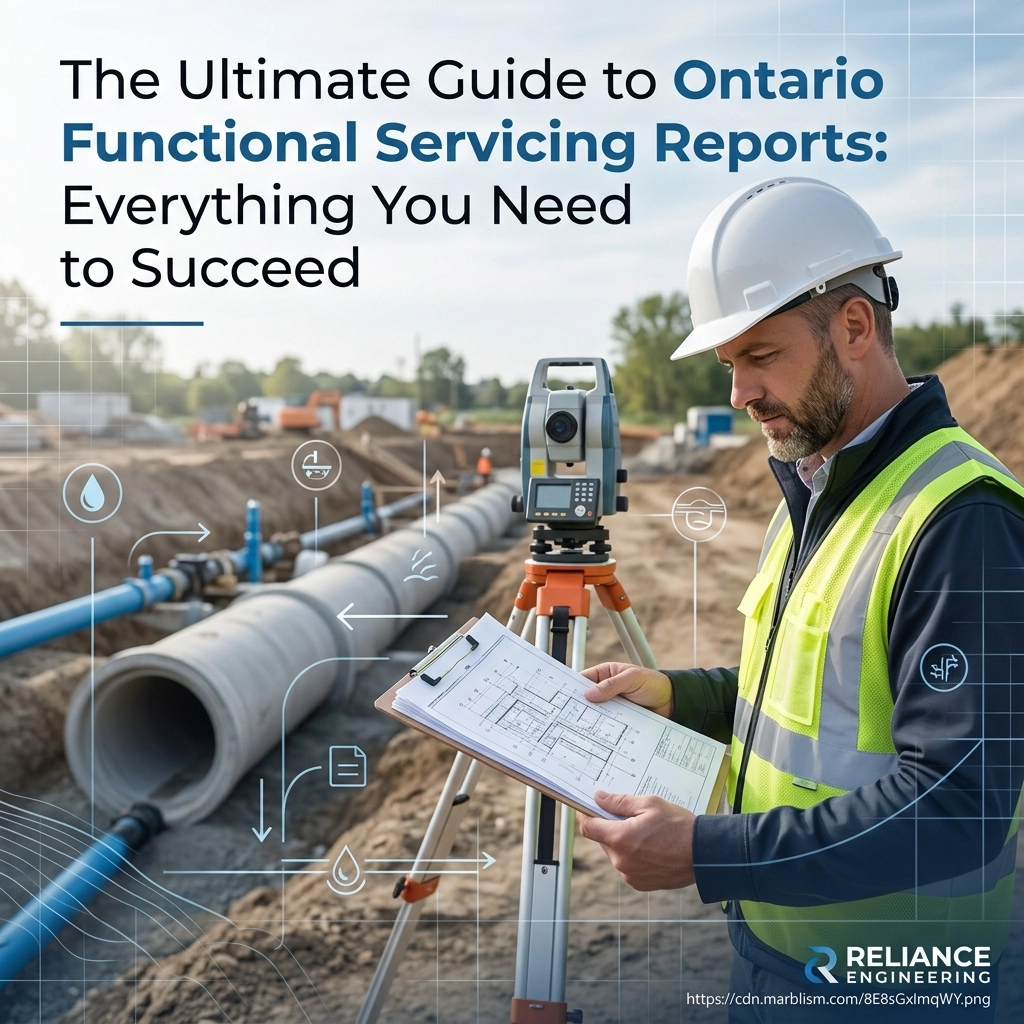
In the high-stakes world of Ontario land development, a Functional Servicing Report (FSR) is not just a checkbox; it is the technical backbone of your project. Whether you are navigating a Site Plan Approval in Toronto or a Zoning By-law Amendment in Newmarket, the FSR determines if your vision is physically and economically viable.
At Reliance Engineering, we have spent over 20 years mastering the complexities of Ontario’s regulatory landscape. We know that a well-executed FSR can mean the difference between a streamlined approval and months of costly municipal delays.
What is a Functional Servicing Report?
A Functional Servicing Report is a comprehensive engineering document that evaluates how a proposed development will integrate with existing municipal infrastructure. It is a planning-level study that proves your project can be supported by the current water, sanitary, and storm systems without negatively impacting the surrounding community.
In Ontario, municipalities require this report to confirm that there is sufficient capacity in the local pipes and treatment facilities to handle the increased load. Without a sealed FSR from a licensed Professional Engineer (P.Eng.), your development application will not move forward.
When is an FSR Required in Ontario?
Municipalities across Ontario request an FSR during the early stages of the development process. You will typically need one for:
- Official Plan Amendments (OPA): When changing the long-term land use designation.
- Zoning By-law Amendments (ZBA): When increasing density beyond current permissions.
- Draft Plans of Subdivision: To outline how a large tract of land will be serviced.
- Site Plan Approvals (SPA): To provide granular detail on how a specific building connects to the street.
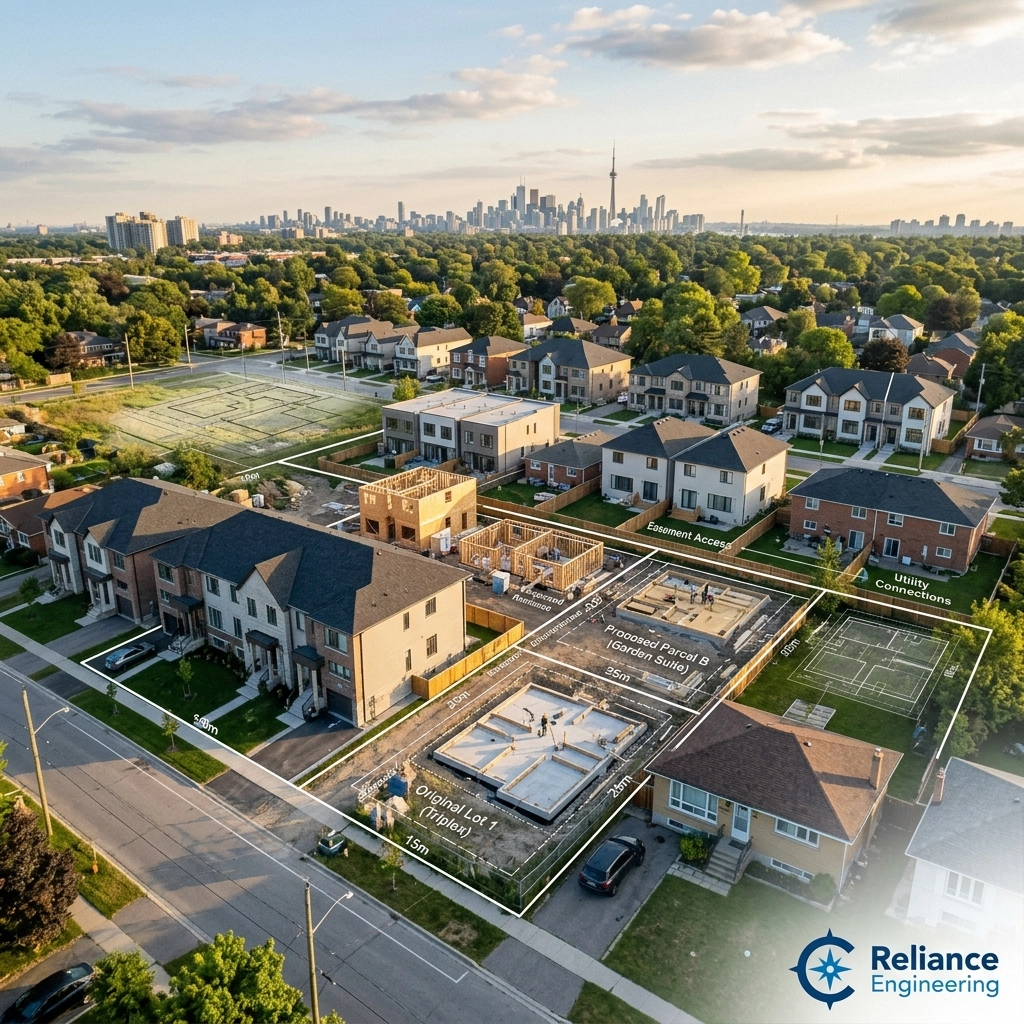
- Severance Applications: Often required by Committees of Adjustment to ensure new lots are viable.
Core Components of a Successful FSR
A professional FSR is a multi-disciplinary effort. It combines hydraulic modeling, civil design, and environmental strategy. Here are the critical elements we include at Reliance Engineering:
1. Water Distribution and Fire Flow
We calculate the domestic water demand based on the proposed population or building use. More importantly, we analyze fire flow requirements. If the municipal water main cannot provide the necessary pressure to fight a fire at your building, the project cannot proceed without significant off-site upgrades.
2. Sanitary Sewer Analysis
We perform Sanitary Sewer Design calculations to determine peak wastewater flows. This involves looking at downstream capacity. If the existing sewers are already near their limit, we must propose mitigation strategies or infrastructure improvements to prevent basement flooding or system overflows.
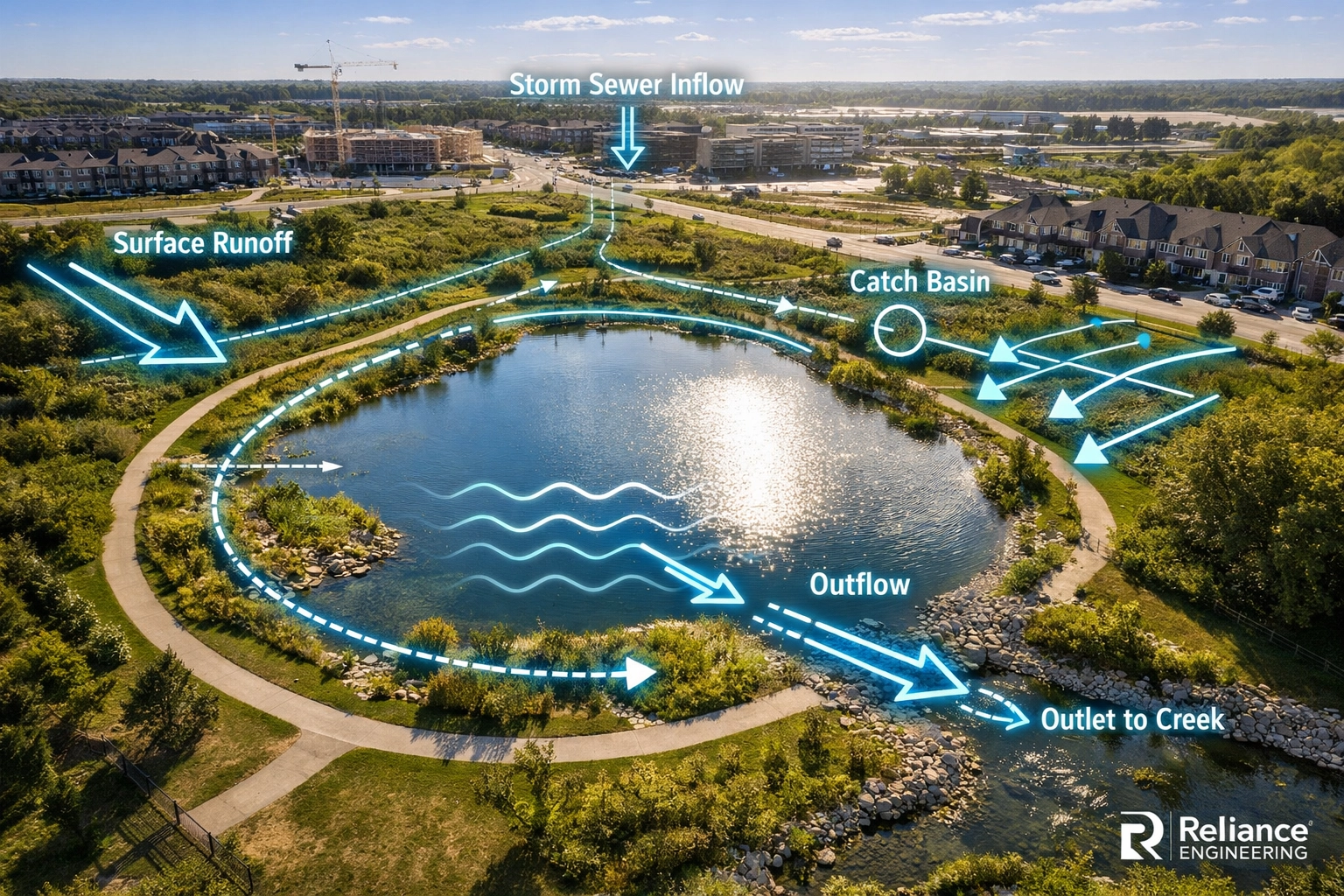
3. Stormwater Management (SWM)
Ontario has some of the strictest Stormwater Management standards in North America. An FSR must address:
- Quantity Control: Ensuring post-development runoff does not exceed pre-development levels.
- Quality Control: Removing pollutants and sediments before water enters local watercourses.
- Water Balance: Maintaining groundwater recharge rates, especially in environmentally sensitive areas.
4. Site Grading and Drainage
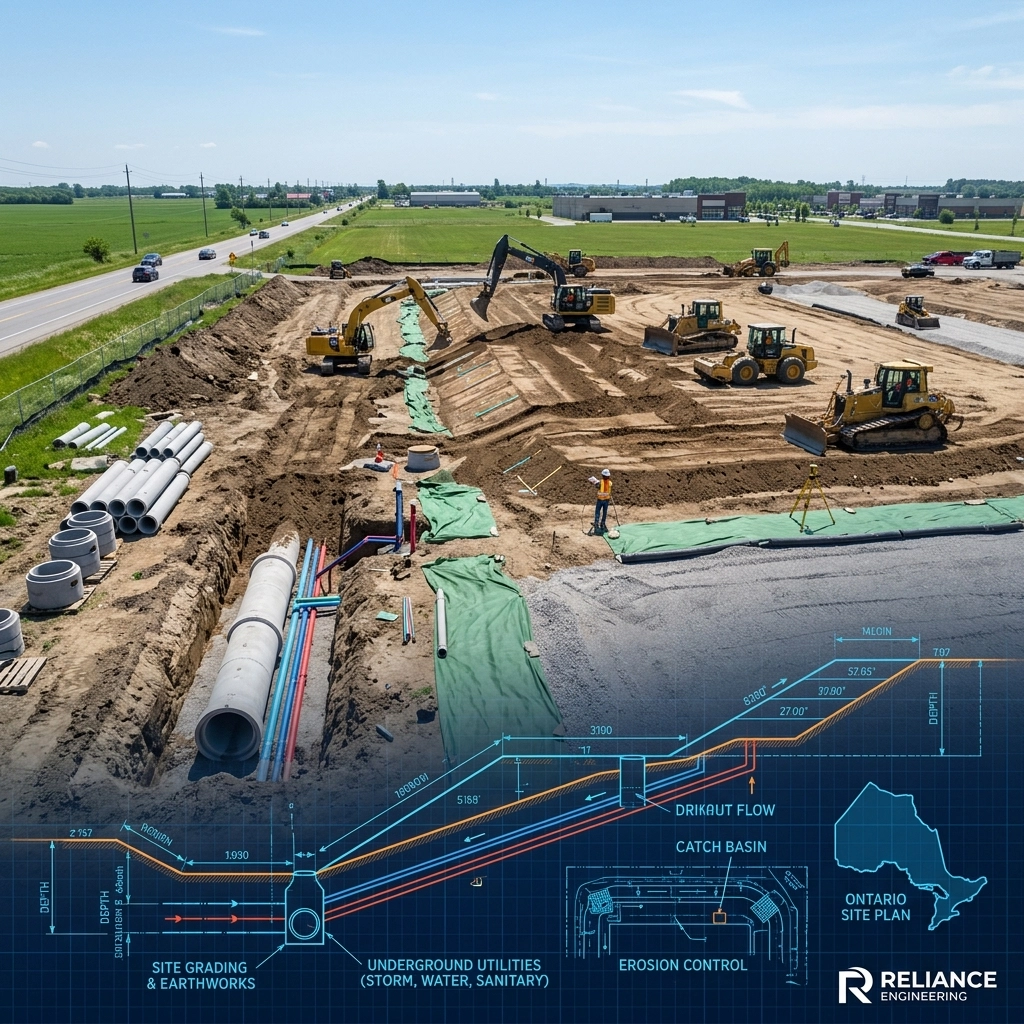
A functional report must demonstrate that the land can be graded to facilitate proper drainage. We integrate the Site Grading Plan to ensure that the proposed building elevations work with the existing topography and municipal road heights.
Navigating the Ontario Regulatory Landscape
Every municipality in Ontario has its own "Standard Operating Procedures." What works for a project like the 345-351 Davis Drive in Newmarket might not meet the specific criteria for the Redevelopment of Etobicoke General Hospital.
The Planning Act and PPS
The Ontario Planning Act and the Provincial Policy Statement (PPS) mandate that infrastructure must be "efficient and cost-effective." Our role is to ensure your FSR aligns with these high-level provincial mandates while satisfying the specific engineering design criteria of the local municipality.
Conservation Authority Involvement
If your site is near a creek, wetland, or floodplain, Conservation Authorities (like the TRCA or CVC) will review your SWM strategies within the FSR. We coordinate directly with these agencies to ensure your Storm System Design meets both municipal and environmental protection standards.
Why Technical Precision Matters
A poorly prepared FSR is a liability. If the flow calculations are off by even a small margin, you could face:
- Project Rejection: Municipalities will return incomplete or inaccurate reports immediately.
- Unforeseen Costs: Discovering you need a $500,000 external sewer upgrade during the construction phase can kill a project’s ROI.
- Legal Delays: Faulty drainage designs can lead to litigation from neighboring property owners.
At Reliance Engineering, we use advanced hydraulic modeling and current GIS data to ensure every calculation is airtight. Our experience with projects like the 35 Wabash Avenue Townhomes proves that precision in the early stages leads to success in the final build.

Best Practices for a Smooth Approval
- Early Consultation: Talk to municipal engineers before you start. Understanding their specific concerns about a local pumping station or water main can save weeks of rework.
- Verify Data: Never rely solely on old record drawings. We recommend site-specific flow testing and topographic surveys to confirm actual conditions.
- Integrate ESC: Incorporate Erosion and Sediment Control measures early. This shows the municipality you are committed to protecting local infrastructure during the transition from "functional" to "actual" construction.
- Professional Certification: Ensure your report is signed and sealed by a P.Eng. in good standing with the Professional Engineers of Ontario.
The Reliance Engineering Advantage
We don't just write reports; we solve problems. Our team understands that land development is a business. You need a partner who can provide permit-ready plans and practical engineering solutions that satisfy regulators without overbuilding.
From Site Servicing Plans to complex SWM reports, Reliance Engineering provides the expertise required to navigate Ontario’s evolving development standards.

Contact Information
Ready to move your project forward? Contact us today for an expert consultation.
- Principal: Naresh Ochani, P.Eng. M.Eng.
- Company: Reliance Engineering
- Address: 6850 Millcreek Dr, Mississauga, ON L5N 2H4
- Phone: 647-385-6418
- Email: [email protected]
- Website: www.relianceengineering.ca
Office Hours
- Saturday: 12:00 PM – 2:00 PM
- Sunday: Closed
- Monday – Friday: 9:00 AM – 5:00 PM
Whether you are looking for more information About our firm or want to see our past Projects, we are here to help you succeed in the Ontario market. Reach out to us via our Contact Us page to start your next Functional Servicing Report.




Leave A Comment