Ontario Stormwater Management | November 1, 2026 | By Reliance Engineering
An SWM report’s conclusions are only as reliable as the assumptions and data behind them. Before relying on the final flow rates or storage calculations, reviewers need to understand the inputs: which criteria were applied, where rainfall data came from, how catchments were defined, and how the model was configured.
When an input is incorrect or unexplained, the calculations may still look precise, but the results may not answer the municipality’s question. For stormwater management reports in Ontario, making assumptions traceable is an essential part of a review-ready submission.
1. Identify the source of each design criterion
Start by listing the applicable requirements for the project and identifying their sources. These may include municipal design criteria, conservation authority requirements, and applicable provincial guidance. Do not assume that a familiar criterion applies unchanged to every municipality or site.
The City of Hamilton’s SWM report guidelines and summary checklist offer a clear municipal example. Checklist item 8 asks whether the appropriate criteria were used and whether the information was provided by the City. Hamilton’s accompanying guidance says that when criteria are not provided by the City, confirmation may be required.
For reviewers, a list of criteria is more useful when it also shows where each requirement came from, such as a named guideline, current municipal document, or written confirmation. Hamilton’s guideline calls for criteria covering areas such as quantity, quality, erosion control, and infiltration. The applicable scope varies by project.
2. Document rainfall data, storm duration and distribution
Rainfall inputs affect the analysis directly. State the source of the intensity-duration-frequency (IDF) data, the design events evaluated, and the storm duration and temporal distribution used. Provide the rainfall volumes used in the model, not just the resulting flows.
Municipal requirements are not interchangeable. For example, the Region of Peel’s December 2022 stormwater report requirements specify that Region of Peel IDF curves be used for peak-flow analysis. For quantity-control storage, Peel identifies a 24-hour Chicago or 24-hour SCS Type II distribution.
Hamilton’s checklist asks which design storms were used, recommends use of the design-storm time-series data in the City’s current Comprehensive Development Guidelines and Financial Policies Manual, and asks whether rainfall volume for each storm from 2- to 100-year has been provided. These are examples of local requirements, not a province-wide specification. Confirm the current criteria with the municipality responsible for the review.
Climate-change adjustments also depend on current local direction and project requirements. Confirm whether an adjustment is required and which method or data source the municipality accepts; do not assume a percentage.

3. Explain catchment parameters and supporting evidence
Catchment areas and their parameters should be easy to trace between the report, drainage-area plans and model. Use consistent catchment IDs, and explain how runoff coefficients and other model parameters were selected.
Hamilton checklist item 28 asks the report author to discuss how model parameters were determined. In practical terms, a reviewer should be able to understand the basis for the assumed land cover and drainage characteristics, and see how each catchment contributes to the analysis.
Check these assumptions against available site information. Soil type, infiltration conditions and groundwater findings can affect whether an assumed infiltration approach is supported. Hamilton’s guideline calls for the SWM report to be consistent with relevant geotechnical, hydrogeological, fluvial geomorphic, erosion and water-balance studies. If those studies are incomplete or use different assumptions, resolve the discrepancy rather than leaving it for the reviewer to interpret.
4. Show how the model works, and provide the evidence
Name the method or software used and explain why it is appropriate for the analysis. Include a modelling schematic that shows the relationship between catchments, controls and outlets. Present key parameters, calculations and results clearly enough that a reviewer can follow the path from inputs to conclusions.
Hamilton checklist item 25 asks what method or modelling software was used to determine existing and proposed flows. Item 26 asks for sensitivity-analysis details to identify the governing temporal distribution and storm duration, where applicable. Item 27 asks for calibration and validation details, if applicable. Item 67 asks whether a digital copy of the modelling files has been included.
Sensitivity analysis matters when reasonable choices, such as storm distribution or duration, could change which event governs the design. Explain what was tested and how the selected case was identified. Include calibration or validation information when applicable; do not imply it is always required.
The City of Waterloo’s Stormwater Management Report Terms of Reference provides another municipal example. Its requirements include hydrologic modelling for existing and proposed conditions, an explanation of modelling, computer modelling results and design calculations. It notes that failure to meet the Terms of Reference may result in an application being deemed incomplete and returned. Waterloo also reserves the right to request an updated study or peer review in applicable cases.

5. Align assumptions before submission
Where possible, discuss the report’s scope and design assumptions with municipal staff during pre-consultation. Waterloo’s Terms of Reference encourages applicants to discuss the need, scope and assumptions with Engineering staff before preparing a report. Confirming inputs early can help avoid a late change to the analysis.
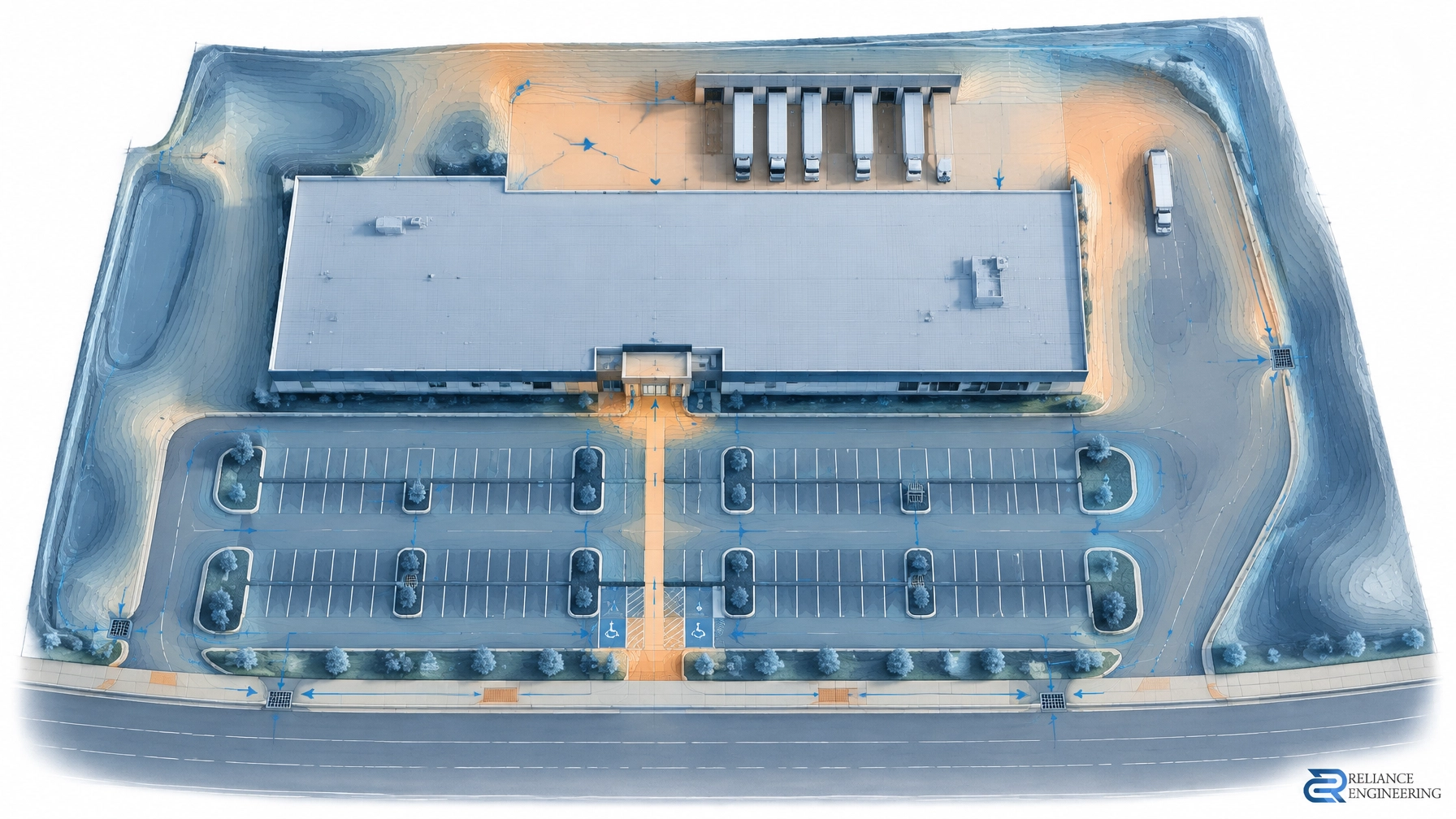
A practical approach is to summarize key assumptions on one page, with the source beside each one. Use municipal rainfall data where provided, retain model files, and make sure the SWM report agrees with the site’s grading and servicing information. Coordinated design helps keep catchment boundaries, drainage routes and model assumptions consistent with the drawings.
This is where clear calculations, clean layouts and constructible routing support a stronger review. Site servicing plans and a functional servicing report should use compatible drainage information. Practical controls and buildable grading are easier to assess when the supporting plans and report tell the same story.
Six-point pre-submission checklist
- Confirm the source of each design criterion, preferably in writing.
- Verify whether the municipality requires its own IDF curves or rainfall data.
- Confirm design-storm distribution and duration against the current local Terms of Reference.
- Justify runoff coefficients and catchment parameters against land use and available soil information.
- Include the modelling schematic, parameter rationale and sensitivity analysis where applicable.
- Prepare the digital model files for submission, as required.

Key takeaways
- Reviewers need to see where criteria and rainfall inputs came from.
- Municipal examples differ; confirm the current local requirements for each project.
- Catchment parameters should be explained and consistent with supporting studies.
- Model methods, schematics and files make the analysis easier to review.
- Sensitivity analysis can show whether the selected storm assumptions govern the result.
An SWM report should make its reasoning clear before asking reviewers to accept its conclusions. Reliance Engineering prepares stormwater management reports across Ontario, with municipal experience and more than 20 years of principal engineer experience. Contact us to discuss your criteria, modelling inputs or approval requirements.
Request a consultation: Contact Reliance Engineering
Explore our services: Stormwater Management Reports · Site Servicing Plans · Functional Servicing Reports
Professional credentials and contact
Naresh Ochani, P.Eng. M.Eng.
Principal Engineer, Reliance Engineering Canada Limited
PEO Certificate of Authorization: 100548882
Address: 6850 Millcreek Dr, Mississauga, ON L5N 2H4
Phone: 647-385-6418
Email: [email protected]
Office hours: Monday to Friday, 9:00 AM–5:00 PM; Saturday, 12:00 PM–2:00 PM; Sunday, Closed.