Article type: Practical how-to and decision guide
Topic: Commercial parking lot drainage and asphalt regrading across Ontario
Prepared by: Reliance Engineering
Estimated reading time: 7 minutes
A patch can smooth a rough spot without correcting the reason water collects there. If the asphalt around it is raised, the patch may leave a shallow bowl, or create a small ridge that traps water elsewhere. Repeated patching without checking elevations can make ponding return after the next rainfall.
For commercial parking lots, the right repair depends on both the pavement’s condition and the way water moves across the site. A drainage-focused approach starts with existing grades, catchbasin elevations and the cause of the depression. Only then can a property owner decide whether targeted asphalt regrading, a mill-and-overlay, or full-depth reconstruction is appropriate.

Why parking-lot drainage gets worse over time
Commercial asphalt is exposed to vehicle loads, water, freeze-thaw cycles and repeated repairs. Over time, these conditions can change the pavement surface and the route water takes across it.
Common causes include:
- Settlement: Weak or poorly compacted base material can sink under traffic, forming low spots.
- Frost heave: Seasonal movement can lift sections of pavement. When the surface thaws, uneven areas or depressions may remain.
- Accumulated patching: Successive repairs can raise parts of the pavement around a low spot, leaving water trapped in the original depression.
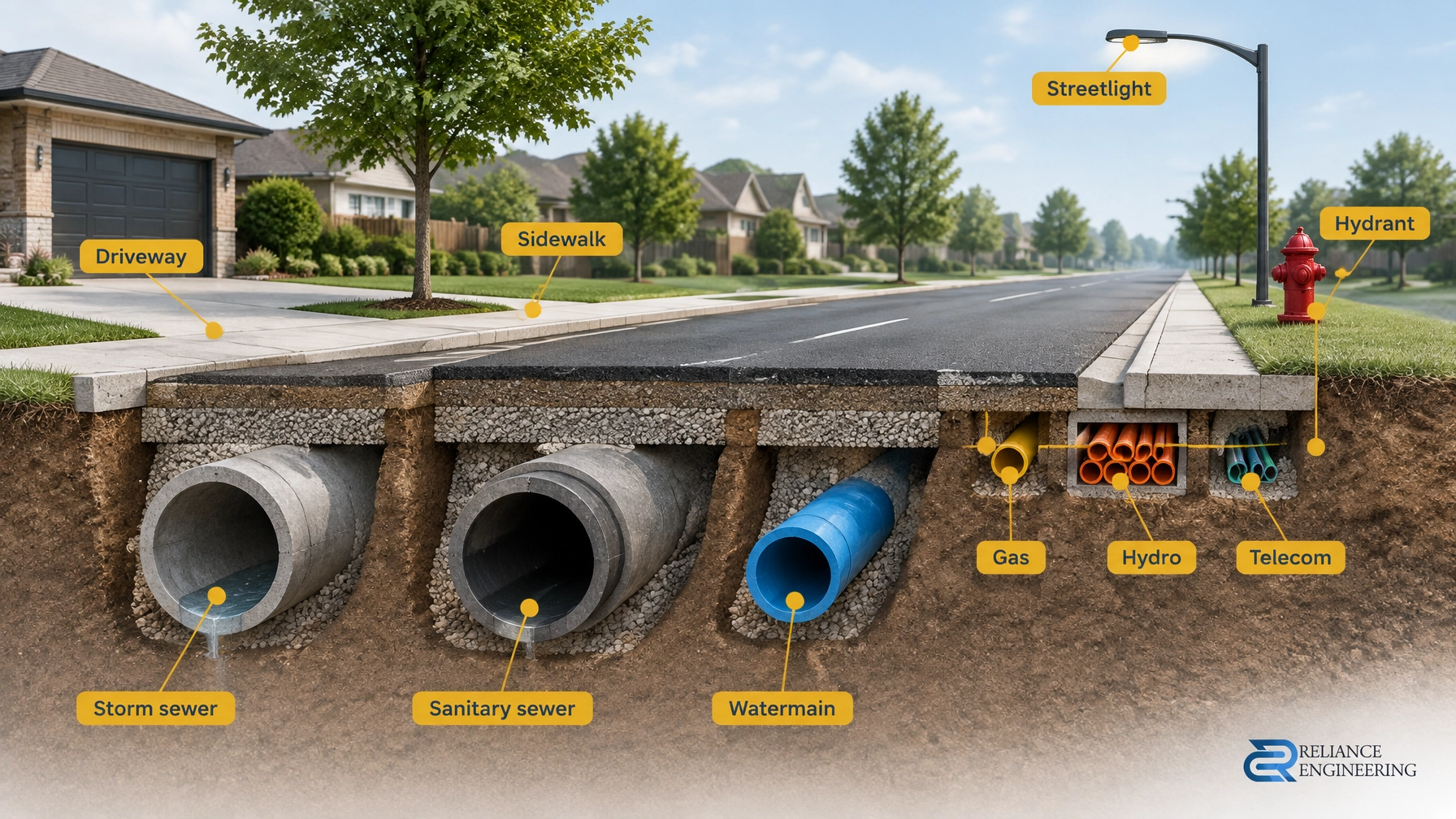
- Worn or blocked drainage: Debris, damaged grates, settled catchbasin frames or problems in the connected storm system can prevent water from entering or draining away effectively.
- Changing site conditions: New curbs, entrances, resurfacing or adjacent work can alter the elevations water needs to cross.
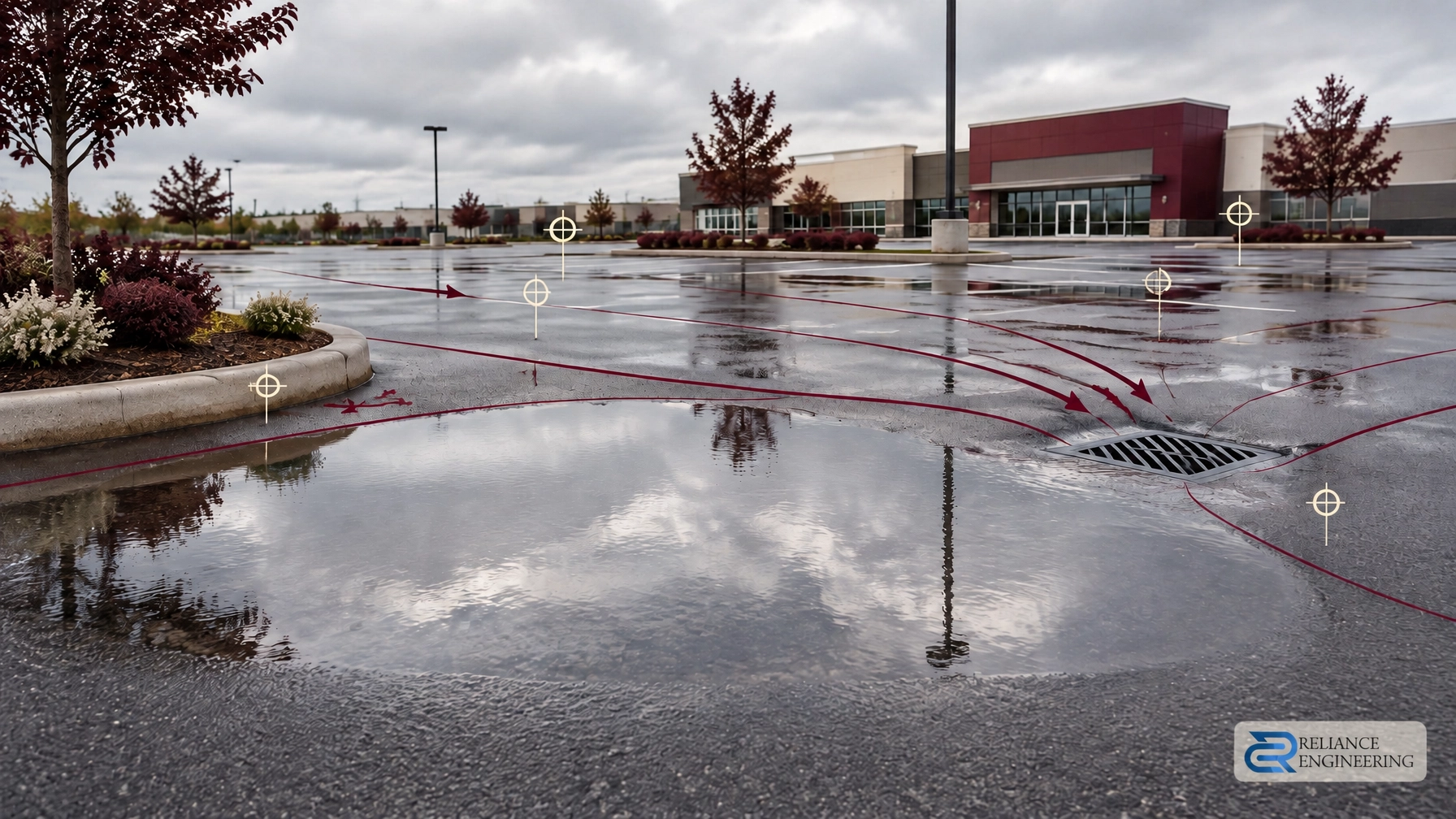
The result may be a bird bath in a drive aisle, ponding beside a curb, or water that flows toward a building entrance. These are not just surface defects: they can signal a grading or drainage issue that a thin patch will not solve.
How to choose the right repair
1. Map the ponding and inspect the surface
Note where water collects, how long it remains after rainfall, and whether the problem appears in one stable area or across much of the lot. Check for recurring cracks, raveling, rutting, pumping, or repeated patches. Look at nearby catchbasins and observe whether water can flow toward them without crossing a raised edge.
A visual inspection is useful, but it cannot confirm the pavement structure or establish proposed grades. A topographic survey and pavement investigation may be needed before selecting a repair.
2. Check the catchbasins and drainage route
A catchbasin must be at a useful low point, with its grate and rim coordinated to the finished asphalt. Confirm whether the grate is clear and whether the frame has settled or been left too high or low. Where recurring ponding suggests a system problem, the private storm sewer and downstream connection may also need inspection.
If a basin is blocked, damaged or poorly located, adding asphalt around it is unlikely to provide a lasting solution. Depending on the findings, the work may require resetting a catchbasin rim, adjusting a double catchbasin, repairing a connection, or changing the surface drainage design.
3. Decide between targeted regrading and full-depth work
A mill-and-overlay or targeted asphalt regrading may fit when:
- The problem is shallow and limited to a small, stable area.
- The base appears sound and there is no evidence of recurring settlement.
- Existing catchbasins can receive the proposed runoff.
- Enough elevation flexibility remains to create positive drainage without creating new conflicts at curbs, doors or property boundaries.
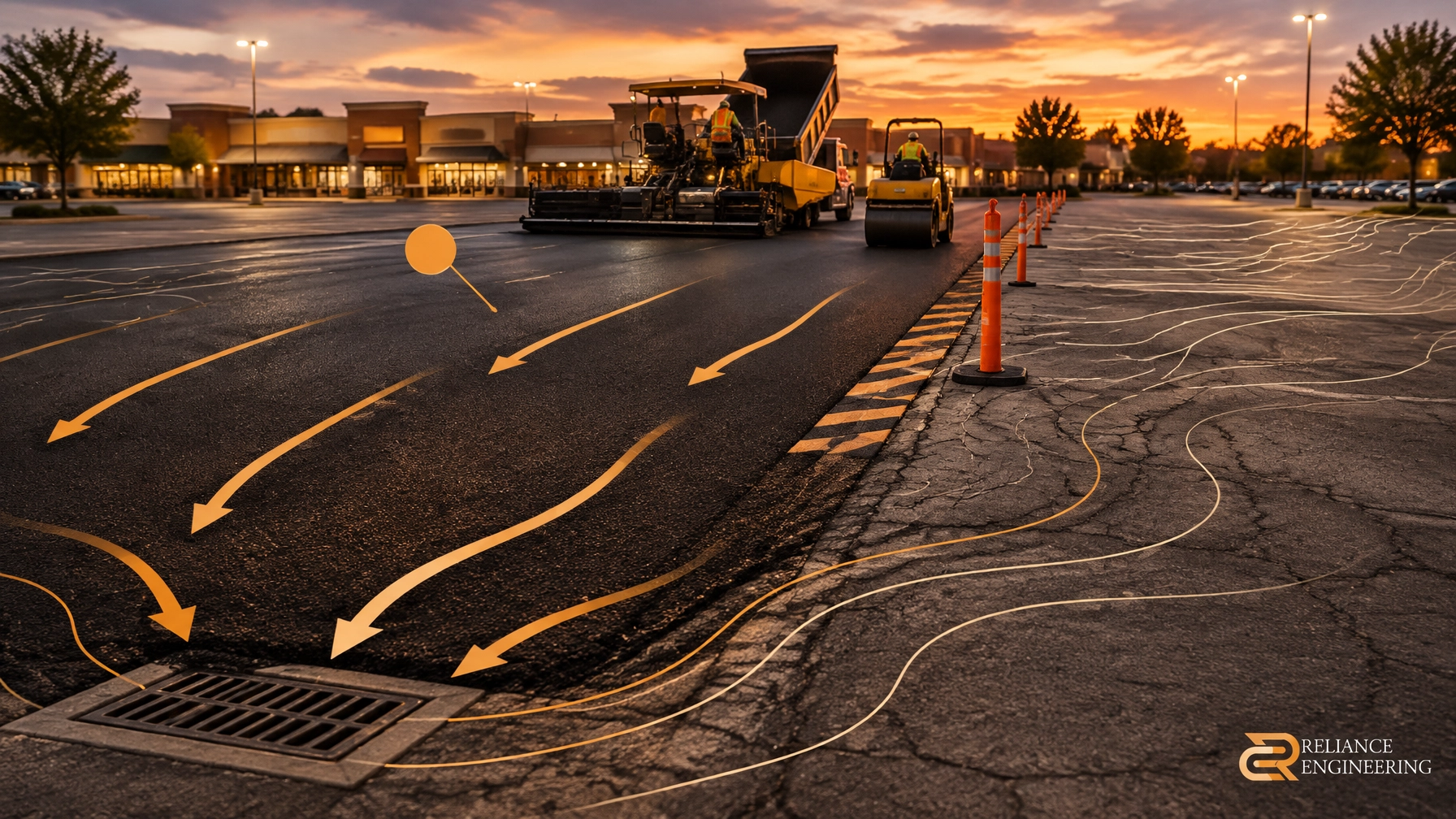
A surface-level repair can mill high areas, remove worn asphalt and reshape the surface with a properly designed asphalt lift. It is most effective when the underlying grades and pavement structure are already suitable.
Full-depth reconstruction may be needed when:
- Ponding is widespread or repeatedly returns after repairs.
- There are signs of base failure, settlement, pumping or significant pavement movement.
- The existing elevations do not allow water to reach the catchbasins.
- Drainage infrastructure or flow routes need to be redesigned.
Full-depth work can remove the asphalt and affected granular material so the base, pavement section and grades can be rebuilt. A hybrid approach may also make sense: reconstruct failed areas and mill-and-overlay stable portions.
The key distinction is the cause. A mill-and-overlay is not a substitute for repairing a failed base or redesigning drainage. A patch that only raises the bottom of a depression may recreate the same ponding, or shift it to the edge of the patch.

4. Design the new surface as a connected system
Effective commercial property grading fixes depend on more than removing visible bird baths. Proposed pavement elevations should establish:
- Pavement crowns and cross-slopes that direct runoff toward intended inlets.
- Smooth, buildable transitions between repaired and existing asphalt.
- Catchbasin and double catchbasin rim elevations that match the proposed finished surface.
- Re-sloped pavement that directs water to the catchbasins or approved overland flow routes.
- Corrections to bird baths and edge-of-pavement ponding along curbs.
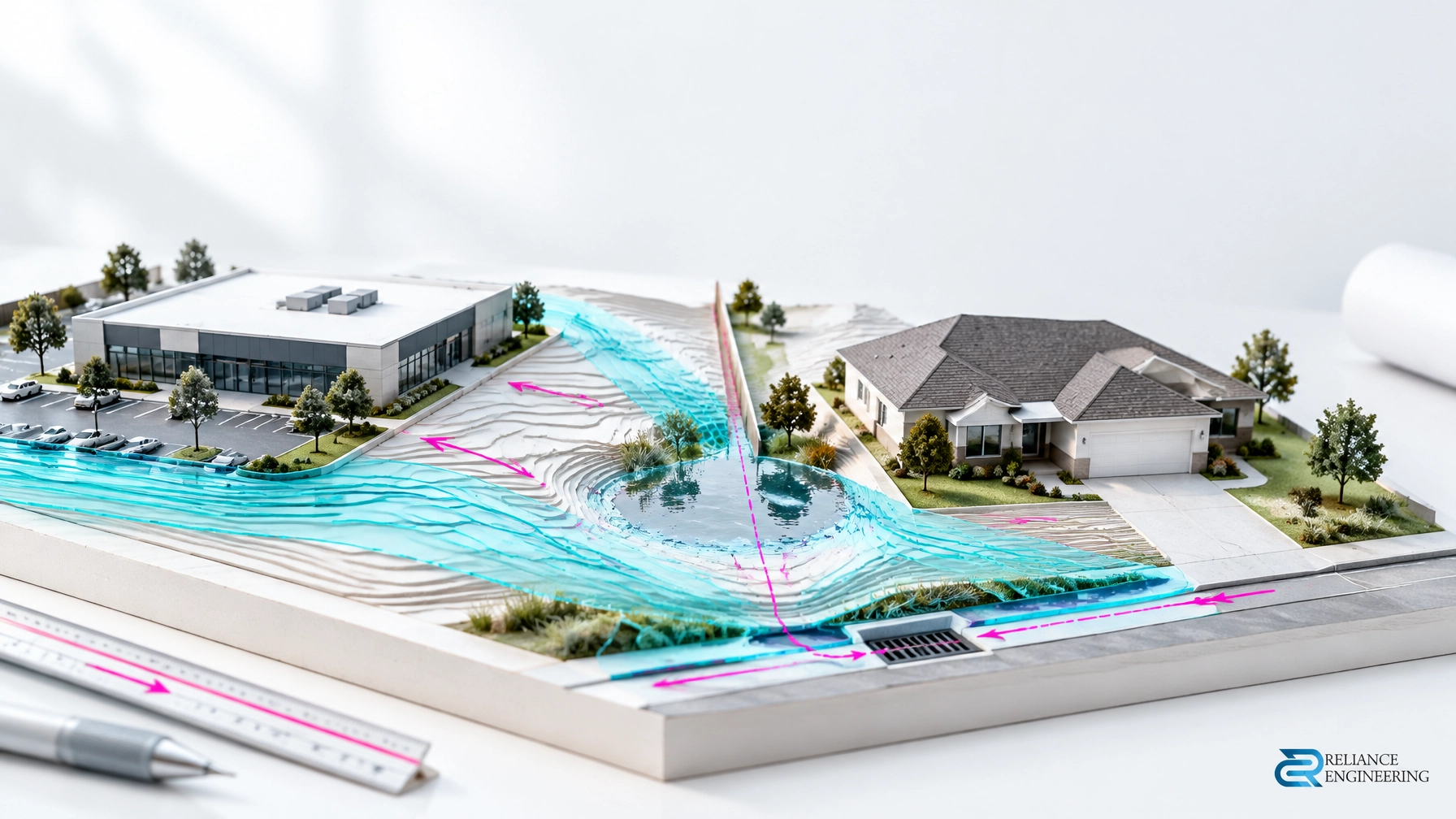
The new elevations also need to tie into surrounding grades, building entrances, sidewalks, accessible routes, property boundaries and municipal road grades. A drainage fix that sends water toward a doorway, neighbouring property or public right-of-way can create a new problem. A surveyed grading plan helps show whether the proposed slopes can be built and where runoff will go.
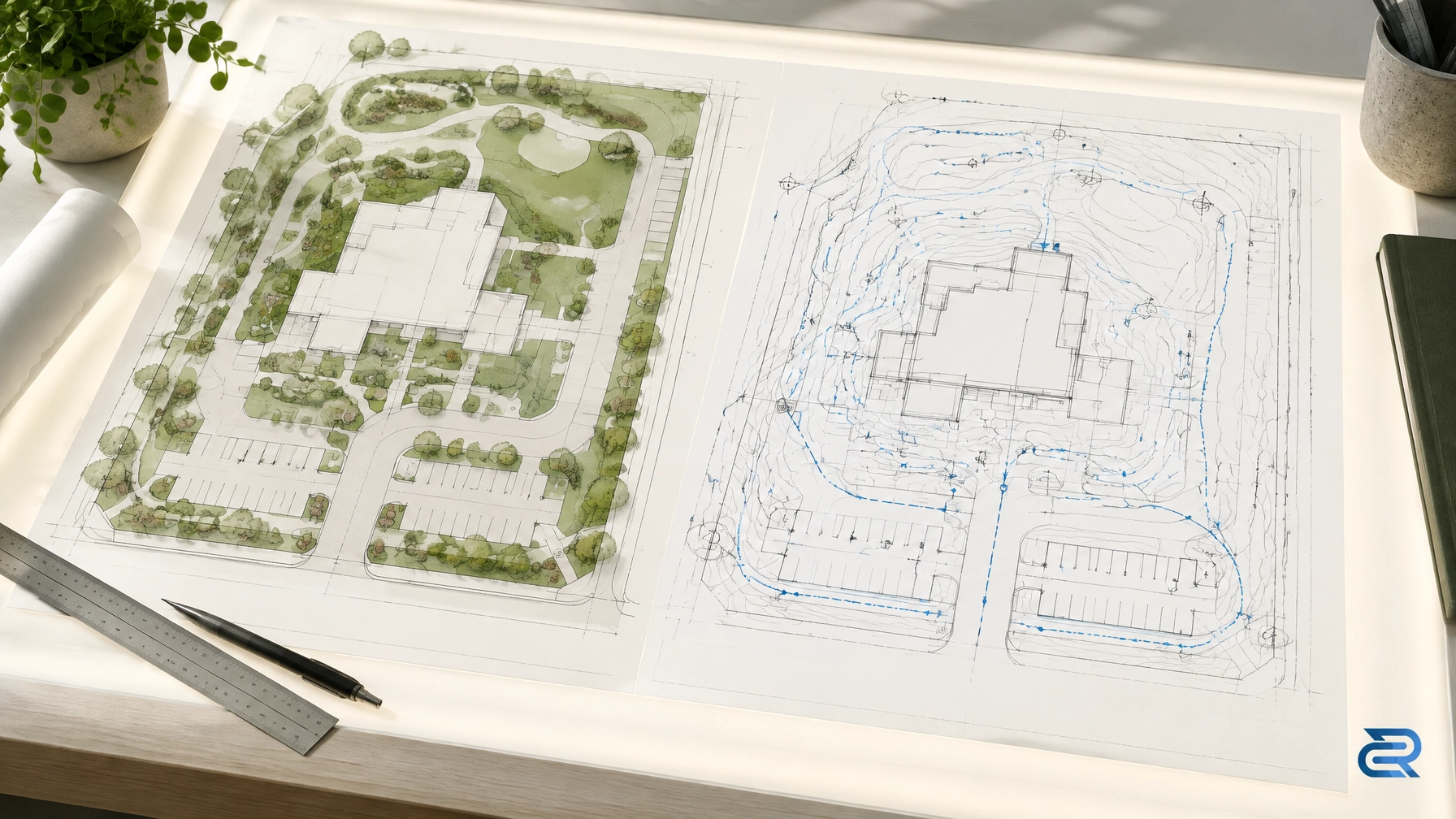
Reliance Engineering’s Site Grading Plans are prepared using survey information, site conditions and municipal criteria, with clear elevations and drainage routes to support construction and review.
5. Confirm local municipal requirements before construction
Municipal requirements vary across Ontario. Depending on the work and location, a municipality may require a grading permit, site alteration approval, revised grading plan, site-plan review, or other approvals. Requirements can depend on the scope of regrading, whether drainage patterns or storm connections change, and conditions in an existing site-plan approval or agreement.
Check with the municipality before tendering or starting work. For example, the City of Brampton’s Site Alterations information describes permit requirements for certain grade and drainage changes. The Town of Milton’s site-plan standards illustrate the type of grading information that may be required. These are local examples, not province-wide rules.
Where drawings are needed, a coordinated grading plan can document existing and proposed elevations, flow arrows, overland flow routes, catchbasin rim elevations and connections to surrounding grades. Depending on the project, servicing or stormwater documentation may also be needed. Confirm the applicable submission requirements with the local municipality.
A practical sequence before paving
- Record ponding locations and inspect the asphalt, curbs and catchbasins.
- Survey the lot and relevant tie-in elevations, including entrances and municipal road grades.
- Investigate pavement and base conditions where settlement or failure is suspected.
- Develop proposed grades and confirm that water can reach functioning drainage inlets.
- Confirm municipal requirements and prepare permit-ready drawings where required.
- Specify the repair limits, catchbasin adjustments and finished drainage slopes before paving begins.

Get advice before repeating the patch
If ponding keeps returning, assess the grades before authorizing another surface repair. Reliance Engineering prepares practical designs, buildable grading and permit-ready drawings for commercial properties across Ontario. We can review the drainage problem, coordinate proposed elevations and provide approval support based on the site and local requirements.
Contact Reliance Engineering: Request a consultation.
Contact and credentials
Reliance Engineering
6850 Millcreek Dr, Mississauga, ON L5N 2H4
Phone: 647-385-6418
Email: [email protected]
Office hours: Saturday 12:00 PM–2:00 PM; Sunday Closed
Naresh Ochani, P.Eng. M.Eng.
PEO Certificate of Authorization: 100548882