2:00 PM Daily Post | Ontario Site Servicing & Stormwater
Service focus: Stormwater Management Reports, Site Servicing Plans, Functional Servicing Reports, and municipal approvals
Stormwater management is a core approval requirement for development projects across Ontario. Municipalities and Conservation Authorities expect the design to control runoff quantity, protect water quality, provide safe overflow routes, and connect properly to existing infrastructure.
A complete Stormwater Management Report must do more than list drainage areas. It must explain the design criteria, prove the storage volume, confirm outlet performance, and coordinate with the site servicing plan and grading plan.
There is no single allowable release rate for every Ontario property. The controlling criteria depend on the municipality, Conservation Authority, watershed policies, downstream system capacity, and the type of development.
How Ontario Municipalities Set the Allowable Release Rate
The allowable release rate is the maximum flow permitted from the site to a municipal storm sewer, watercourse, or other approved outlet.
Common approaches include:
- Matching the pre-development peak flow for a specified storm event
- Controlling post-development flow to the pre-development 2-year or 5-year peak
- Applying a fixed rate in litres per second per hectare
- Limiting release based on downstream storm sewer capacity
- Applying a maximum runoff coefficient for redevelopment sites
- Requiring no increase in post-development peak flows
The applicable rate must be confirmed from the municipality’s current engineering standards, Conservation Authority requirements, master drainage plan, subwatershed study, or project-specific comments.
A rate used on another Ontario project cannot simply be transferred to a new site. The Stormwater Management Report should identify:
- The source of the allowable release rate
- The storm events to which it applies
- The receiving infrastructure or watercourse
- Any downstream capacity limitations
- The resulting storage and outlet-control requirements
This clear documentation helps municipal reviewers understand the design basis without requesting repeated clarification.
Storage Volume Must Be Proven
When the allowable release rate is lower than the uncontrolled post-development runoff, the site requires storage.
Storage may be provided through:
- Surface stormwater management ponds
- Parking lot storage
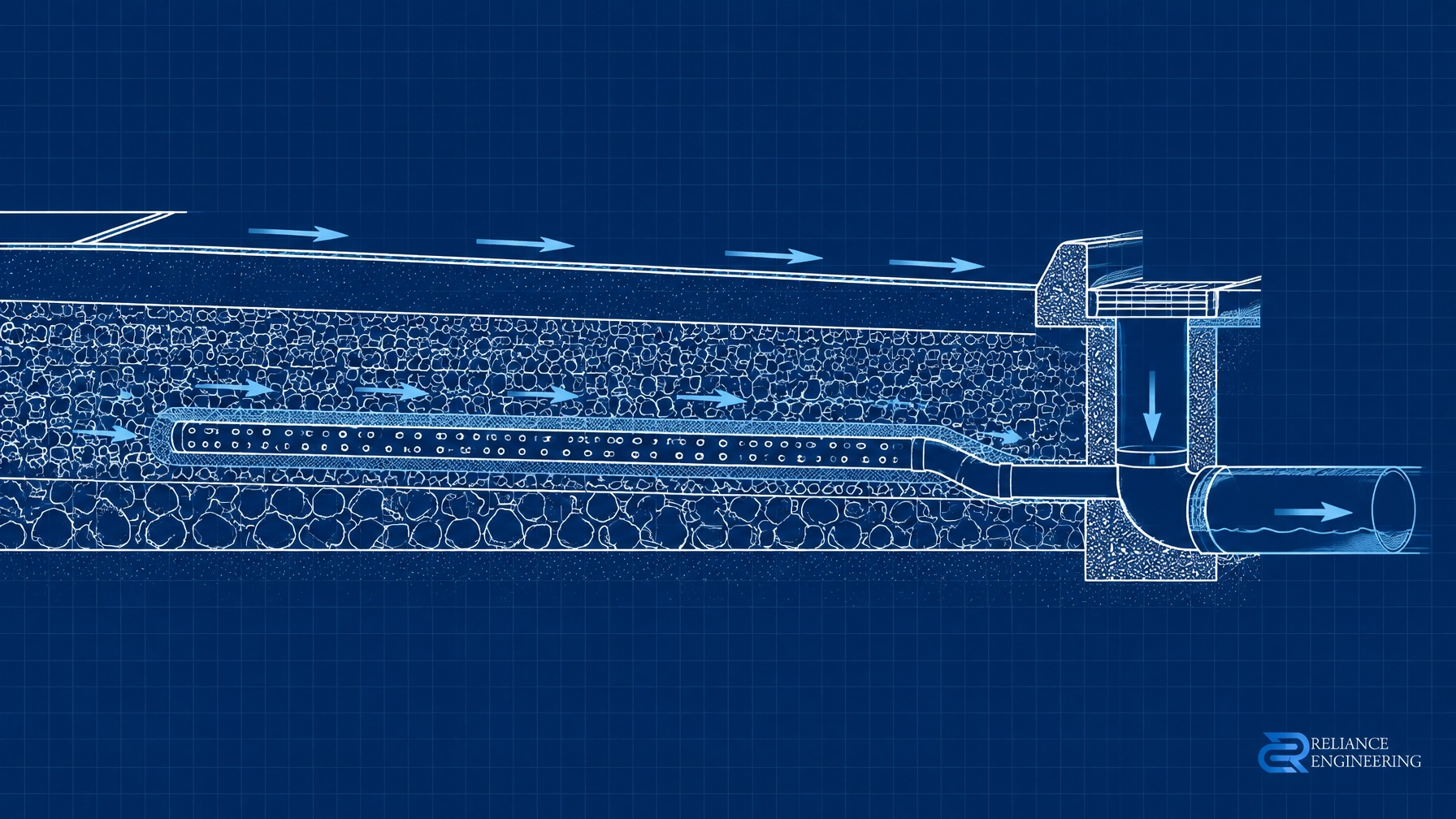
- Underground tanks
- Oversized storm pipes
- Modular underground chambers
- In-line storage within a controlled drainage system
The required volume is not selected as a general allowance. It is calculated by comparing the post-development inflow hydrograph with the permitted controlled outflow.
A typical analysis includes:
- Existing site drainage areas and runoff characteristics
- Proposed impervious area and land use
- Design rainfall events
- Pre-development and post-development peak flows
- Time of concentration and catchment routing
- Allowable release rate
- Outlet rating and control structure performance
- Maximum water level and freeboard
- Emergency overflow requirements
The report should show that the proposed facility provides enough effective storage for the governing storm event. It should also confirm that the proposed pond, underground system, or parking lot storage remains safe and functional at the design water level.
Storage depth, grading, access, maintenance requirements, and impact on adjacent properties must be shown on the drawings. A volume that appears in a report but cannot be constructed from the grading plan is a common reason for review comments.

Outlet and Orifice Sizing Requires Clear Calculations
Flow control is commonly provided through an orifice plate, orifice pipe, inlet control device, vortex device, roof drain restrictor, or another approved control structure.
The outlet must be sized for the required release rate under the actual operating head. It is not enough to specify a nominal pipe size.
For a submerged circular orifice, the basic hydraulic relationship is commonly expressed as:
[
Q = C_d A \sqrt{2gh}
]
Where:
- Q is the controlled discharge
- Cd is the discharge coefficient
- A is the opening area
- g is gravitational acceleration
- h is the operating head above the orifice
The final design should confirm the relationship between water level and discharge. The outlet must perform acceptably across the required storm events, not only at one calculated point.
The report should identify:
- Orifice diameter or device model
- Invert elevation
- Design head
- Discharge coefficient or manufacturer rating
- Controlled flow at each relevant storm event
- Blockage protection
- Access for inspection and maintenance
- Connection point to the municipal storm system
For smaller sites, an inlet control device or roof drain restrictor may be more practical than a pond outlet. The selected device still requires a rating curve, installation detail, and confirmation that it meets the municipality’s allowable release rate.
Emergency Overflow and Overland Flow Routes Are Essential
Every stormwater facility needs a safe major-system route if the outlet becomes blocked or the design event is exceeded.
The grading plan should show where excess water will flow and confirm that it will not:
- Enter buildings
- Cross private property without approval
- Damage retaining walls
- Flood access routes
- Reach an unsafe slope
- Bypass required treatment
- Discharge directly to a neighbouring property
Emergency overflow routes may include a spillway, overflow weir, graded swale, road overland route, or controlled discharge point.
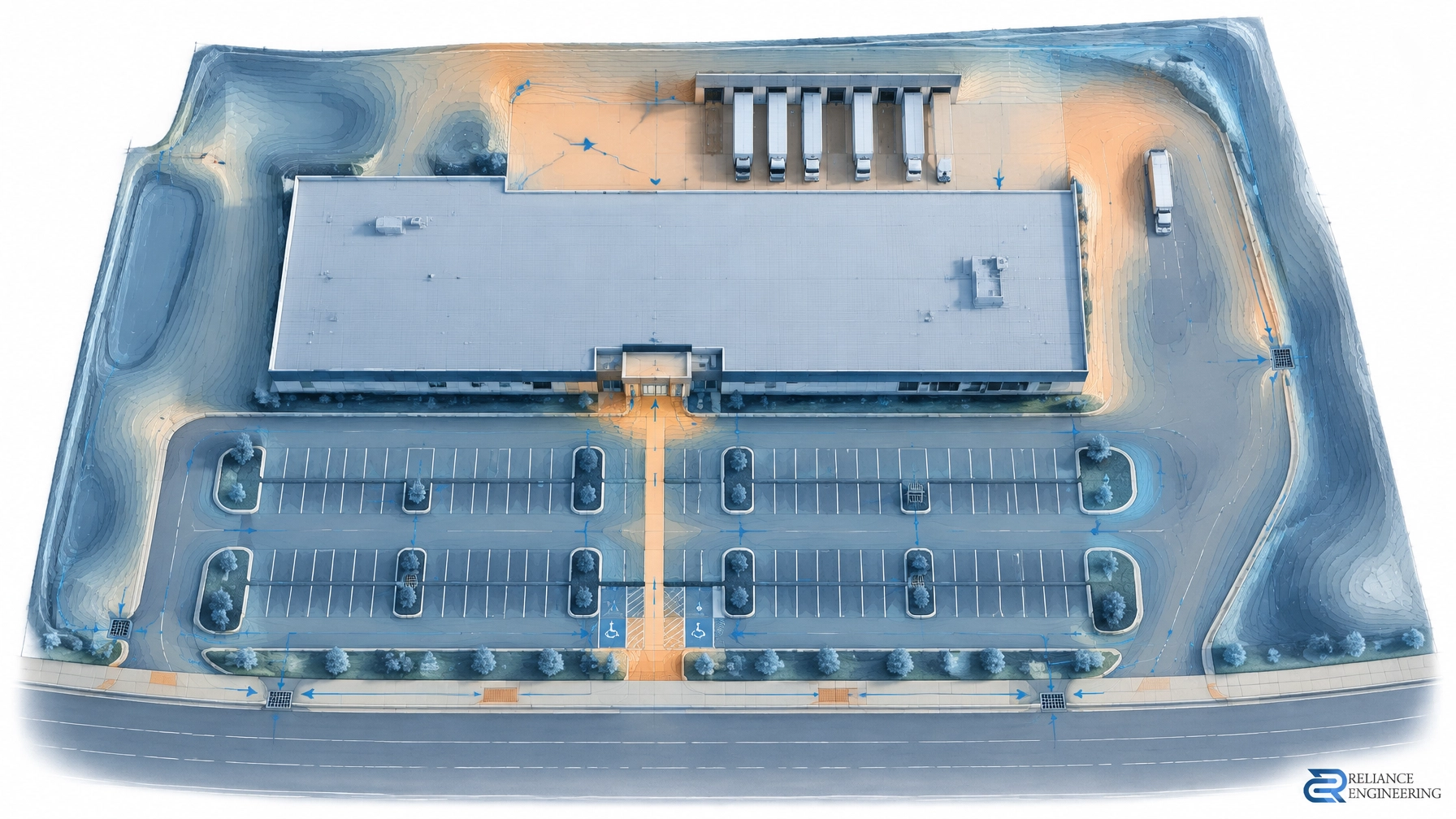
The route should be supported by spot elevations, arrows, sections, and sufficient freeboard. It must be coordinated with building entrances, finished floor elevations, parking areas, sidewalks, fire routes, and property boundaries.
This is where a coordinated design matters. The Stormwater Management Report, site servicing plans, and site grading plans must describe the same drainage strategy.

Water Quality Controls Must Match the Site Use
Stormwater quantity control does not replace water quality treatment. Municipalities and Conservation Authorities may require treatment for suspended solids, hydrocarbons, debris, and other pollutants before discharge.
Common water quality controls include:
- Oil/grit separators
- Manufactured treatment devices
- Wet ponds
- Forebays
- Constructed wetlands
- Bioretention areas
- Infiltration systems
- Enhanced catch basin inserts
- Vegetated swales
For sites with parking, loading, fueling, commercial activity, or industrial use, oil/grit separation may be a specific municipal requirement. The report should identify the treatment unit, design flow, treatment rate, bypass arrangement, access requirements, and maintenance obligations.
A practical control is one that can be inspected and maintained after construction. The design should state:
- Who is responsible for maintenance
- How frequently inspection is required
- How sediment and oil will be removed
- Where maintenance access is provided
- How the facility will be protected during construction
Construction-phase sediment control is also separate from permanent stormwater quality treatment. An Erosion and Sediment Control Plan sample can help illustrate how temporary controls are documented.
The Report Must Match the Servicing and Grading Plans
Stormwater review comments often result from inconsistencies between the report and drawings.
The following items must align:
- Catchment areas
- Catch basin locations
- Pipe sizes and slopes
- Manhole locations
- Storm connection point
- Invert elevations
- Outlet control structure
- Storage limits
- Ponding depths
- Emergency overflow route
- Grading direction
- Treatment device location
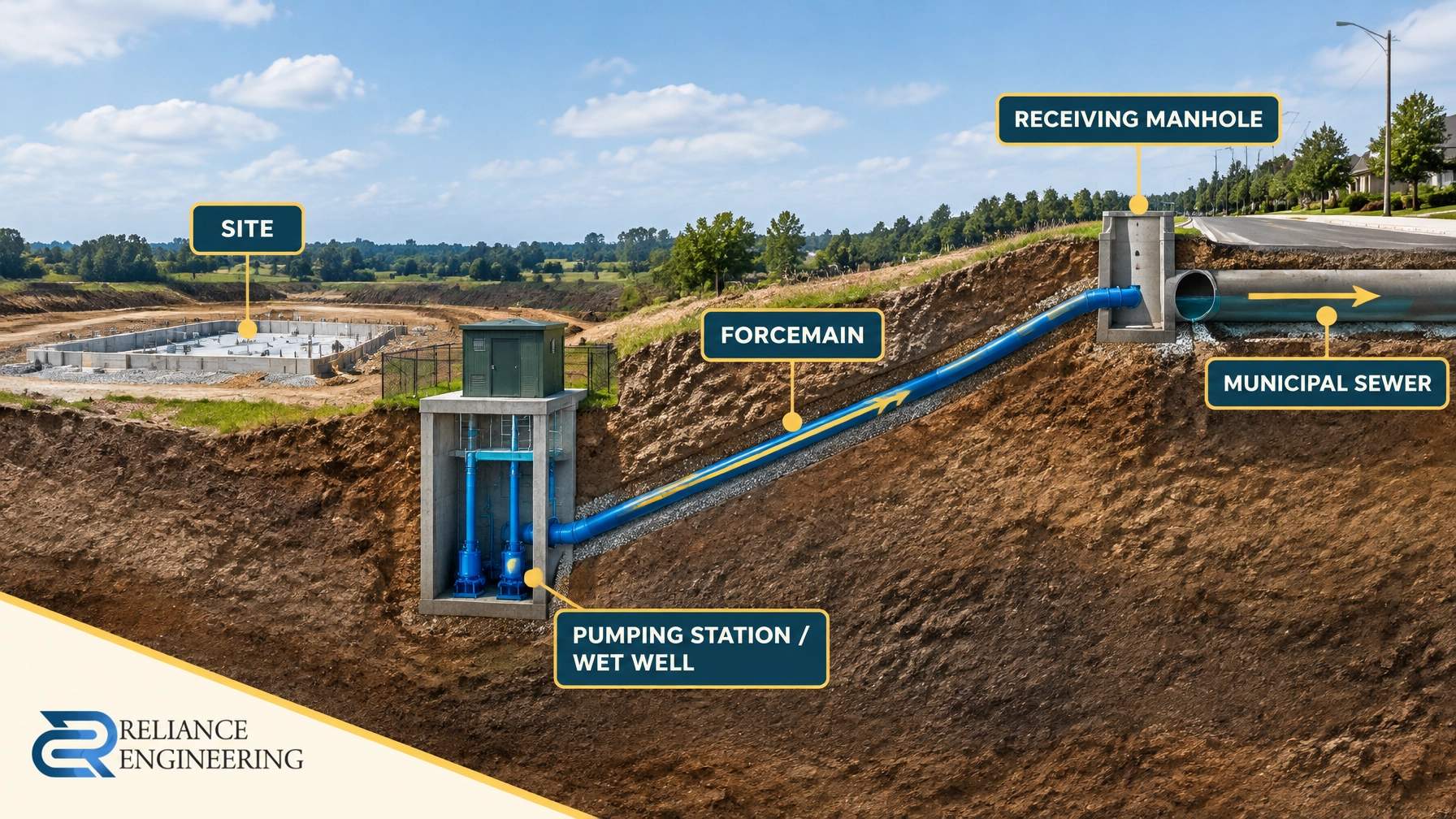
The site servicing plans should show the proposed storm sewer network, connection details, pipe information, and municipal infrastructure interface.
The site grading plan should show how runoff reaches the storm system or storage facility. It should provide buildable grading, positive drainage, and constructible routing around buildings, entrances, retaining walls, and property lines.
A functional servicing report should address the broader infrastructure strategy, including storm servicing, municipal capacity, proposed connections, and required upgrades.
For reference, our sample storm sewer sizing and servicing drawing includes a storm sewer sizing section with a proposed 300 mm STM PVC connection to a manhole. It is provided as an example of our servicing drawing style and level of technical coordination.
Common Reasons Stormwater Reports Receive Review Comments
The most frequent issues are practical and avoidable:
1. The allowable release rate is not supported
The report states a flow rate but does not identify the municipal or Conservation Authority source.
Solution: State the exact design criterion and show how it applies to the property.
2. Storage volume is listed without a routing summary
A report may show a storage number without demonstrating how it was calculated.
Solution: Include inflow, outflow, maximum storage, water level, and freeboard for the governing storm events.
3. The outlet is oversized or not fully defined
A pipe diameter alone does not prove flow control.
Solution: Provide clear calculations, device ratings, elevations, and controlled discharge results.
4. Emergency overflow is missing
A site may work under normal conditions but have no safe route for exceedance or blockage.
Solution: Show the overflow route on the grading plan and confirm its elevations and downstream discharge point.
5. Water quality treatment is unclear
The report may name an oil/grit separator without confirming sizing, bypass, or maintenance.
Solution: Document the treatment target, device performance, access, and maintenance requirements.
6. Drawings and report do not match
Different pipe sizes, drainage areas, or connection elevations create uncertainty during review.
Solution: Use clean layouts and coordinated design across all civil documents before submission.
Municipal Experience Improves Approval Readiness
A strong Stormwater Management Report combines engineering analysis with municipal experience. It must be technically complete, easy to review, and practical to construct.
Reliance Engineering prepares stormwater management reports, site servicing plans, grading plans, erosion and sediment control plans, and functional servicing reports for residential, commercial, industrial, institutional, and redevelopment projects across Ontario.
Our focus is direct: practical controls, clear calculations, permit-ready drawings, and approval support from initial criteria review through municipal comments.
Request a Stormwater Consultation
Contact Reliance Engineering before finalizing your site layout. We can review the municipality, Conservation Authority requirements, proposed drainage strategy, storm connection, storage approach, and outlet-control concept.
Request a consultation through Reliance Engineering
Professional Contact Information
Naresh Ochani, P.Eng. M.Eng.
Principal, Reliance Engineering
PEO Certificate of Authorization: 100548882
6850 Millcreek Dr, Mississauga, ON L5N 2H4
Phone: 647-385-6418
Email: [email protected]
Office hours: Saturday 12:00 PM–2:00 PM; Sunday Closed.
For broader technical context, consult the Ontario Stormwater Management Planning and Design Manual and the applicable municipal and Conservation Authority criteria for your project.