Published: September 22, 2026
Post slot: 2:00 PM, Ontario Site Servicing & Stormwater
Service area: Ontario-wide
Prepared by: Reliance Engineering Canada Limited
A stormwater management report must do more than present runoff calculations. It must show how a proposed site will collect, control, treat, and safely release stormwater without increasing risk to municipal systems, downstream properties, or nearby watercourses.
For Site Plan Approval and other municipal approvals, reviewers typically expect clear calculations, practical controls, and a coordinated design that can be built as shown.
Reliance Engineering prepares stormwater management reports in Ontario for residential, commercial, industrial, institutional, infill, parking lot, and redevelopment projects.
What a Stormwater Management Report Must Demonstrate
A complete report usually addresses five connected questions:
- What is the existing drainage condition?
- How will development change runoff volume and peak flow?
- What is the allowable release rate?
- How much storage and outlet control are required?
- How will water quality and overland flow be managed?
The answer depends on the municipality, receiving system, watershed, Conservation Authority, and applicable project requirements. Municipal SWM criteria, MECP stormwater guidelines, Conservation Authority requirements, and Site Plan Approval conditions must all be reviewed before the design is finalized.
A report may also be coordinated with a functional servicing report and site servicing plans, but its main purpose is to prove that stormwater quantity and quality objectives are satisfied.
Allowable Release Rates Start With Criteria Review
The allowable release rate is the maximum flow permitted to leave the site during a design storm. It is not selected by assumption.
Depending on the municipality and receiving system, the allowable rate may be based on:
- Pre-development peak flow
- Existing storm sewer capacity
- A watershed or subwatershed study
- A municipal area-based standard
- Conservation Authority criteria
- An approved master drainage or stormwater management plan
- Site-specific conditions from the municipality or MECP
Some jurisdictions require post-development flows to match pre-development flows for selected design events. Others apply a fixed rate or require control to the lower of pre-development flow and downstream capacity.
The design storm events may include 2-year, 5-year, 10-year, 25-year, 50-year, and 100-year storms. The applicable events are confirmed during the criteria review.
A clear SWM report should identify:
- The source of the allowable release rate
- The design storm events used
- Existing and proposed drainage areas
- Runoff coefficients or other hydrologic assumptions
- Pre-development peak flows
- Post-development uncontrolled flows
- Proposed controlled release rates
- Required and provided storage volumes
- Maximum water levels and emergency overflow conditions
This comparison allows reviewers to confirm that the proposed control strategy meets the applicable standard.
Storage Sizing Requires More Than a Volume Estimate
Once the allowable release rate is established, the report must determine how much detention storage is required.
Development commonly increases impervious area through new roofs, driveways, parking areas, walkways, and paved access routes. This can produce higher and faster runoff than the existing site condition. Quantity control storage temporarily holds that runoff and releases it at a controlled rate.
Storage may be provided through:
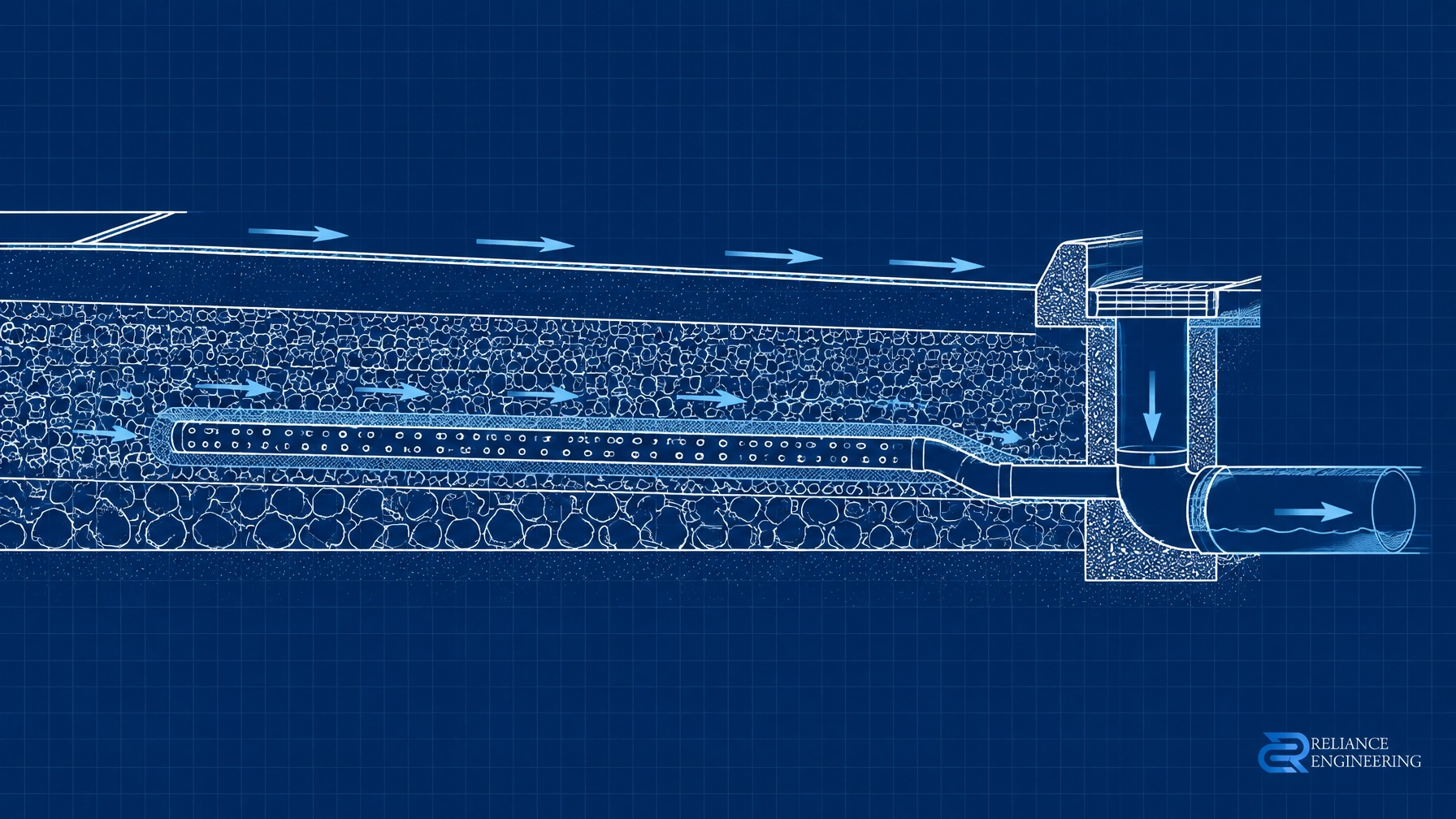
- Underground tanks
- Oversized storm pipes
- Surface detention areas
- Parking lot storage
- Roof storage
- Bioretention or Low Impact Development systems
- Combined surface and underground systems
Storage sizing should account for inflow, controlled outflow, water depth, available footprint, and emergency overflow. A simple volume comparison may not be sufficient because the outlet discharge changes as the water level changes.
For this reason, the report should include routing results that demonstrate:
- Peak inflow for each design storm
- Maximum controlled outflow
- Required storage
- Provided storage
- Maximum hydraulic grade or water level
- Drawdown or release characteristics
- Emergency overflow route

Orifice and Outlet Controls Must Be Practical
An orifice or outlet structure is often used to restrict discharge to the allowable release rate. Its diameter, invert elevation, head condition, and downstream connection must work together.
The outlet design should be coordinated with:
- Proposed grading
- Storm sewer inverts
- Maintenance access
- Surface or underground storage
- Emergency overflow elevations
- Construction tolerances
- Safety requirements
- Downstream municipal infrastructure
An outlet that works mathematically but cannot be installed, inspected, or maintained is not a complete design.
Reliance Engineering focuses on practical controls, clean layouts, and constructible routing. The report and drawings should tell the contractor exactly how the storage and outlet system relates to the site.
Water Quality Control Must Be Explicit
Quantity control limits peak discharge. Quality control addresses pollutants carried by runoff.
Depending on the site and receiving environment, a water quality strategy may include:
- Oil-grit separators
- Enhanced grass swales
- Vegetated filter strips
- Bioretention areas
- Infiltration measures
- Wet ponds or extended detention
- Permeable surfaces
- Sediment and erosion protection
- Runoff volume reduction
Water quality targets are set by the applicable municipal and Conservation Authority criteria. Some projects require enhanced total suspended solids removal, while others include additional requirements for groundwater, temperature, erosion, infiltration, or sensitive receiving systems.
Low Impact Development should be reviewed where required. The report should explain the selected treatment approach, its performance, location, maintenance requirements, and relationship to the proposed grading and servicing design.
A reviewer should not have to infer how the treatment system works. The report should provide a direct explanation supported by calculations, design tables, and clean drawings.
Overland Flow Protects the Site and Adjacent Properties
Even when the minor storm sewer system is properly designed, major storm events may exceed the underground system. The SWM report and supporting drawings must show where excess runoff will travel.
An overland flow assessment should identify:
- Major flow routes
- Low points
- Grading transitions
- Emergency spill elevations
- Building entrance protection
- Rear and side yard drainage
- Adjacent property interfaces
- Safe discharge points
- Potential ponding areas
The objective is to provide a safe, continuous route that does not direct uncontrolled runoff toward buildings, neighbouring lots, retaining walls, or public infrastructure.
Overland flow must be coordinated with the site grading plan, drainage structures, storage system, and final site elevations. This is where coordinated design and buildable grading become essential.

The Four-Step SWM Report Process
1. Criteria Review
We review municipal comments, project drawings, receiving systems, watershed requirements, Conservation Authority criteria, MECP considerations, and Site Plan Approval requirements.
Relevant technical references may include the Toronto Wet Weather Flow Management Guidelines, TRCA Stormwater Management Criteria, and applicable local standards. Requirements vary across Ontario and must be confirmed for the project location.
2. Hydrologic Analysis
We establish pre- and post-development drainage areas, runoff coefficients, design storms, peak flows, and receiving system conditions.
The analysis must be transparent. Clear calculations and organized summary tables make it easier for municipal and Conservation Authority reviewers to verify the work.
3. SWM Design
We size storage, orifices, outlet controls, water quality measures, LID features, and overland flow routes. The design is coordinated with grading, site servicing, building locations, access routes, and constructible site constraints.
4. Report Submission
We prepare the SWM report, design recommendations, summary tables, supporting drawings, and responses to review comments. Our complete support continues through the approval process where revisions or clarifications are required.

What Helps Reduce Resubmission Cycles
Municipal and Conservation Authority reviews are more efficient when the submission clearly answers the following:
- What is the applicable allowable release rate?
- How was the rate calculated?
- Does storage control all required design storms?
- Is the outlet sized and located correctly?
- Are water quality targets identified?
- Is LID reviewed where required?
- Does the overland flow route protect adjacent properties?
- Are emergency overflow conditions shown?
- Are the SWM report and drawings coordinated?
- Do the recommendations match the construction documents?
A technically sound report can still attract comments if its tables, plans, and calculations do not align. Clean layouts, consistent elevations, and coordinated design help reviewers confirm compliance without unnecessary interpretation.
Request an Ontario SWM Consultation
Reliance Engineering provides practical, approval-focused stormwater management solutions across Ontario. We prepare SWM reports with clear calculations, municipal experience, practical controls, and complete support through review.
Request a consultation to discuss allowable release rates, storage sizing, water quality controls, overland flow, or Site Plan Approval requirements.
Contact and Professional Credentials
Reliance Engineering Canada Limited
6850 Millcreek Dr, Mississauga, ON L5N 2H4
Phone: 647-385-6418
Email: [email protected]
Office hours:
Monday–Friday: 9:00 AM–5:00 PM
Saturday: 12:00 PM–2:00 PM
Sunday: Closed
Naresh Ochani, P.Eng. M.Eng.
PEO Certificate of Authorization: 100548882
Authorized by the Association of Professional Engineers of Ontario to offer professional engineering services.