Article type: Practical engineering guide
Service focus: Commercial grading, drainage, and erosion and sediment control
Service area: Ontario
Published by: Reliance Engineering Canada Limited
Commercial grading projects can lose time when sediment reaches roads, catchbasins, storm sewers, or neighbouring properties. A practical Erosion and Sediment Control (ESC) Plan helps prevent these problems while supporting municipal approvals and orderly construction.
For commercial sites, ESC controls must work with the grading and drainage design. They should not be added as standard notes after the civil drawings are complete. The control locations, drainage paths, construction access, and maintenance requirements must reflect how the site will actually be built.
Reliance Engineering provides practical, buildable, drainage-aware civil designs and approval support across Ontario. Our Erosion and Sediment Control Plans are coordinated with Site Grading Plans, servicing, stormwater management, and site plan approval requirements.
Why ESC Plans Matter on Commercial Sites
Commercial grading projects often expose large areas of soil. Parking lots, access roads, building pads, service connections, and storm infrastructure may be constructed at different stages.
Without proper controls, rainfall can carry sediment toward:
- Catchbasins and storm sewer systems
- Municipal roads and sidewalks
- Adjacent properties
- Ditches, watercourses, and natural areas
- Completed portions of the development
Sediment discharge can result in blocked infrastructure, site complaints, inspection deficiencies, municipal enforcement, and construction delays. It can also create rework when a poorly controlled site loses its intended grades or drainage routes.
A coordinated ESC Plan helps keep sediment on site, protects public infrastructure, and gives contractors clear installation and maintenance instructions.
ESC Controls Must Follow the Grading Design
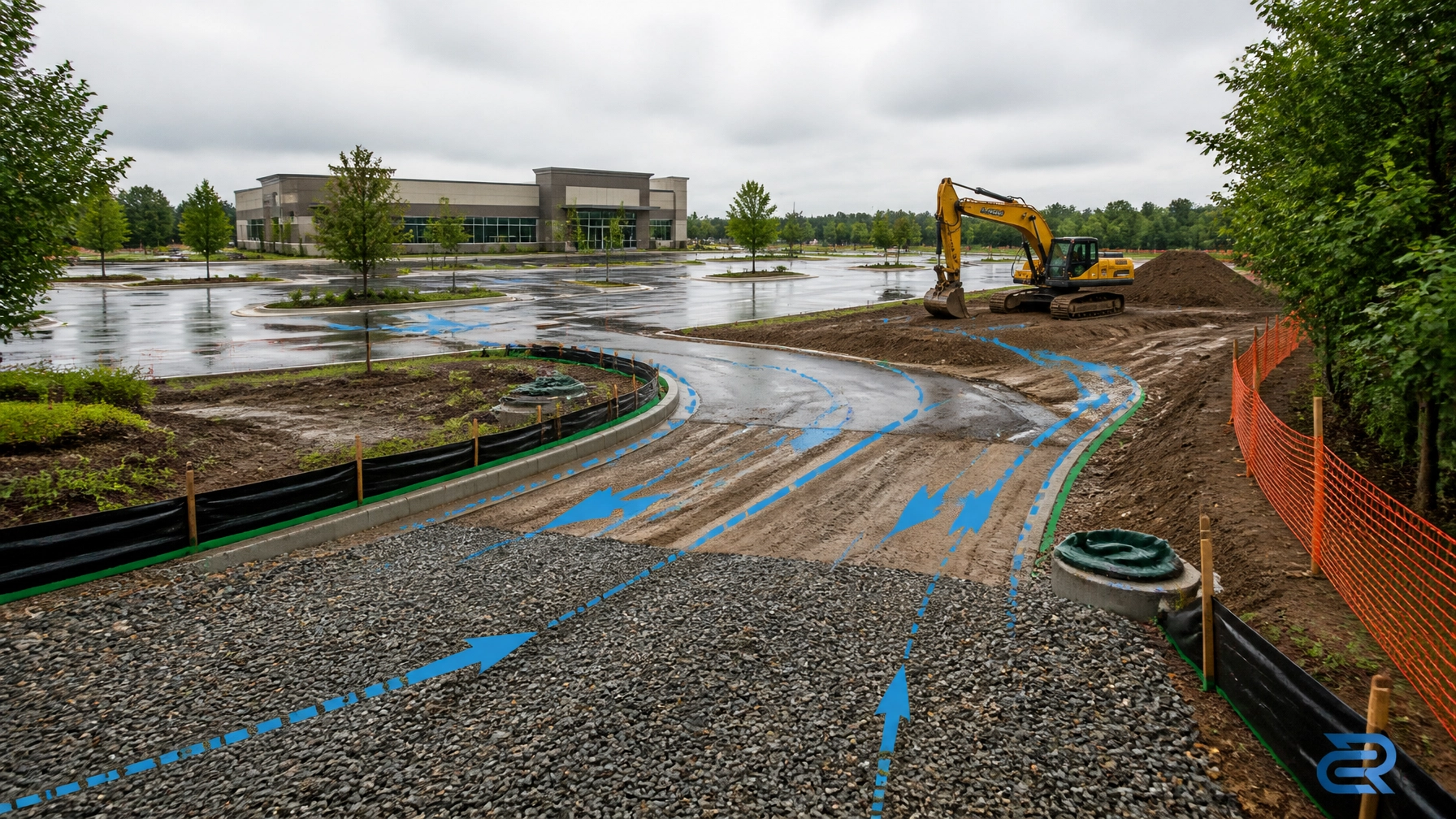
The most effective ESC plans begin with a clear understanding of existing and proposed grades. Controls should follow the direction of runoff and protect the receiving points identified in the civil design.
A drainage-focused ESC design considers:
- Positive drainage away from buildings and vulnerable areas
- Temporary and permanent overland flow routes
- Low points, catchbasins, swales, and storm connections
- Phased construction and changing drainage areas
- Stable outlets for temporary discharge
- Tie-ins to roads, ditches, and adjacent properties
- Construction access and vehicle movement
This coordination is especially important when addressing commercial parking lot drainage Ontario projects. Temporary runoff paths may change as subgrade, curbs, asphalt, and storm structures are installed. The ESC measures must remain effective through each stage.
Key Controls for Commercial Grading Projects
Catchbasin Protection
Catchbasins can quickly become sediment collection points during construction. Every affected inlet should be reviewed and protected using an appropriate method for the site conditions.
A permit-ready ESC drawing should identify:
- Catchbasins requiring temporary protection
- The type and location of inlet protection
- Bypass or overflow considerations
- Inspection and cleaning requirements
- Removal timing after surrounding areas are stabilized
Protection must not create unintended flooding or direct concentrated flow toward buildings, roadways, or unsafe areas. It should be inspected regularly for clogging, damage, bypassing, and sediment accumulation.

Mud Mats and Stabilized Construction Access
Construction vehicles can track soil onto public roads, particularly where access routes cross exposed subgrade or wet areas. A stabilized construction entrance with a properly sized mud mat helps reduce tracking and protects adjacent roads.
The ESC Plan should show:
- The construction entrance location
- Mud mat or granular stabilization limits
- Vehicle access direction
- Drainage controls near the entrance
- Maintenance and replacement requirements
The entrance must be practical for the equipment using the site. A control that cannot handle truck traffic or that sits in a low, ponding area will not perform as intended.
Silt Fencing
Silt fencing is useful for controlling sediment carried by sheet flow. It should be placed along the downslope edge of disturbed areas, around selected stockpiles, and near construction limits where appropriate.
Silt fencing should not be used as a substitute for a properly designed temporary swale or channel. It is not intended to manage concentrated flow.
The plan should identify:
- Fence alignment and limits
- Installation details
- Low points and potential bypass locations
- Access for inspection and maintenance
- Locations where additional controls may be required
Fencing must be installed correctly, including proper anchoring and trenching. Damaged, sagging, undercut, or overtopped fencing should be repaired promptly.
Sediment Traps and Check Dams
Sediment traps and check dams can reduce flow velocity and allow sediment to settle before runoff reaches a downstream control or outlet.
Their locations should be based on the drainage area and temporary grading plan. The ESC drawings should show the contributing area, inlet, outlet, access for cleanout, and stabilization requirements.
Controls should be sized and detailed according to applicable municipal, conservation authority, and project requirements. A sediment trap that is too small, poorly located, or difficult to maintain will not provide reliable protection.
Stockpile Protection
Soil stockpiles can become a major source of sediment if they are located in flow paths or left unprotected during rainfall.
Practical stockpile controls may include:
- Silt fencing around the downslope perimeter
- Covers or temporary stabilization
- Berms or diversion measures
- Separation from catchbasins and drainage routes
- Defined access for loading and removal
The stockpile location should be coordinated with construction staging. It should not block an approved overland flow route or create a new drainage problem.

Dewatering Notes
Excavation for foundations, servicing, storm sewers, and utility connections may require dewatering. Pumping muddy or sediment-laden water directly to a catchbasin, road, ditch, or neighbouring property is not an acceptable drainage solution.
Dewatering notes should address:
- The proposed discharge location
- Sediment bags, settling tanks, or other treatment measures
- Stable outlet protection
- Inspection of the pump and discharge system
- Procedures for stopping discharge if controls fail
- Required approvals or additional requirements
The discharge must be directed to a stable, protected location. The appropriate method depends on the expected flow, sediment load, site conditions, and receiving system.
Construction-Limit Fencing
Construction-limit fencing helps identify the approved disturbance area and protects lands that are not intended to be graded or disturbed.
It can help protect:
- Existing vegetation
- Adjacent properties
- Watercourses and natural areas
- Easements and municipal lands
- Permanent drainage features
Fencing should be installed before major construction activity begins and maintained until the relevant portion of the site is stabilized.
Inspection and Maintenance Keep Controls Effective
An ESC Plan is not complete when the drawing is issued. Controls must be inspected and maintained throughout construction.
Inspection requirements should address:
- Silt fence condition and sediment buildup
- Catchbasin protection and inlet performance
- Mud mat cleanliness and access stability
- Sediment trap and check dam capacity
- Stockpile covers and perimeter controls
- Dewatering equipment and discharge points
- Evidence of off-site sediment tracking
- Damage after rainfall or construction activity
Inspections should be completed at the frequency required by the municipality, conservation authority, permit, or applicable regulation. Additional inspections are typically needed after significant rainfall and during active grading.
Inspection records should identify the date, weather conditions, person completing the inspection, observed deficiencies, and corrective actions. Maintenance should be completed promptly, not after sediment has already reached public infrastructure.
ESC Supports Better Grading and Drainage Outcomes
A well-coordinated ESC Plan can also help resolve existing drainage concerns. For example, asphalt regrading, temporary drainage improvements, and construction staging may be required where a commercial parking lot has low points or uncontrolled runoff.
When reviewing ponding solutions or commercial property grading fixes, the civil design should consider both construction-period controls and the final drainage condition. Temporary measures should not interfere with the final grading plan, storm sewer layout, accessible routes, fire access, or building entrances.
Reliance Engineering coordinates ESC with:
- Site grading and drainage plans
- Site servicing plans
- Stormwater management reports
- Functional servicing reports
- Site plan approval drawings
- Building permit drawings
- OPA/ZBA and severance application drawings, where applicable
The result is a clear, coordinated civil package that supports municipal review and field construction.

Prepare Permit-Ready ESC Drawings
Commercial projects need more than generic erosion control notes. They need clear drawings that show where controls go, how runoff will move, and how the controls will be inspected and maintained.
Reliance Engineering prepares practical ESC plans with:
- Control locations and installation details
- Construction access and mud mat requirements
- Catchbasin and storm inlet protection
- Silt fencing and construction-limit fencing
- Sediment traps, check dams, and stockpile controls
- Dewatering notes and discharge protection
- Inspection and maintenance notes
- Coordination with grading, servicing, and stormwater design
- Engineer-stamped, permit-ready drawings
Our team provides approval support and responds to municipal or conservation authority comments when required. With more than 20 years of principal engineer experience and detailed knowledge of Ontario municipal requirements, we help clients move from design to approval with fewer avoidable delays.
Request an ESC Plan Consultation
If your commercial project requires grading, drainage, parking lot work, site plan approval, or construction-phase sediment protection, contact Reliance Engineering before construction begins.
We provide practical designs, clear drawings, buildable grading, and approval support across Ontario.
Naresh Ochani, P.Eng. M.Eng.
PEO Certificate of Authorization: 100548882
Reliance Engineering Canada Limited
6850 Millcreek Dr, Mississauga, ON L5N 2H4
Phone: 647-385-6418
Email: [email protected]
Office hours: Monday–Friday 9:00 AM–5:00 PM; Saturday 12:00 PM–2:00 PM; Sunday Closed
Request a consultation for expert advice on your commercial grading and erosion control requirements.