Published: September 1, 2026 at 2:00 PM ET
Article type: Expert guide
Primary topic: Functional Servicing Reports
Service area: Ontario
A proposed development may look straightforward on paper. The servicing strategy is often more complex.
Before detailed civil design proceeds, municipalities need confidence that the site can connect to available water, sanitary, and storm infrastructure. They also need to understand whether existing systems have sufficient capacity and whether upgrades will be required.
A Functional Servicing Report (FSR) provides that assessment.
It outlines how a proposed development will be serviced, identifies infrastructure constraints, and gives municipal reviewers a clear basis for evaluating the application. For developers, architects, and property owners, it is an important planning document that can identify major servicing risks before significant money is spent on detailed design.
What a Functional Servicing Report Does
A functional servicing report is the connection between a development concept and a practical civil engineering solution.
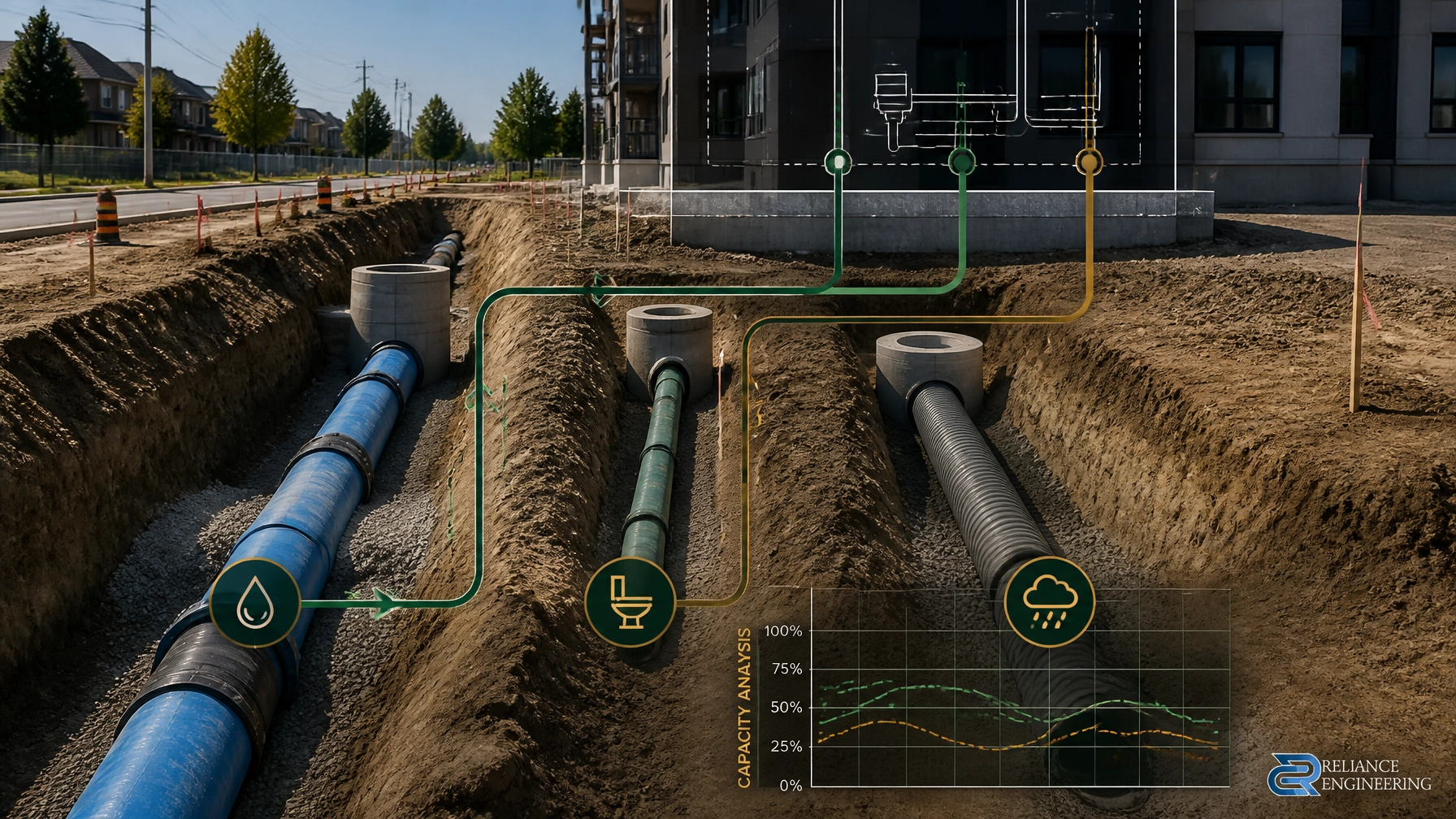
The report reviews existing municipal infrastructure and evaluates the proposed development’s anticipated demands. It then presents a servicing strategy for:
- Potable water supply
- Sanitary sewage collection
- Storm drainage and stormwater management
- Proposed municipal connection points
- Required pipe sizing and routing
- Infrastructure capacity and potential upgrades
The objective is not simply to describe where pipes may go. A properly prepared FSR confirms whether the development can be supported by available infrastructure and identifies the work needed to make the proposal viable.
This information supports municipal approvals, including site plan approval, rezoning, official plan amendment, severance and consent applications, and larger development applications.
Why Servicing Must Be Confirmed Early
A weak servicing strategy can create problems long before construction begins.
If water demand is underestimated, sanitary capacity is not addressed, or storm drainage is treated as an afterthought, the municipality may issue avoidable comments or request additional analysis. The result can be:
- Delayed planning approvals
- Repeated technical submissions
- Capacity concerns from municipal reviewers
- Changes to building layouts or site density
- Conflicts with grading and fire access
- Costly redesign of detailed engineering drawings
- Delays to building permit or construction schedules
These issues are easier and less expensive to resolve during the planning stage.
A strong FSR gives municipalities confidence that the proposed development can be supported. It also gives the project team a clear direction before site servicing plans, grading plans, stormwater controls, and permit-ready drawings are finalized.
The Core Components of an Ontario FSR
The exact requirements vary by municipality and project type. However, a complete functional servicing report generally addresses the following areas.
1. Existing Municipal Infrastructure Review
The first step is understanding what already exists.
Reliance Engineering reviews available surveys, record drawings, municipal information, utility data, previous reports, and planning documents. The assessment typically considers:
- Existing watermains near the property
- Sanitary sewer locations and available connection points
- Storm sewer systems, outlets, and drainage patterns
- Existing pipe sizes, elevations, and inverts
- Easements and rights-of-way
- Known downstream constraints
- Existing grades and overland flow routes
This review establishes the conditions that the proposed development must work within. It also identifies missing information that may need to be confirmed with the municipality or through field investigation.
2. Water Demand and Fire Flow Review
The report calculates the expected water demand based on the proposed land use, building type, occupancy, and development intensity.
Where required, the FSR also includes a fire flow review. This helps determine whether the existing water system can provide the required supply for fire protection while maintaining acceptable operating conditions.
The review may identify the need for:
- A larger water service
- A different connection point
- Additional looping or redundancy
- A hydrant or fire protection review
- Municipal watermain upgrades
- Confirmation of available pressure and flow
The recommendation must be practical and coordinated with the building design, fire access, utility layout, and future site servicing plans.
3. Sanitary Flow Calculations
Sanitary servicing must be sized for the proposed development and evaluated against the receiving municipal system.
Sanitary flow calculations consider the proposed use and expected population or occupancy. The FSR then discusses the connection point, available downstream capacity, and whether the municipal system can receive the additional flow.
Recommendations may address:
- Sanitary service size
- Connection location
- Sewer slope and invert requirements
- Manhole locations
- Servicing constraints caused by site grades
- Pumping or special infrastructure requirements
- Required downstream upgrades
The goal is to provide a sanitary strategy that is technically supportable and constructible. A connection that appears possible in plan view may not work once elevations, basement levels, road grades, and municipal sewer inverts are reviewed.
4. Storm Drainage Strategy
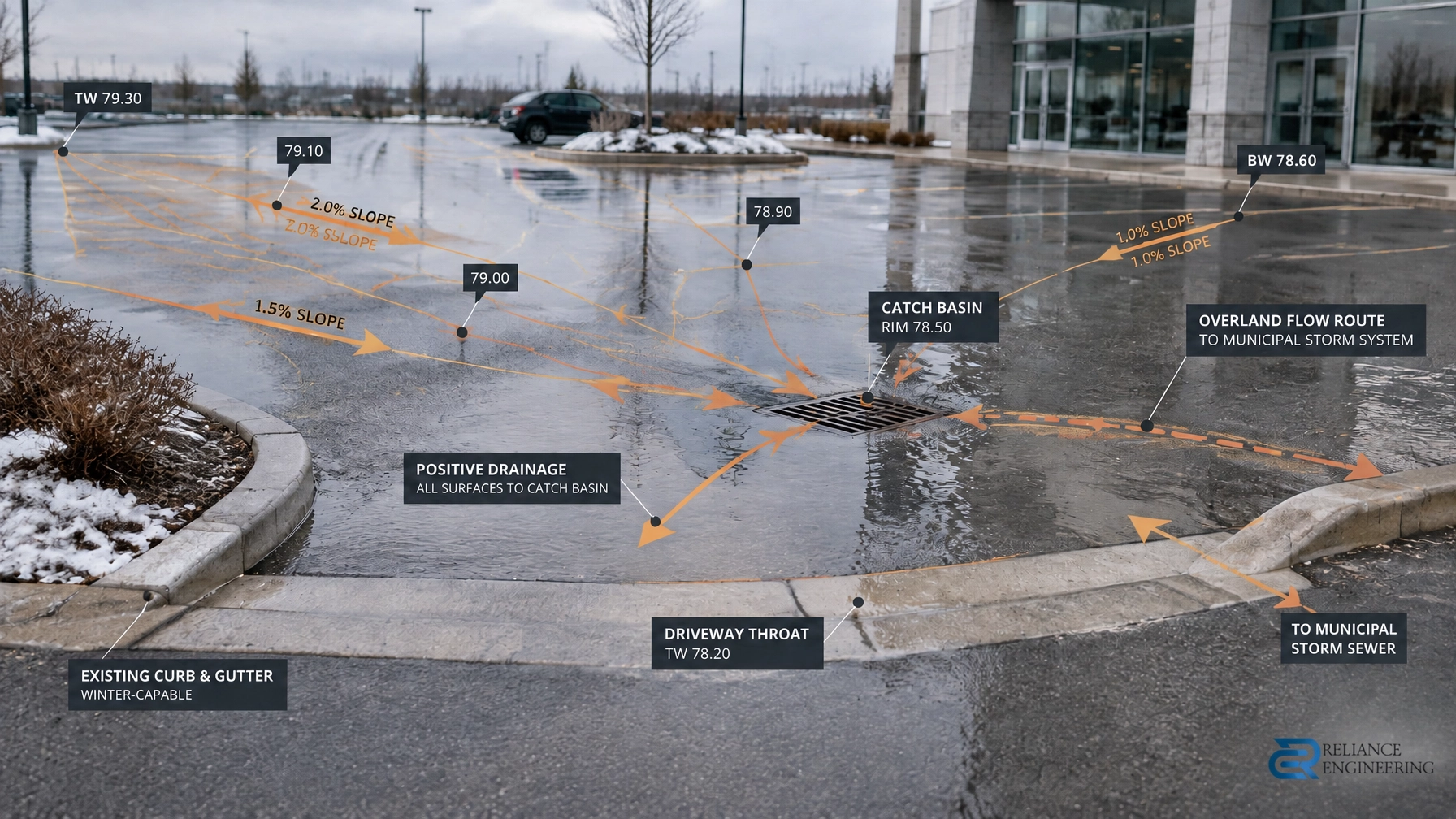
Storm drainage must be considered together with grading, site coverage, municipal capacity, and the receiving outlet.
A functional servicing report typically describes how stormwater will be collected, conveyed, controlled, treated, and released. Depending on the project, the strategy may include:
- Storm sewer connections
- Site storage
- Quantity control
- Water quality treatment
- Low Impact Development measures
- Overland flow routes
- Erosion protection
- Oil-grit separators
- Infiltration or water balance considerations
This is where an FSR connects directly with Stormwater Management Reports in Ontario. A stormwater strategy must meet municipal criteria and remain compatible with the available site area, grading limits, landscape requirements, and building footprint.
Practical controls are important. Storage and outlet structures must not only satisfy calculations; they must also fit the site and remain feasible to build and maintain.

How the FSR Coordinates With Site Servicing Plans
The FSR is not a replacement for detailed drawings. It establishes the servicing concept that detailed drawings will develop.
Site servicing plans show the precise layout of water, sanitary, and storm services. They include pipe sizes, slopes, inverts, connection details, cleanouts, manholes, valves, meters, chambers, easements, and construction notes.
The FSR and servicing plans must agree on:
- Proposed connection points
- Service sizes
- Routing and separation
- Elevations and available slopes
- Stormwater discharge approach
- Municipal infrastructure assumptions
- Required upgrades
- Utility and easement constraints
Early coordination prevents conflicts between civil, architectural, structural, landscape, and mechanical designs.
Reliance Engineering prepares clean layouts, coordinated design packages, and constructible routing that support both municipal review and future construction. The objective is a servicing strategy that works in the report, on the drawing, and in the field.
What Municipal Reviewers Need to See
Municipal reviewers need more than general statements that services are “available.” They need clear calculations, defensible assumptions, and practical recommendations.
An approval-focused report should clearly explain:
- What existing infrastructure is available.
- What demand the proposed development will create.
- Where each service will connect.
- Whether available capacity is adequate.
- What assumptions were used.
- Whether upgrades or further studies are required.
- How the strategy will be carried into detailed design.
- What conclusions support the application.
Clear conclusions help reduce uncertainty during review. If a limitation exists, it should be identified early with a reasonable solution. Concealing or postponing a capacity concern usually creates more delay later.
When an FSR May Be Required
A functional servicing report may be requested for:
- Site plan approval projects
- OPA and ZBA applications
- Townhouse developments
- Apartment buildings
- Commercial and industrial facilities
- Institutional projects
- Infill developments
- Severance and consent applications
- Plan of subdivision applications
- Major redevelopment sites
Requirements depend on the municipality, project scale, servicing conditions, and proposed changes to the site. Some projects may require coordination with regional agencies, conservation authorities, or provincial approval processes.
An experienced engineer can confirm the expected submission requirements before the design advances.

Reliance Engineering Prepares Practical, Approval-Focused Reports
Reliance Engineering provides civil engineering services across Ontario for land development and municipal approval projects.
Our FSR process includes:
- Background and site information review
- Existing municipal infrastructure assessment
- Water demand calculations
- Fire flow review where required
- Sanitary flow calculations
- Storm drainage and servicing strategy
- Capacity discussion and upgrade recommendations
- Coordination with site grading and servicing plans
- Clear report conclusions for municipal review
- Support with revisions and technical comments
Our approach combines municipal experience with practical design judgment. We focus on clear drawings, coordinated design, buildable grading, and recommendations that support the actual development: not just the submission.
When comments arise, our team provides fast comment response and works to keep the FSR, stormwater management report, site servicing plans, and related approval documents aligned.
Confirm Servicing Before Detailed Design
The right time to identify a servicing constraint is before detailed design, not after a municipal submission or during construction.
A properly prepared functional servicing report can confirm whether the site is serviceable, identify required upgrades, and provide a clear path toward municipal approval. It can also prevent changes to the building footprint, grading, stormwater controls, and utility layout later in the process.
If you are planning a development in Ontario, contact Reliance Engineering for a free consultation about your functional servicing requirements.
Request a free consultation or speak with our team at 647-385-6418.
Contact Reliance Engineering
Reliance Engineering
6850 Millcreek Dr
Mississauga, ON L5N 2H4
Phone: 647-385-6418
Email: [email protected]
Office hours: Saturday 12:00 PM–2:00 PM; Sunday Closed.
Principal Engineer: Naresh Ochani, P.Eng. M.Eng.
PEO Certificate of Authorization: 100548882