Article type: Technical thought leadership and approval guide
Primary keyword: stormwater management reports Ontario
Secondary keywords: municipal approvals, site servicing plans, functional servicing report
Service area: Ontario
Last updated: August 20, 2026
Why Stormwater Management Reports Matter
A development changes how water moves across a property. New roofs, driveways, parking areas, roads, and compacted surfaces can increase runoff and reduce natural infiltration. Without proper controls, the additional flow may create flooding risk, overload municipal infrastructure, affect adjacent properties, or cause erosion downstream.
This is why municipalities and conservation authorities often require a professional stormwater management report as part of the development approval process.
A clear report does more than present calculations. It explains how stormwater will be collected, controlled, treated, stored, and safely released after construction. It also shows that the proposed solution works with the grading, servicing, building, and site layout.
Stormwater Management Reports prepared by Reliance Engineering are designed for residential, commercial, industrial, and institutional projects across Ontario. Our approach combines clear calculations, practical controls, and municipal experience to support efficient review.
What an Ontario Stormwater Management Report Should Demonstrate
Municipal reviewers need to understand the difference between existing site conditions and the proposed development. A complete SWM report should clearly address:
- Existing and proposed drainage patterns
- Pre-development and post-development catchment areas
- Runoff coefficients by surface type
- Peak flow calculations for applicable design storms
- Required storage volumes
- Allowable release rates
- Orifice and outlet control sizing
- Water quality treatment
- Low Impact Development, or LID, opportunities
- Overland flow routes
- Downstream infrastructure and adjacent property impacts
- Erosion and sediment control during construction
- Summary tables showing compliance with applicable criteria
The report should connect every proposed control to a specific design objective. For example, a storage facility should show how much water it holds, how the outlet limits discharge, and how the final release rate compares with the allowable municipal rate.
A report that is difficult to follow can create unnecessary review comments. A report with clear calculations and labelled conclusions gives reviewers the information they need to make decisions.
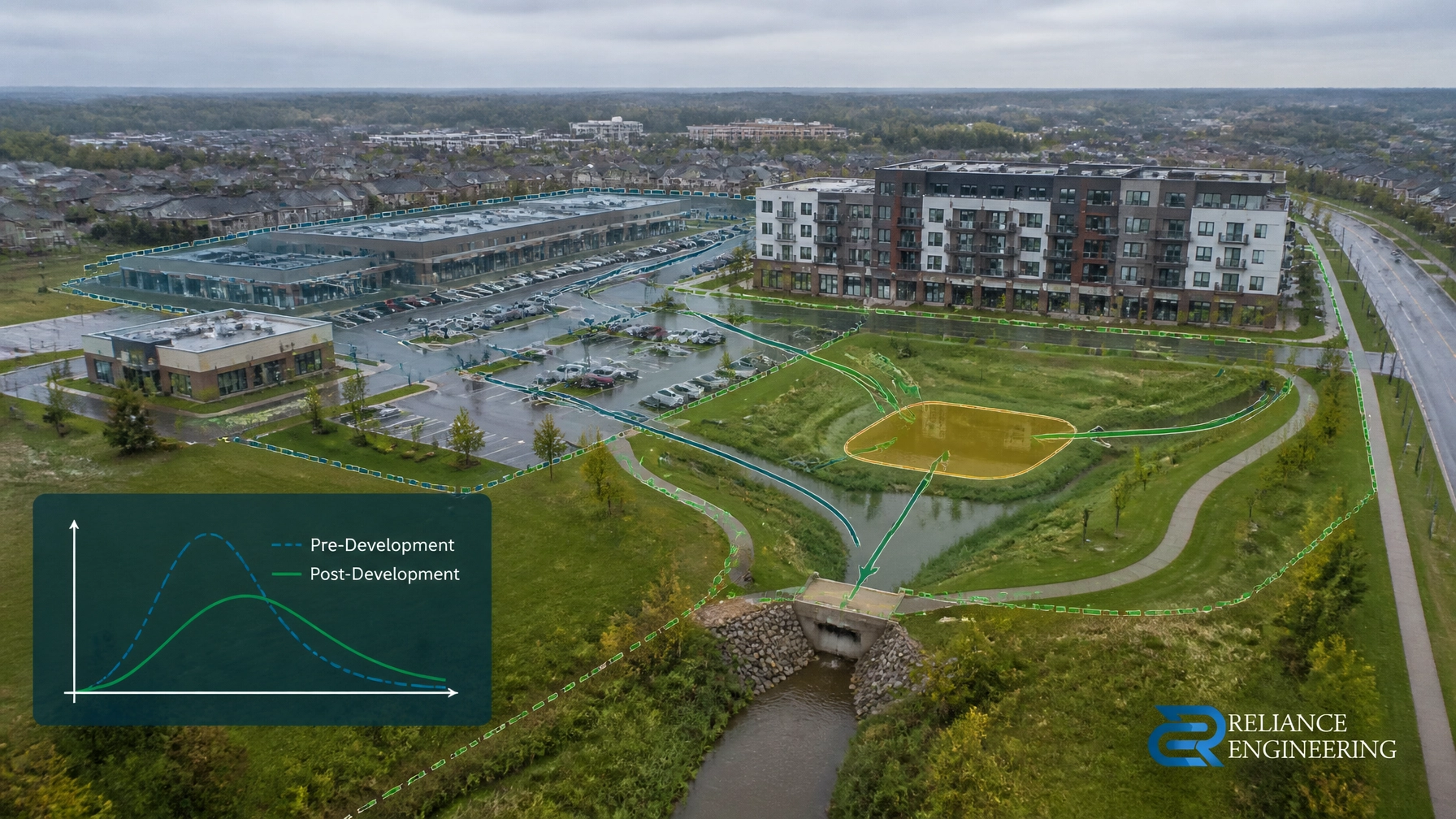
Pre-Development and Post-Development Drainage Analysis
The first step is understanding how water currently leaves the property.
The pre-development analysis typically considers existing buildings, paved areas, landscaped surfaces, slopes, soil conditions, drainage divides, existing storm infrastructure, and receiving outlets. The site is divided into drainage catchments so that runoff can be evaluated at the correct points.
The post-development analysis then considers the proposed building footprint, parking areas, driveways, landscaped areas, grading, storm sewer system, and stormwater facilities. The proposed surfaces may have a higher runoff response than existing conditions, particularly where permeable ground is replaced with roofs and pavement.
This comparison establishes whether the development will increase runoff volume or peak discharge. It also identifies where quantity control, quality treatment, LID measures, or additional conveyance capacity may be required.
A reliable analysis must use consistent assumptions. Catchment areas, slopes, surface percentages, runoff coefficients, rainfall data, time of concentration, and routing parameters should be documented clearly. When assumptions are visible, municipal reviewers can assess the work efficiently.

Runoff Coefficients and Peak Flow Calculations
Runoff coefficients describe how much rainfall becomes surface runoff from different parts of a site. Roofs and pavement generally produce more direct runoff than landscaped areas. The selected values must be appropriate for the surface type, slope, soil conditions, and applicable municipal criteria.
For composite catchments, the report should show how the weighted runoff coefficient was calculated. This makes the result traceable and helps confirm that the post-development model reflects the proposed site design.
Peak flow calculations are equally important. They help determine whether the proposed development will send more water toward a municipal storm sewer, drainage ditch, outlet, or neighbouring property than the receiving system can safely accept.
The methodology may vary by project. Depending on the site and authority requirements, the analysis may use the Rational Method or a hydrologic model. The report should state the selected method, design storm assumptions, rainfall information, and key parameters.
A professional SWM report should compare:
- Pre-development peak flows
- Uncontrolled post-development peak flows
- Controlled post-development peak flows
- Applicable allowable release rates
- Storage requirements for each relevant design condition
The final results should be summarized in clear tables rather than left only in model files or calculation sheets.
Quantity Control: Storage, Release Rates, and Outlets
Quantity control limits the rate at which stormwater leaves the site. This helps protect downstream infrastructure and reduces the risk of flooding or erosion.
Depending on the site, quantity control may include:
- Underground detention tanks or chambers
- Oversized storm sewer storage
- Parking lot or rooftop storage
- Dry or wet stormwater management facilities
- Surface storage within landscaped areas
- Orifice plates
- Control structures
- Weirs and outlet pipes
- LID features that retain or infiltrate runoff
The report must show how the required storage was established and how the proposed outlet performs under the applicable storm events. Orifice and outlet control sizing should account for the relationship between water depth, opening size, discharge, and available storage.
The design must also consider what happens when the minor storm system is exceeded. An overland flow assessment confirms that emergency runoff can move safely through the site without entering buildings, causing unsafe ponding, or directing water toward adjacent properties.
Practical controls are important. A theoretically compliant solution may not be suitable if it conflicts with building foundations, utilities, parking, landscaping, fire access, or construction requirements. The best design is one that meets criteria and remains buildable.
Water Quality Treatment and LID Review
Stormwater carries sediment, oils, metals, nutrients, and other pollutants from roofs, roads, parking areas, and exposed construction surfaces. A stormwater management report should identify the appropriate water quality treatment strategy for the project.
Depending on the site and applicable criteria, treatment may include:
- Oil-grit separators
- Wet ponds
- Dry ponds
- Constructed wetlands
- Filtration systems
- Bioretention areas
- Bioswales
- Permeable pavement
- Infiltration trenches
- Rain gardens
- Green roofs
Some sites require a treatment train using more than one measure. For example, runoff may pass through a pretreatment device before reaching a bioretention area or larger stormwater facility.
LID review should be integrated with the overall civil design. Infiltration and retention measures must be coordinated with grading, groundwater conditions, soils, foundations, utilities, and maintenance access. They should not be added as an isolated feature after the site has already been designed.
The report should explain what LID measures were reviewed, which measures are proposed, and how they support water balance, water quality, or quantity control objectives.

Coordination With Site Servicing Plans and the Functional Servicing Report
Stormwater management is not separate from the rest of the civil design.
The SWM report should coordinate with the site grading plan and site servicing plans. Storm sewer locations, pipe sizes, slopes, inverts, storage areas, outlet controls, and overland flow routes must work together.
The stormwater strategy should also be consistent with the functional servicing report. The FSR considers whether the proposed development can be supported by available water, sanitary, and storm infrastructure. The SWM report provides the detailed storm drainage analysis that supports that conclusion.
Coordination is especially important for:
- Site Plan Approval applications
- Commercial and industrial developments
- Townhouse and apartment projects
- Infill developments
- Parking lot expansions
- Rezoning and planning applications
- Building permit submissions
- Severance and redevelopment projects
When these documents are prepared as a coordinated design package, conflicts are identified earlier and municipal comments can be answered more directly.

Municipal and Conservation Authority Review
Ontario projects may be reviewed by the municipality, conservation authority, regional authority, or other agencies depending on the site and proposed work.
Reviewers may assess:
- Quantity control
- Water quality
- Erosion protection
- Water balance
- LID measures
- Downstream capacity
- Flooding and major system flow
- Construction-phase erosion and sediment control
- Operations and maintenance requirements
Applicable criteria vary by municipality, watershed, site context, and development type. Project teams should confirm requirements early and review the relevant technical guidance, such as the Lake Simcoe Region Conservation Authority Technical Guidelines or Grand River Conservation Authority guidelines for SWM submissions, where applicable.
Early criteria review reduces the risk of designing a system that must later be replaced. It also helps confirm whether the municipality requires a standalone SWM report, modelling files, detailed drawings, maintenance information, or additional supporting studies.
How Reliance Engineering Supports Approval-Focused SWM Design
Reliance Engineering prepares practical stormwater management reports for projects across Ontario. Our process includes:
- Criteria review : We review municipal and conservation authority requirements, available studies, and project comments.
- Hydrologic analysis : We assess existing and proposed drainage conditions, runoff coefficients, peak flows, and control targets.
- SWM design : We develop storage, outlet, quality treatment, LID, and overland flow solutions that fit the site.
- Coordinated documentation : We align the report with grading, servicing, and functional servicing documents.
- Submission support : We provide clear responses to review comments and assist through the approval process.
Our objective is straightforward: provide clear drawings, transparent calculations, practical controls, and approval support that help keep the project moving.
Discuss Your Stormwater Requirements
A professional stormwater management report protects the development, municipal infrastructure, neighbouring properties, and receiving environment. It also gives reviewers a clear technical basis for evaluating the application.
If you need a stormwater management report in Ontario, contact Reliance Engineering for practical advice on your project requirements.
Reliance Engineering
6850 Millcreek Dr, Mississauga, ON L5N 2H4
Phone: 647-385-6418
Email: [email protected]
Office hours: Monday–Friday 9:00 AM–5:00 PM; Saturday 12:00 PM–2:00 PM; Sunday Closed.
Naresh Ochani, P.Eng. M.Eng.
PEO Certificate of Authorization: 100548882
Request a consultation for expert guidance on SWM reports, site servicing plans, functional servicing reports, grading, and municipal approvals across Ontario.