Article type: Practical diagnostic and solution guide
Focus: Commercial parking lot drainage Ontario
Service area: Ontario
Estimated reading time: 6 minutes
Standing water in a commercial parking lot is not only a maintenance issue. It is usually evidence of a grading, drainage, or stormwater management problem.
Ponding can damage asphalt, accelerate freeze-thaw deterioration, create slippery conditions, obstruct accessible routes, and increase complaints from tenants, customers, and neighbouring property owners. Repeated ponding may also indicate that the existing drainage system is not working as designed.
A professional commercial property grading fix starts with understanding why water is collecting and how runoff should move across the site.
What Causes Ponding in a Commercial Parking Lot?
Common causes include:
- Settlement or failure of the asphalt base
- Inadequate pavement slopes
- Low points without catch basins or area drains
- Blocked or undersized storm inlets
- Incorrect catch basin elevations
- Changes made during resurfacing
- Snow storage placed in drainage areas
- Grading that directs water toward buildings or pedestrian routes
- Poor coordination between grading, storm sewers, landscaping, and site access
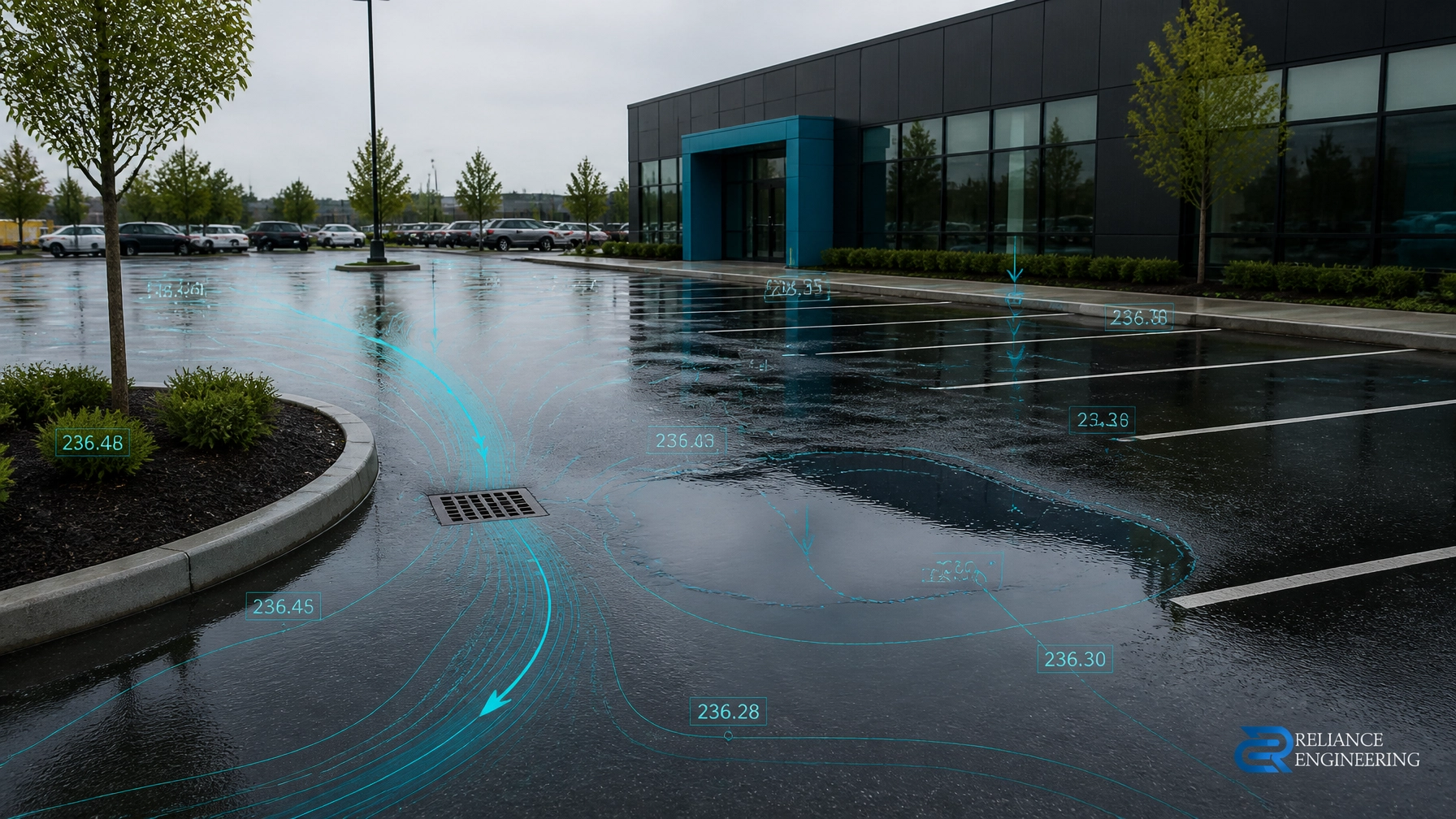
A parking lot can appear generally level while still containing small depressions that hold water. These low points may not be visible until after a significant rainfall or spring snowmelt.
Maintenance should always be checked first. However, if ponding returns after cleaning catch basins or completing surface repairs, the issue likely requires a proper engineering review.

Why Band-Aid Repairs Often Fail
Patching, milling, or adding asphalt may temporarily remove a depression. It does not necessarily correct the drainage pattern.
A surface repair can fail when:
- The surrounding pavement still drains toward the repaired area
- The catch basin is too high
- The low point has no positive outlet
- The storm sewer lacks capacity
- Finished elevations were not coordinated with building entrances
- The repair creates a new low point elsewhere
A reliable ponding solution must consider the entire parking lot, not only the visible puddle.
Reliance Engineering uses a drainage-focused approach that reviews existing grades, proposed elevations, inlet locations, storm connections, overland flow routes, and municipal requirements together.
The Site Grading Fix: Buildable Grading and Positive Drainage
A professional Site Grading Plan establishes how the parking lot should be shaped to move water safely and consistently.
The design typically reviews:
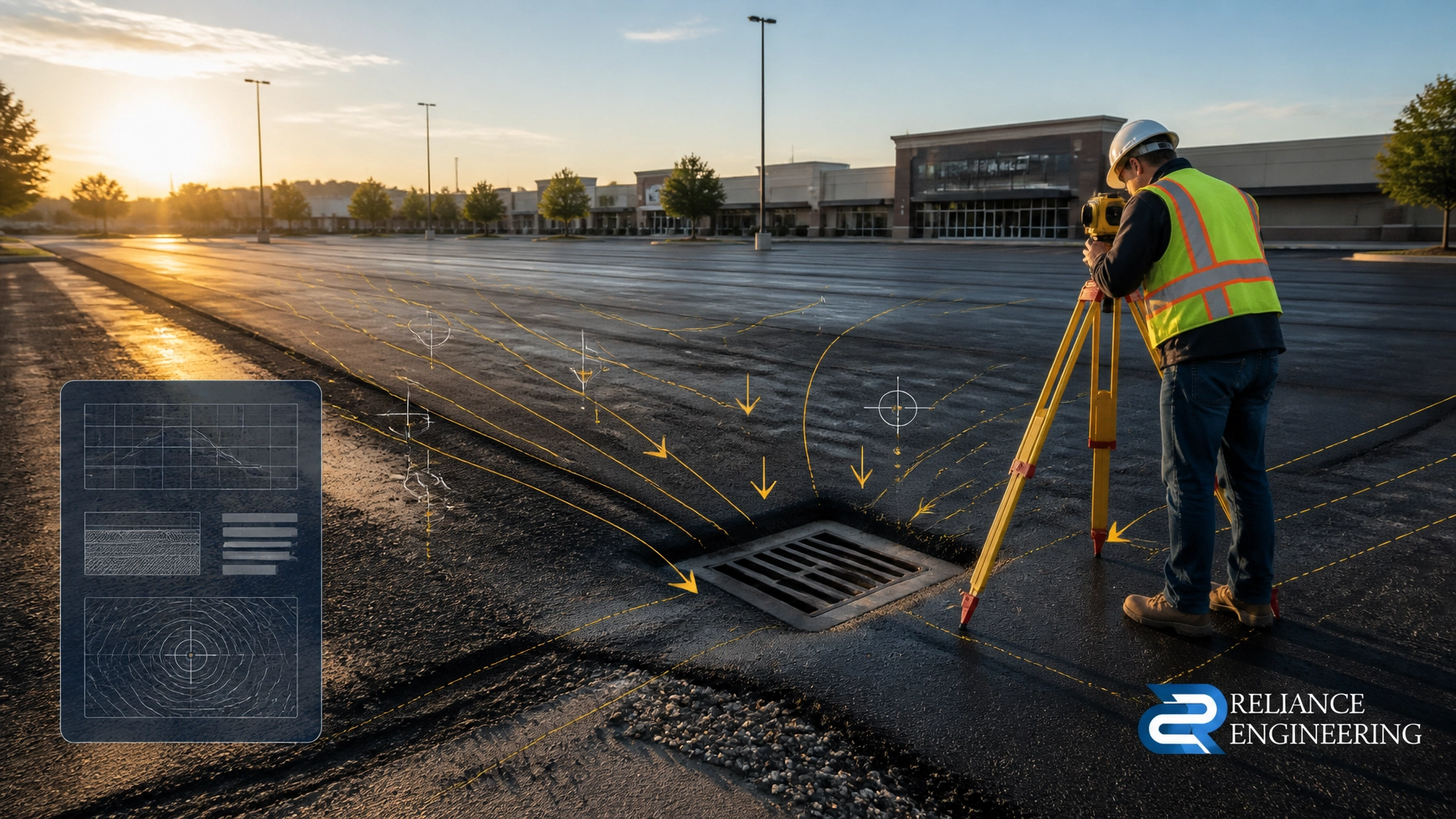
- Existing and proposed spot elevations
- Pavement slopes and cross-falls
- Drive aisle and parking stall grades
- Catch basin and area drain locations
- Building entrances and finished floor elevations
- Accessible routes and pedestrian areas
- Road, ditch, and property-line tie-ins
- Swales and landscaped drainage areas
- Emergency and overland flow routes
- Protection of adjacent properties
The objective is positive drainage: water should move toward a planned collection point or approved outlet without creating nuisance ponding.
Commercial parking lots commonly require enough slope to avoid surface storage during frequent rainfall and snowmelt. The exact criteria depend on the municipality, site conditions, pavement design, and stormwater strategy. Local engineering standards should always be confirmed before construction.
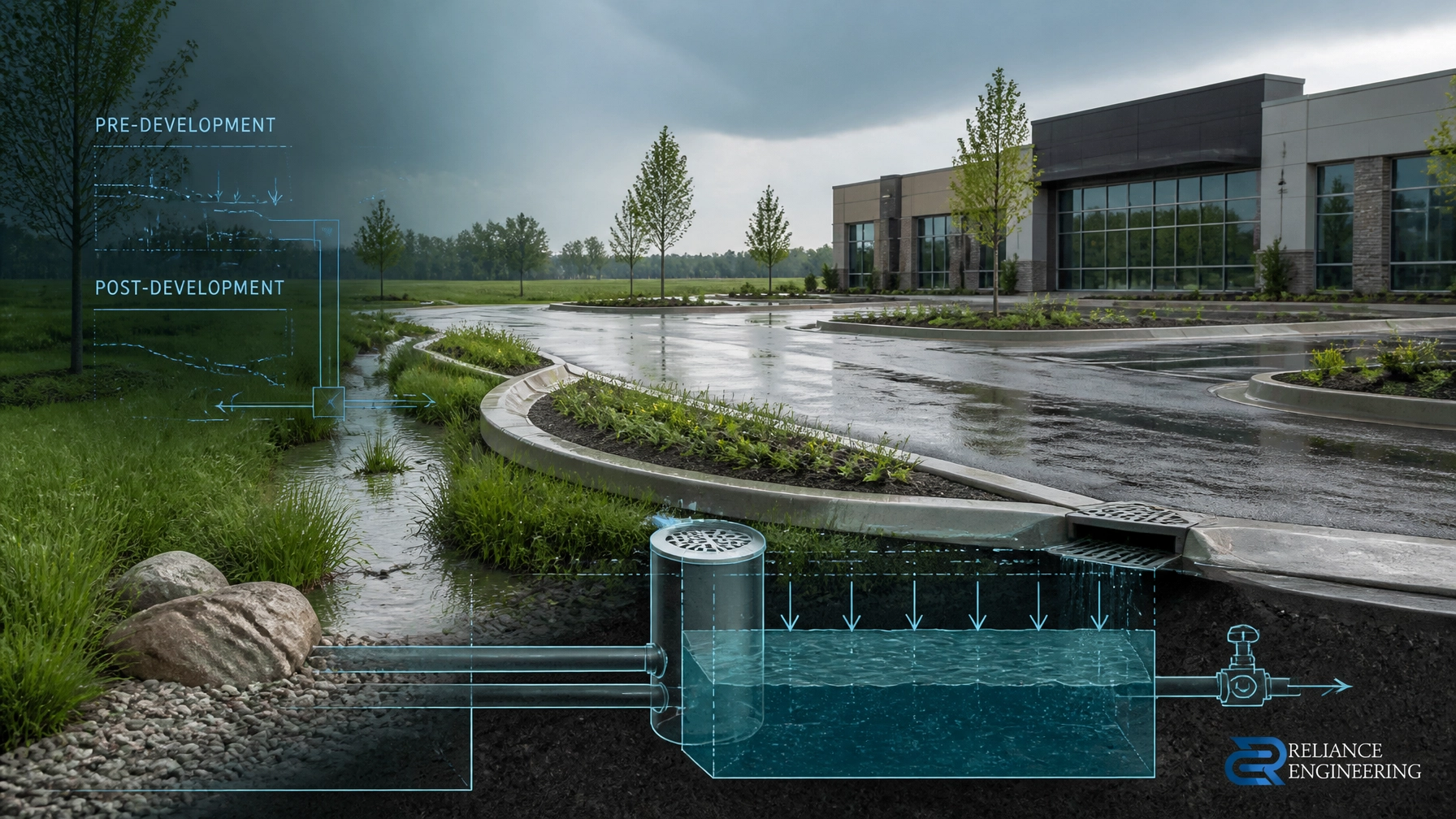
Where pavement cannot drain directly to the municipal system, the design may use landscaped areas, swales, underground storage, or other approved stormwater measures. Any intentional storage must be located and sized according to applicable municipal requirements.
Catch Basins and Storm Servicing Must Work Together
Ponding may be caused by grading, but it can also result from a problem in the storm servicing system.
A coordinated Site Servicing Plan reviews:
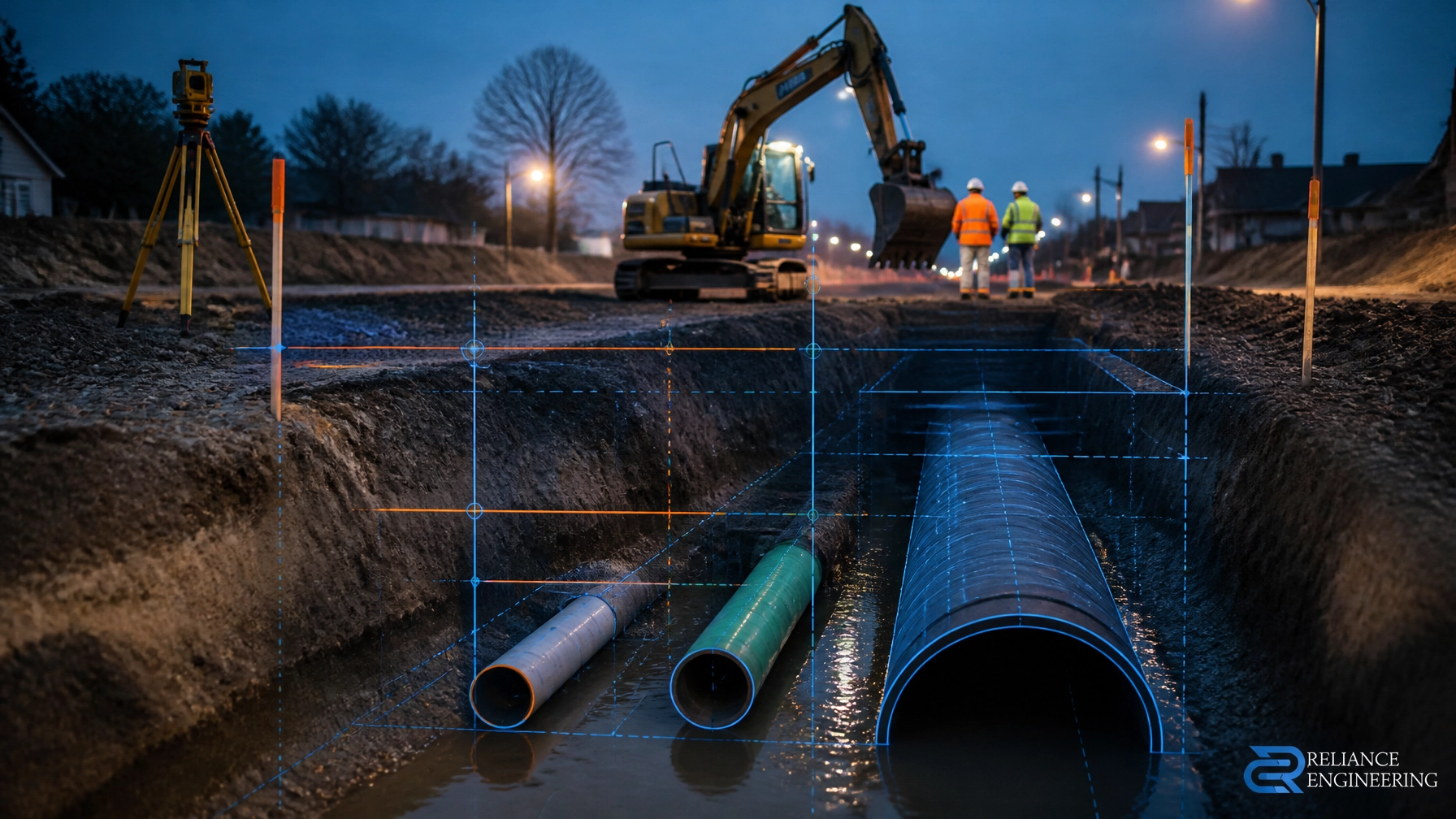
- Storm sewer routes
- Pipe sizes and slopes
- Catch basin leads
- Inverts and connection points
- Existing municipal infrastructure
- Utility conflicts
- Maintenance access
- Outfall or municipal connection requirements
The grading and servicing designs must match. A catch basin shown on a plan is not effective if the surrounding pavement does not drain toward it. Similarly, well-graded pavement will continue to pond if an inlet is blocked, incorrectly set, or connected to an inadequate system.
For larger commercial properties, a Functional Servicing Report may also be required. An FSR can assess existing infrastructure, storm drainage demands, connection strategies, and whether municipal systems can support the proposed or modified site.
Review the related Site Grading Plans, Site Servicing Plans, and Functional Servicing Reports services.
Overland Flow Routes Protect the Property During Major Storms
Even a properly designed storm sewer system has limits. A commercial site needs a safe major-system or emergency route for runoff when inlets surcharge or a storm exceeds the minor system design.
A practical design should show:
- Where excess runoff will travel
- Which areas may temporarily store water
- How water will avoid building entrances
- How fire routes and accessible paths will remain safe
- Where runoff will discharge
- How adjacent properties will be protected
These overland flow routes should be intentional, visible on the plans, and coordinated with landscaping, curbs, retaining walls, loading areas, and parking circulation.
The GRCA stormwater submission guidelines and Ontario’s Stormwater Management Planning and Design Manual provide useful technical context. Municipal criteria remain site-specific and must be confirmed for each project.
Ponding Solutions for Existing Commercial Properties
Depending on the findings, a commercial property grading fix may include:
-
Localized pavement correction
Regrade a limited area where settlement has created a low point. -
Catch basin adjustment
Reset the inlet elevation or improve the connection where the basin is not intercepting runoff. -
Additional drainage structures
Add catch basins, trench drains, or area drains where the existing layout leaves an unserved low point. -
Parking lot regrading
Reconstruct larger pavement areas to establish continuous positive drainage. -
Storm sewer improvements
Modify pipe routes, sizes, slopes, or connections where the existing system is inadequate. -
Landscaped storage or conveyance
Use swales, storage areas, or other approved features where surface drainage cannot connect directly to the storm system. -
Maintenance and operational changes
Relocate snow storage, clean inlets, protect drainage paths, and repair damaged curbs or asphalt.
The correct solution depends on survey information, site observations, pavement condition, municipal standards, and the intended construction budget.

When Permits or Approvals Are Involved
A grading correction may require more than a construction sketch, particularly when it changes drainage patterns, site access, storm connections, parking capacity, or building relationships.
Depending on the project, Reliance Engineering can coordinate:
- Site Grading Plans
- Site Servicing Plans
- Stormwater Management Reports
- Functional Servicing Reports
- Erosion and Sediment Control Plans
- Site Plan Approval Drawings
- OPA/ZBA Drawings
- Severance/Consent Application Drawings
- Building Permit Drawings
For commercial redevelopment, the civil package must coordinate with architectural, structural, landscape, planning, and surveying information. Clear, coordinated, permit-ready drawings help municipal reviewers and contractors understand the proposed drainage solution.
See our Site Plan Approval Drawings, OPA/ZBA Drawings, Severance/Consent Application Drawings, and Building Permit Drawings services.

A Practical Process for Diagnosing Ponding
Reliance Engineering’s process typically includes:
-
Review available information
Examine the survey, previous civil drawings, architectural plans, municipal comments, and drainage records. -
Inspect the property
Identify ponding locations, catch basin conditions, pavement settlement, snow storage impacts, and existing flow patterns. -
Confirm the drainage strategy
Determine whether runoff should drain to catch basins, storm sewers, swales, landscaped areas, or an approved outlet. -
Prepare buildable grading
Develop proposed elevations, slope arrows, drainage routes, and tie-ins that can be constructed in the field. -
Coordinate the civil design
Align grading with servicing, stormwater management, erosion and sediment control, access, landscaping, and building elevations. -
Support approvals and construction
Provide clear drawings, respond to municipal comments, and assist with revisions where required.
The result is not simply a drawing that removes a puddle. It is a practical drainage solution that supports safe operation, maintenance, approvals, and construction.
Request a Free Consultation
If ponding is affecting your commercial property, do not wait for another winter cycle or resurfacing project to repeat the problem.
Contact Reliance Engineering for a free consultation about commercial parking lot drainage in Ontario and practical ponding solutions.
Request a free consultation
Phone: 647-385-6418
Email: [email protected]
Professional Credentials and Contact Information
Naresh Ochani, P.Eng. M.Eng.
PEO Certificate of Authorization: 100548882
Authorized by PEO to offer professional engineering services.
Reliance Engineering
6850 Millcreek Dr, Mississauga, ON L5N 2H4
Phone: 647-385-6418
Email: [email protected]
Office hours: Saturday 12:00 PM–2:00 PM; Sunday Closed.