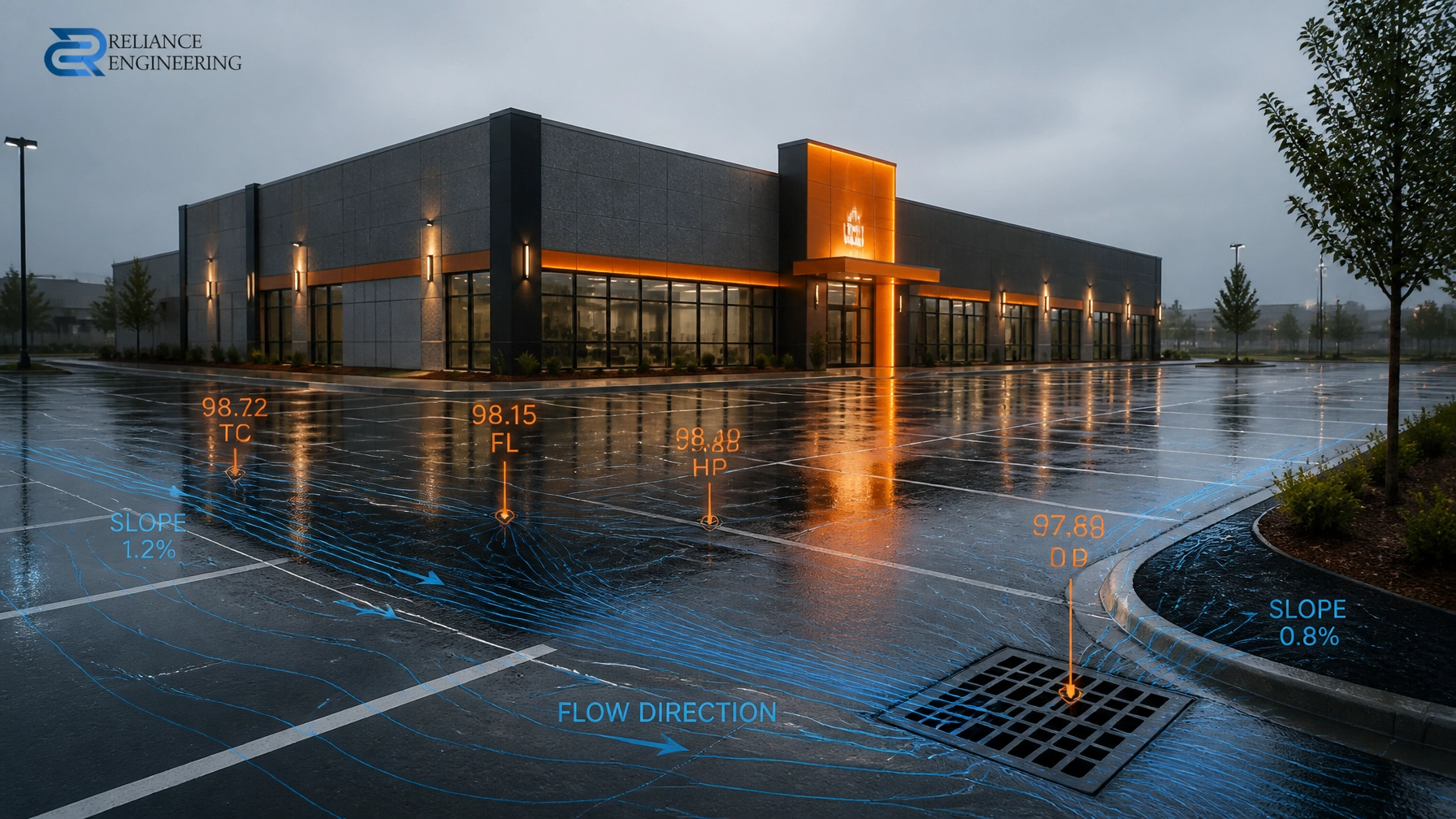
If you own or manage commercial property in Ontario, you already know the stakes are higher than ever. It’s 2026, and the "once-in-a-century" storm seems to happen every second Tuesday. A parking lot isn't just a place for cars anymore; it’s a critical piece of infrastructure that can either protect your investment or become a massive liability.
In the past, a simple slope and a few catch basins might have passed the municipal sniff test. Today, that’s a recipe for permit rejections, asphalt failure, and costly legal headaches. At Reliance Engineering, we’ve seen how the landscape has shifted. Here is why parking lot drainage is the most critical conversation you need to have this year.
The "Invisible" Cost of Bad Drainage
When drainage fails, it doesn't just leave a puddle. It eats your bottom line. In the Ontario climate: with its intense freeze-thaw cycles: standing water is the primary enemy of asphalt.
1. Structural Decay
Water that doesn't move quickly infiltrates the sub-base. By the time you see a pothole, the damage is already structural. In 2026, the cost of asphalt and labour has skyrocketed. Replacing a failed lot is three times more expensive than designing a proper Site Grading Plan from the start.
2. Liability and Safety
Ice is the ultimate liability. Improper flowlines lead to "black ice" patches in winter, creating a nightmare for property owners. Municipalities are now stricter on ensuring accessible parking spaces and pedestrian routes remain dry and safe. If your lot pools water in a barrier-free zone, you are not just out of compliance: you are at risk.
3. Permit Delays
Municipalities across Ontario, from Toronto to Ottawa, have updated their Engineering Design Manuals. If your drainage design doesn't account for modern rainfall intensity, your Site Plan Approval will be kicked back. We’ve seen projects stalled for months because of "simple" grading errors.

Why 2026 Rainfall is Different
The "10-year storm" is a ghost of the past. Recent data shows that Ontario rainfall patterns have become significantly more intense. The infrastructure designed in the early 2000s is being overwhelmed.
Today, civil engineers must use advanced hydrologic modelling to size pipes and storage for future conditions, not just historical averages. This means moving away from "minimum" standards toward over-designed capacities. A Stormwater Management Report is no longer a checkbox; it is your insurance policy against a changing climate.
The Integrated Approach: Modern Solutions for 2026
Modern commercial drainage is a symphony of different systems working together. You can't rely on one catch basin and hope for the best.
Low Impact Development (LID)
LID is the gold standard for 2026. This includes features like bioswales, permeable pavers, and vegetated filters. These systems don't just move water; they treat it. Many Ontario municipalities now offer incentives: including fee credits or expedited permitting: for projects that incorporate LID.

Trench Drains and Flowline Precision
For commercial lots, the "flowline": the lowest point of the pavement: must be continuous. We recommend a minimum 2.0% cross-slope in parking bays and at least 1.0% along drainage aisles. Trench drains are now a standard requirement for building interfaces and loading docks to intercept sheet flow before it reaches your structure.
Underground Storage and Water Quality
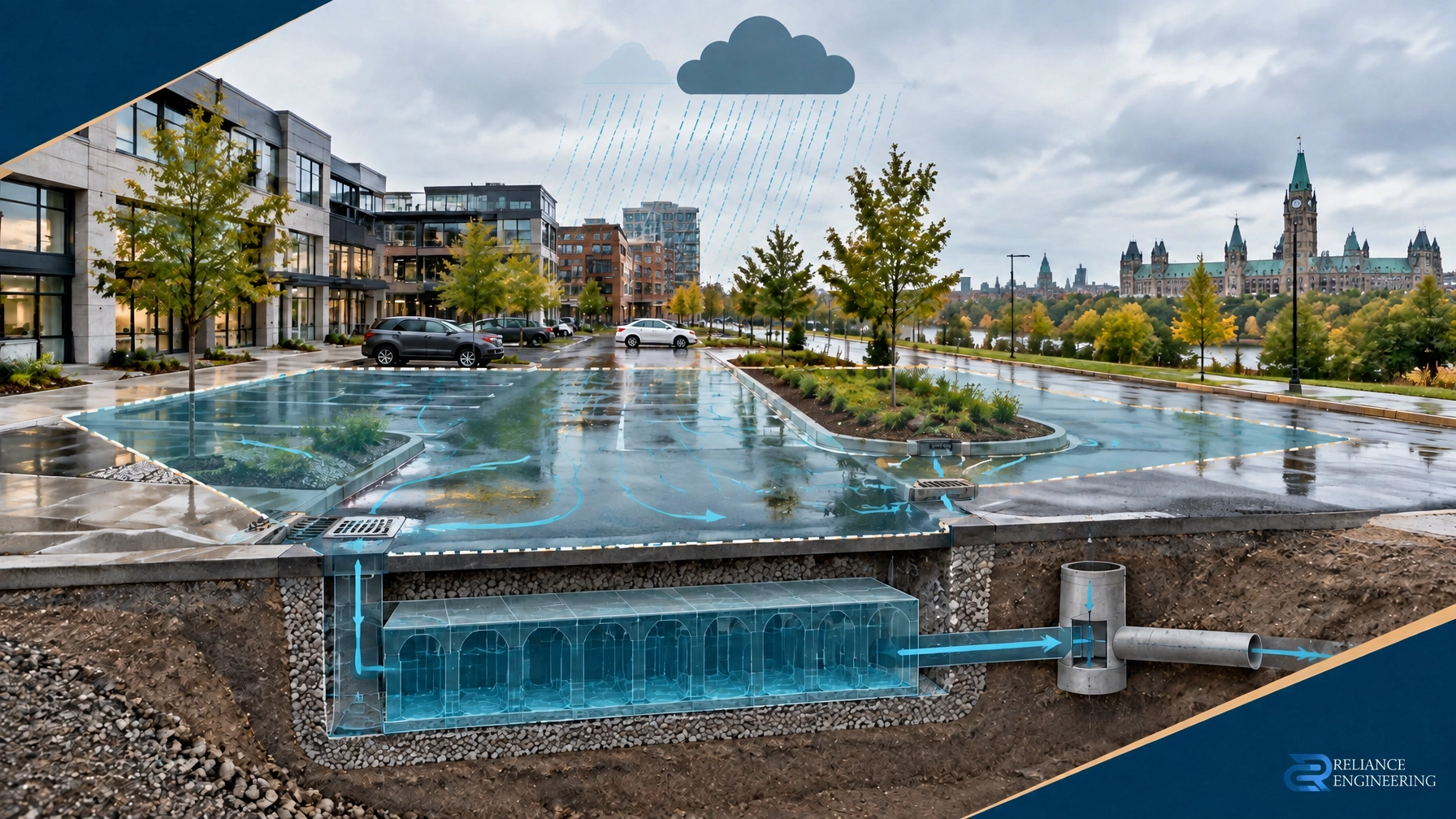
In urban areas where land is expensive, we often design underground chamber systems. These capture and store runoff, releasing it slowly to the municipal system. But it’s not just about quantity; it’s about quality. Oil-grit separators (OGS) and catch basin inserts are now mandatory in most Ontario commercial developments to remove sediments and pollutants before they leave your site.
Navigating the Ontario Approval Process
Getting your project through the municipal maze requires more than just good drawings. It requires an understanding of how each city interprets provincial guidelines.
Whether you are working on a new development or a multi-unit conversion, the submission package is rigorous:
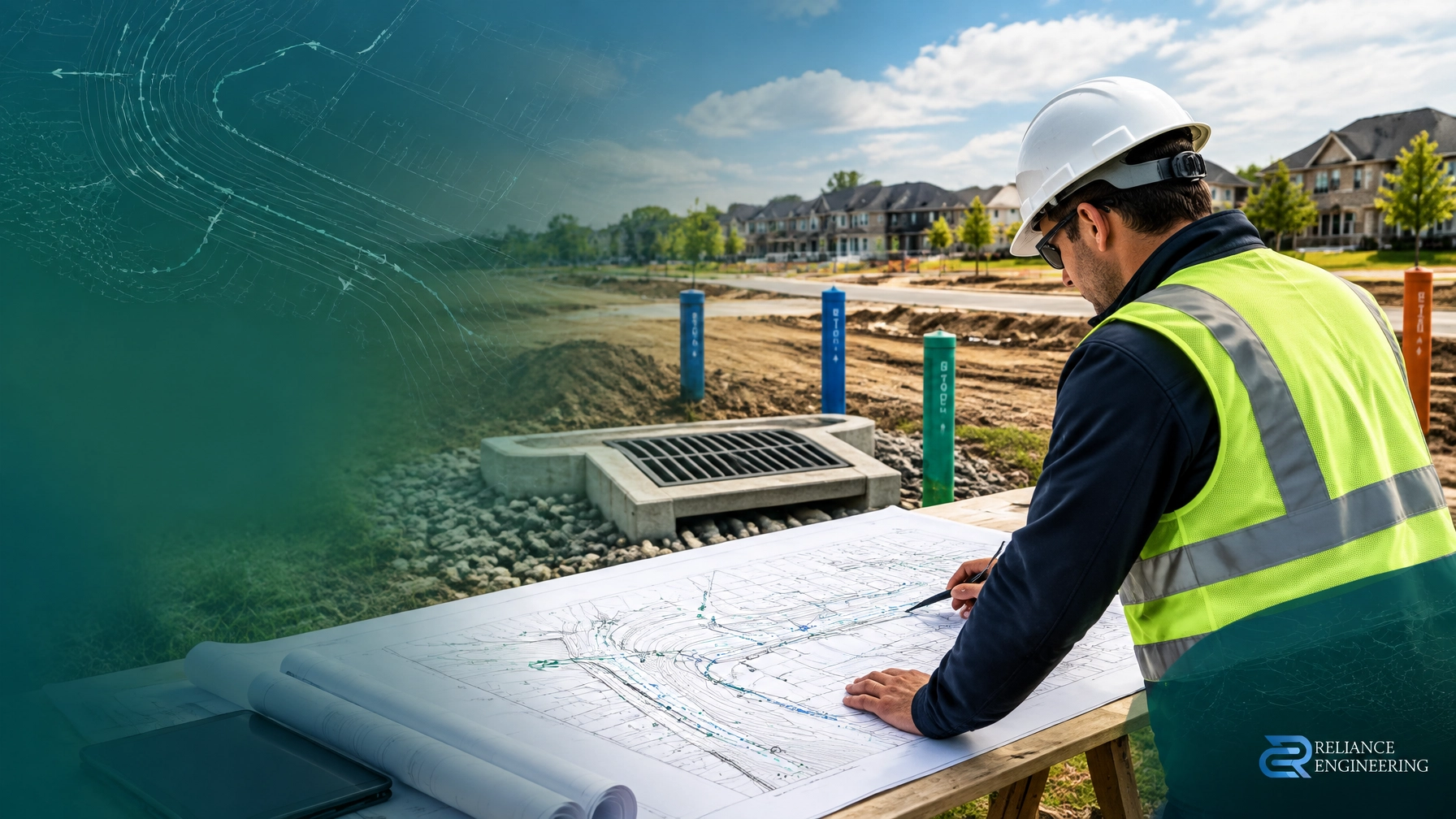
- Site Grading Plan: Showing every slope, flowline, and ponding limit.
- Site Servicing Plan: Detailed storm connections and pipe networks.
- Stormwater Management (SWM) Report: Proving that your post-development flow doesn't exceed pre-development targets.
- Erosion and Sediment Control Plan: Protecting the environment during construction.
At Reliance Engineering, we specialize in getting these approved in one submission. We don't just draw lines; we solve the puzzle of municipal requirements before they become roadblocks.

The Reliance Engineering Advantage
With over 20 years of experience, Naresh Ochani and the team at Reliance Engineering take full ownership of your project. We don't just provide drawings; we provide a path to permit.
- Precision Design: We ensure every square inch of your lot has a purpose-driven slope.
- Deep Expertise: We know the specific engineering manuals of municipalities across Ontario.
- Fast Approval: Our attention to detail means fewer rejections and faster construction starts.
Contact Information
Ready to secure your property's future? Don't leave your drainage to chance.
Principal: Naresh Ochani, P.Eng. M.Eng.
Phone: 647-385-6418
Email: [email protected]
Office Address: 6850 Millcreek Dr, Mississauga, ON L5N 2H4
Website: www.relianceengineering.ca
Office Hours:
Saturday: 12:00 PM – 2:00 PM
Sunday: Closed
Your partner in professional civil engineering and land development across Ontario.