Getting a development project off the ground in Ontario requires more than just a vision and a piece of land. It requires a precise, legally compliant infrastructure plan. If you are a developer, builder, or property owner looking for site servicing in the GTA, you need to understand that what happens underground is just as critical as what happens above it.
At Reliance Engineering, we specialize in turning complex municipal requirements into approved permits. Whether you are working on a multi-unit conversion or a major commercial development, the stakes are high. One oversight in your Site Servicing Plan can lead to months of delays and thousands in unnecessary costs.
Here are 10 critical things you must know before you break ground.
1. The Functional Servicing Report (FSR) is Your Roadmap
You cannot simply "hook up" to municipal pipes. Most municipalities across Ontario require a Functional Servicing Report (FSR) during the rezoning or site plan approval stage. This report proves that the existing municipal infrastructure: water, sanitary, and storm: can actually handle the load of your new project. Without a stamped FSR from a professional engineer, your project stops before it starts.
2. Municipal Capacity is Not Guaranteed
Just because there is a sewer line in the street doesn't mean you can use it. Many areas in Ontario face "servicing constraints." If the downstream sanitary sewer is already at 90% capacity, the city may deny your application or require you to pay for significant infrastructure upgrades. We conduct a thorough sanitary sewer design analysis to ensure your project has a viable path forward.

3. Understanding the "Minor" vs. "Major" System
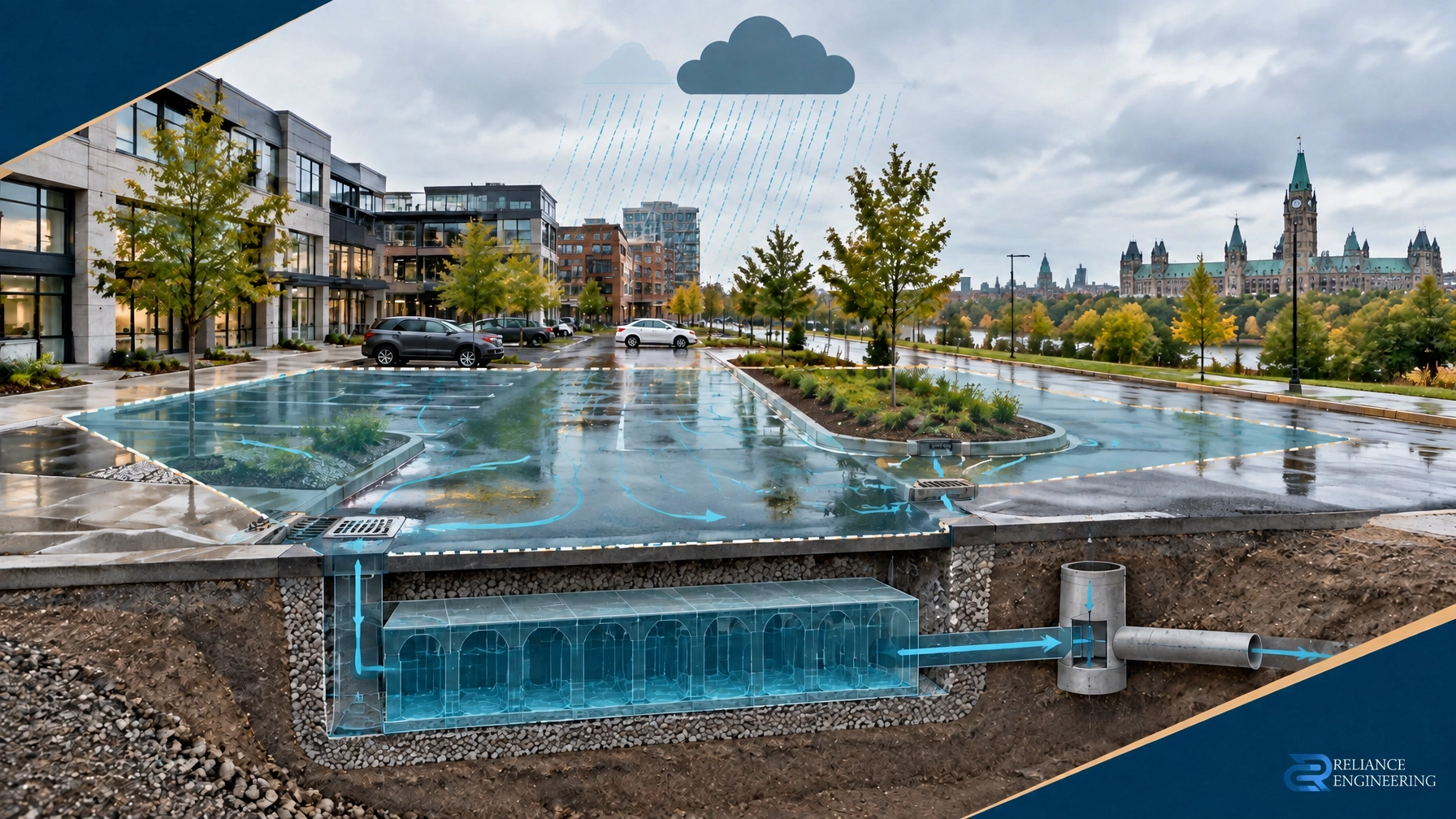
Stormwater management is a two-tiered game.
- The Minor System: This consists of the underground storm system design, including pipes and catch basins that handle frequent, smaller rain events (typically up to a 5-year storm).
- The Major System: This is the "overland flow" route. When a 100-year storm hits and the pipes are full, where does the water go? If it flows toward a building entrance, your permit will be rejected.
4. Fire Flow and Water Pressure Tests
Your water distribution design must do more than just provide drinking water. It must provide enough pressure to fight a fire. We coordinate fire flow tests to measure the actual pressure in the municipal hydrants near your site. If the pressure is too low, you might need to install a booster pump or increase the size of your service lines: decisions that are much cheaper to make on paper than during construction.
5. MECP Compliance and Provincial Standards
While you deal with the city for approvals, the design must meet the standards set by the Ontario Ministry of the Environment, Conservation and Parks (MECP). These regulations govern pipe materials, separation distances between water and sewer lines, and environmental protections. At Reliance Engineering, we ensure every drawing is fully compliant with both provincial and local municipal guidelines.
6. Site Grading and Servicing Integration
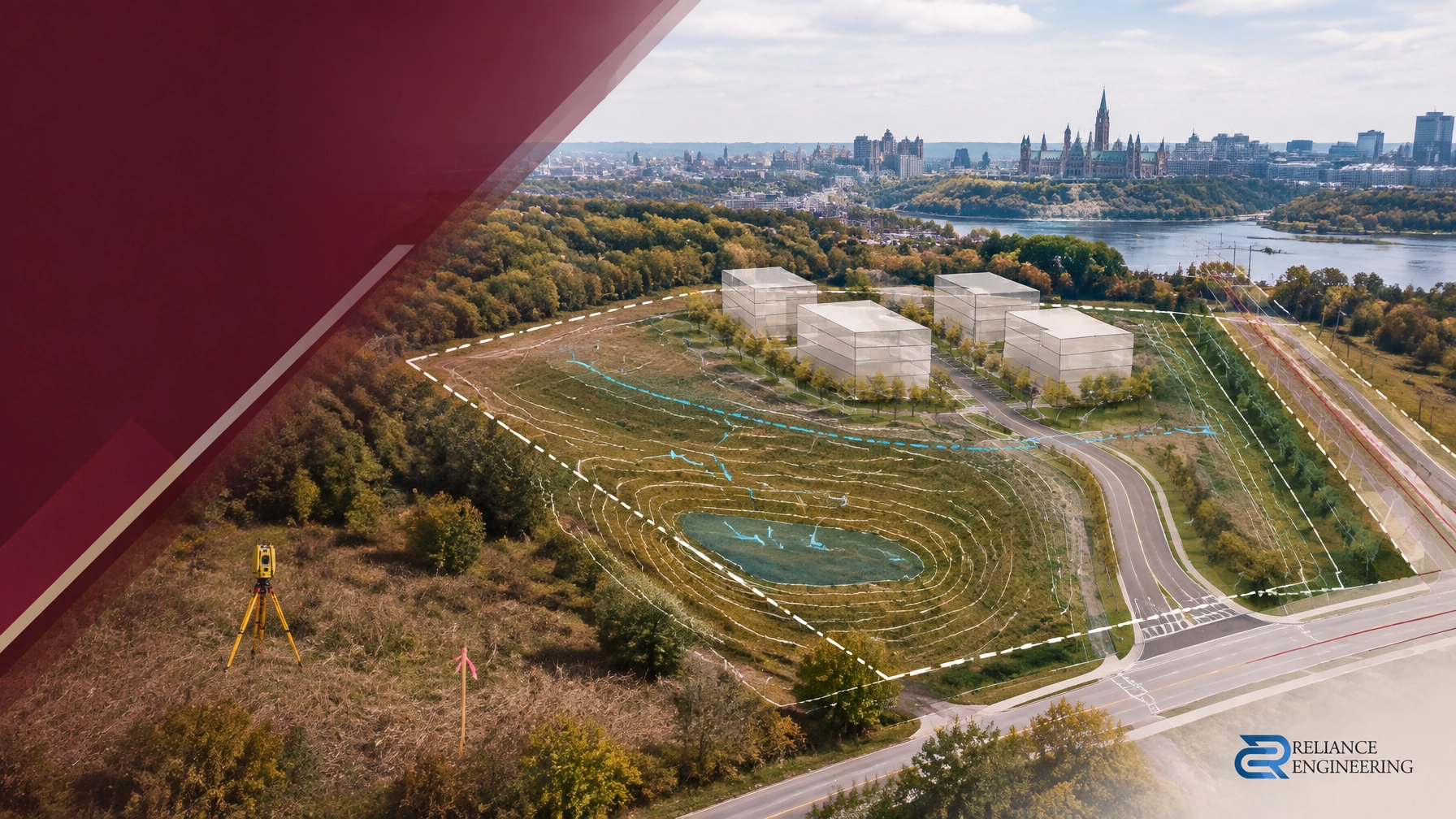
Servicing does not exist in a vacuum. Your site grading plan must work in perfect harmony with your servicing. If your pipes are too shallow, they will freeze. If they are too deep, they may fall below the municipal connection point, forcing you to install an expensive sanitary pumping station. Precision in vertical alignment is where 20+ years of engineering experience pays off.

7. Utility Coordination: Avoiding the "Spaghetti"
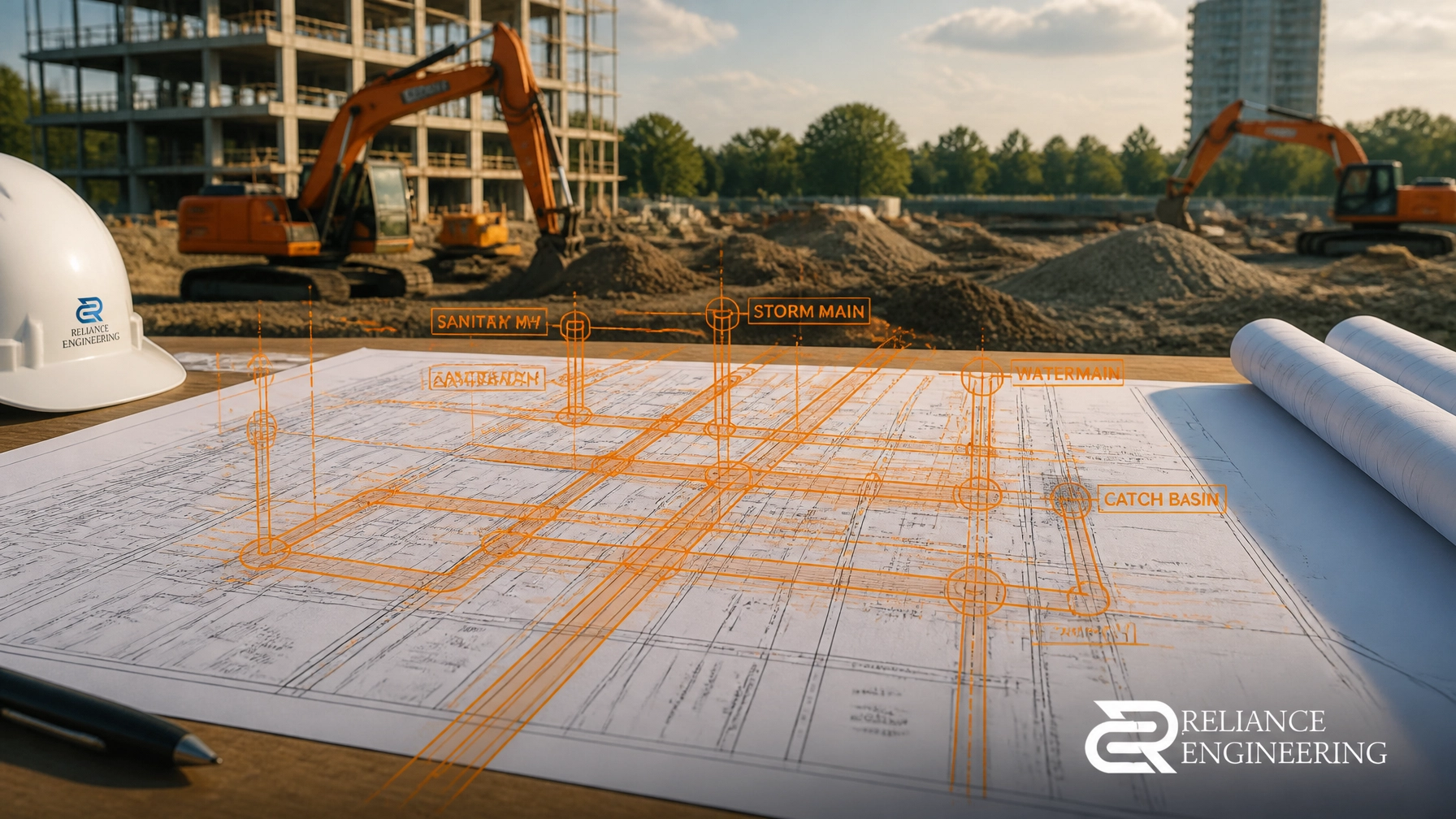
Underneath Ontario's streets is a chaotic web of gas lines, hydro conduits, and fiber optic cables. Your new water and sewer lines must navigate this "spaghetti" without causing strikes or requiring expensive relocations. A professional site servicing plan includes detailed utility coordination to ensure your path is clear before the excavators arrive.
8. The Physics of Gravity (and the Cost of Pumping)
In civil engineering, gravity is your best friend or your worst enemy. Sanitary sewers work best when they flow downhill by gravity. If your site topography doesn't allow for this, you’ll need a lift station. These are expensive to build and expensive to maintain. We prioritize gravity-fed designs whenever possible to save our clients long-term operational costs.
9. Erosion and Sediment Control (ESC)
Before you can install pipes, you must protect the environment. An Erosion and Sediment Control Plan is a mandatory requirement for most construction sites. This ensures that dirt and debris from your dig don't end up clogging the municipal storm system or polluting local Ontario waterways. Failure to maintain ESC measures can result in heavy municipal fines.
10. The Sequence of Approvals
Timing is everything. You typically need your Site Plan Approval drawings completed before you can apply for Building Permit Drawings. Understanding the hierarchy of these approvals: from the FSR to the final Site Servicing Agreement: is essential for keeping your project on schedule.

Why Experience Matters
In Ontario, municipal requirements change frequently. What worked in Mississauga last year might not be the standard in Vaughan today. At Reliance Engineering, we take full ownership of the approval process. Our principal engineer, Naresh Ochani, P.Eng. M.Eng., brings over two decades of expertise to every project, ensuring that your designs are approved quickly: often in just one submission.
Don't leave your project’s foundation to chance. Get it right the first time.
Contact Information
For expert civil engineering and site servicing across Ontario, reach out to us today.
Naresh Ochani, P.Eng. M.Eng.
Reliance Engineering
Address: 6850 Millcreek Dr, Mississauga, ON L5N 2H4
Phone: 647-385-6418
Email: [email protected]
Website: www.relianceengineering.ca
Office Hours:
- Saturday: 12:00 PM – 2:00 PM
- Sunday: Closed