
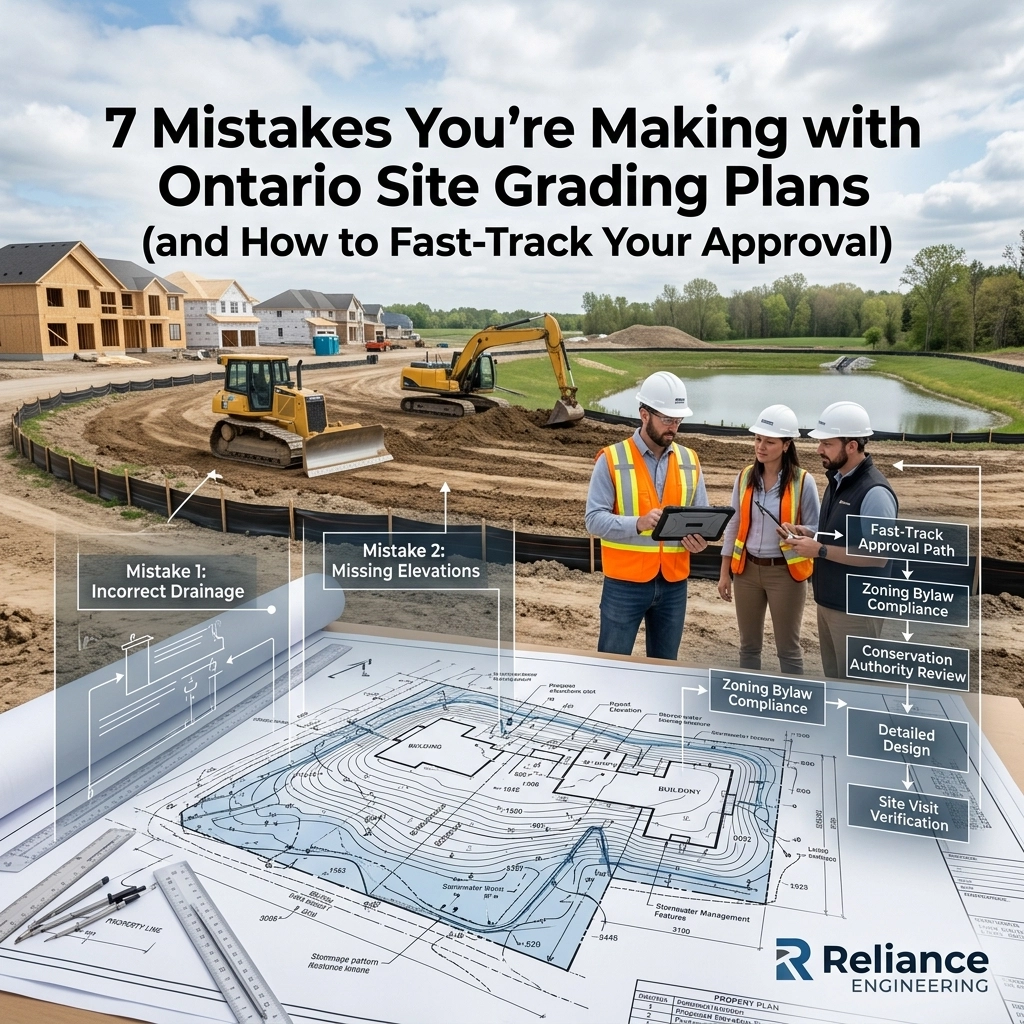
Site grading is the backbone of any successful land development project in Ontario. Whether you are working on a residential severance, a commercial site plan, or an industrial expansion, your grading plan dictates how water moves, how your building sits on the land, and: most importantly: how quickly you get your building permit.
At Reliance Engineering, we see the same mistakes stalling projects across Ontario. These errors don't just cost time; they lead to expensive redesigns, municipal rejections, and legal disputes with neighbors. With over 20 years of expertise, Naresh Ochani, P.Eng. M.Eng., and our team have identified the seven most critical mistakes property owners make and exactly how to fix them.
1. Creating the "Bathtub" Effect
The most common technical failure in site grading is poor drainage design that traps water in low spots. In the engineering world, we call this the "bathtub effect." If your plan does not provide a continuous positive slope away from the building foundation, you are inviting basement flooding and structural damage.
In Ontario, municipal reviewers look for a minimum 2% slope away from residential structures for the first few meters. If your plan shows "flat" areas or depressions without a clear outlet (like a swale or a catch basin), it will be rejected.
How to fast-track: Ensure your Site Grading Plan clearly labels high and low points with specific elevations. Use swales with a minimum 1-2% longitudinal slope to direct water toward the municipal right-of-way or designated drainage easements.
2. Ignoring Neighboring Property Impacts
Ontario law and municipal bylaws are very clear: you cannot change the grade of your land in a way that negatively impacts your neighbors. Many developers try to "fill" their site to a higher elevation to avoid hauling dirt away, only to find they have created a dam that floods the property next door.
Ignoring "existing drainage patterns" is a recipe for a legal injunction and a guaranteed permit denial.
How to fast-track: Always show the existing grades of the adjacent properties on your plan. Your design must demonstrate how you are matching those grades at the property line or using retaining walls and swales to contain your runoff. Professional grade-matching is the only way to avoid costly litigation and delays.

3. Submitting Incomplete Application Packages
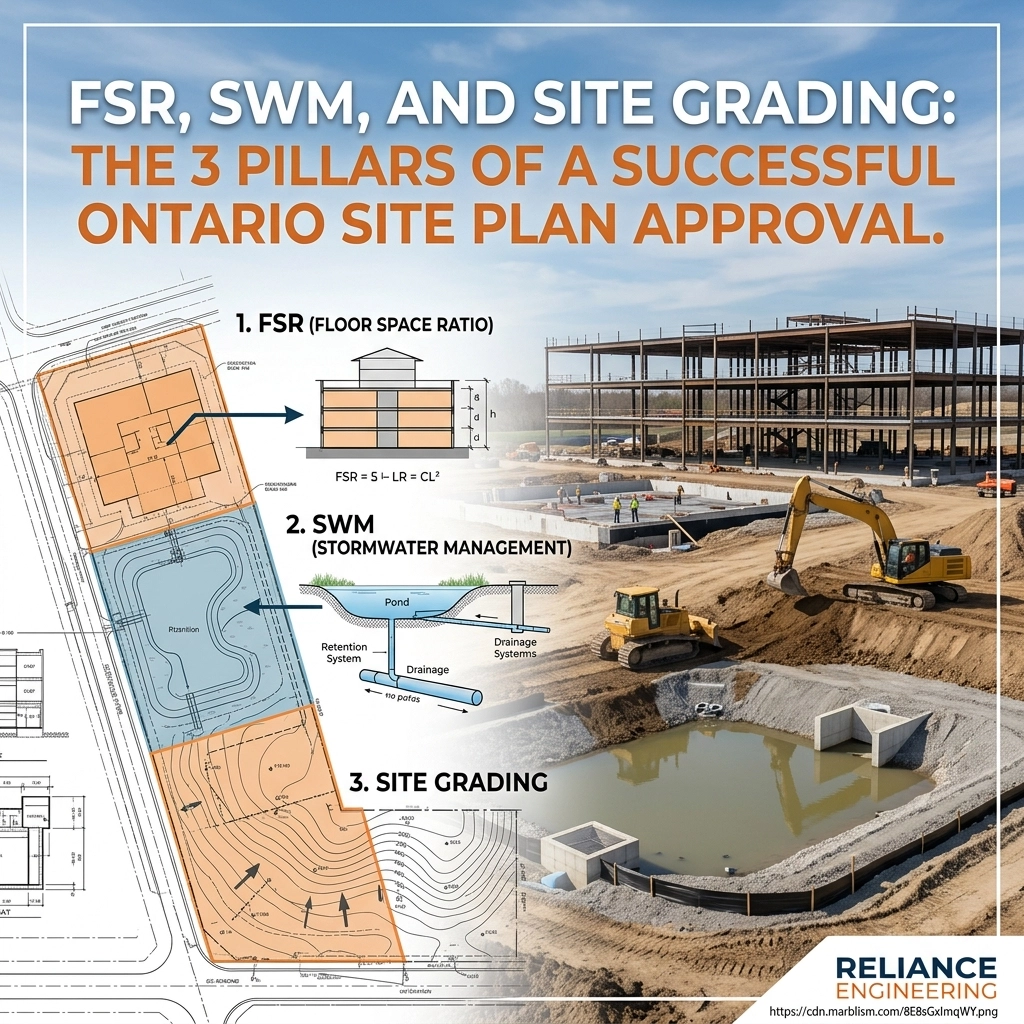
A Site Grading Plan does not exist in a vacuum. It is part of a complex ecosystem of documents required for Site Plan Approval (SPA) or a building permit. Submitting a grading plan without a Topographic Survey or a Functional Servicing Report (FSR) is one of the fastest ways to get your application tossed to the bottom of the pile.
How to fast-track: Ensure your submission is "complete" from day one. In Ontario, this typically includes:
- A legal topographic survey by an OLS (Ontario Land Surveyor).
- A Site Servicing Plan showing water and sewer connections.
- An Erosion and Sediment Control (ESC) plan.
- A Stormwater Management (SWM) Report if required by the municipality.
4. Falling for the "Cheap Engineering" Trap
We understand that development is expensive, but cutting corners on engineering is a false economy. Cheaply produced plans often lack the precision required by modern Ontario standards. Issues like blurry CAD lines, missing benchmark elevations, or failure to show utility poles and existing trees lead to immediate "Incomplete" notices from the city.
If a reviewer has to guess what a line represents, they won't approve it. They will send it back for "clarification," which can take 4-8 weeks per round of comments.
How to fast-track: Work with an established firm like Reliance Engineering. We provide permit-ready plans designed to satisfy even the most rigorous municipal reviewers in Ontario. High-quality plans result in fewer "red-lines" and faster approvals.
5. Failing to Design for "The Big Storm"
With changing weather patterns, Ontario municipalities have significantly increased their stormwater requirements. Many property owners design for a regular rainfall but fail to account for the "100-year storm" event.
If your site is over a certain size, you must prove that the post-development runoff does not exceed the pre-development runoff. If you don't account for on-site detention: such as underground storage tanks or ponding areas: your grading plan will fail the Stormwater Management review.
How to fast-track: Integrate your Storm System Design early. Use the grading plan to create "emergency overland flow routes" that show where water will go if the sewers become overwhelmed. Showing this foresight builds immediate trust with municipal engineers.
6. Overlooking Local Municipal "Flavor"
Ontario is not a monolith. The standards in the City of Toronto are different from the requirements in the Town of Oakville, Mississauga, or rural townships in Northern Ontario. Each municipality has its own specific bylaws regarding:
- Maximum allowable slope for driveways.
- Permissible heights for retaining walls before a structural engineer is required.
- Required setbacks for swales from property lines.
How to fast-track: Hire an engineer who understands local requirements across Ontario. At Reliance Engineering, we tailor every plan to the specific standards of the local jurisdiction, ensuring your design meets the "flavor" of the local building department from the first submission.
7. Neglecting Erosion and Sediment Control (ESC)
A grading plan shows the finished product, but the municipality is equally concerned with how you get there. Failing to include a robust Erosion and Sediment Control plan can lead to site shutdowns and heavy fines if sediment enters the municipal sewer system or local waterways.
How to fast-track: Every site grading plan should be accompanied by an ESC plan that includes silt fences, mud mats at site entrances, and catch basin filters. Protecting the municipal infrastructure is a key requirement for approval.

Why Reliance Engineering is Your Partner for Success
Navigating the regulatory landscape in Ontario requires more than just technical skill; it requires 20+ years of experience and a professional reputation. Reliance Engineering specializes in converting complex civil engineering challenges into approved permits. We focus on Site Grading, Site Servicing, and Stormwater Management for residential, commercial, and ICI projects.
Our Commitment to You:
- Speed: We provide draft plans in days, not weeks.
- Compliance: Our plans are designed to be permit-ready, minimizing municipal back-and-forth.
- Expertise: Led by Naresh Ochani, P.Eng. M.Eng., we bring a high-energy, professional approach to every project.
Contact Information
Reliance Engineering
Naresh Ochani, P.Eng. M.Eng.
Founder and Principal
Address: 6850 Millcreek Dr, Mississauga, ON L5N 2H4
Phone: 647-385-6418
Email: [email protected]
Website: www.relianceengineering.ca
Office Hours:
- Saturday: 12:00 PM – 2:00 PM
- Sunday: Closed
- Monday – Friday: By Appointment

Ready to move your project forward? Don't let a bad grading plan stall your development. Contact Reliance Engineering today for a consultation and let us help you navigate the Ontario site plan approval process with confidence. Whether you need a Sanitary Sewer Design or a full FSR, we have the expertise to get it done right.


Leave A Comment