

Securing a building permit in Ontario is not merely an administrative hurdle; it is a critical milestone that dictates your project’s timeline and financial viability. For developers working across Ontario, the complexity of the regulatory landscape: ranging from the Ontario Building Code (OBC) to local municipal by-laws: requires a strategic approach.
At Reliance Engineering, we have spent over 20 years navigating these requirements. We understand that a delayed permit is a delayed profit. The most common bottleneck in this process is the Site Grading Plan. Without a professional, permit-ready grading plan that accounts for drainage, servicing, and municipal standards, your application will stall.
Here is the definitive 5-step guide to securing your Ontario building permit and site grading plan efficiently.
Step 1: Conduct Pre-Consultation and Verify Zoning Compliance
Before a single line is drawn, you must understand the constraints of your land. Every municipality across Ontario has specific Zoning By-laws that govern land use, building height, setbacks, and lot coverage.
The Importance of Pre-Consultation
Engaging with municipal staff early: often called a "Pre-Consultation" meeting: allows you to identify potential "deal-breakers" before you invest heavily in design. This is the stage where you determine if your project requires:
- Zoning By-law Amendments: If your proposal deviates from current zoning.
- Official Plan Amendments (OPA): If the land use itself needs to change.
- Minor Variances: For small deviations from the by-law, handled by the Committee of Adjustment.
Conservation Authority Checks
In Ontario, if your property is near a creek, wetland, or shoreline, you likely fall under the jurisdiction of a Conservation Authority (e.g., TRCA, CVC, LSRCA). Securing their approval is a prerequisite for a building permit.

Step 2: Assemble Your Technical Team and Prepare Site-Specific Drawings
A building permit application is a compilation of specialized technical documents. You cannot "copy-paste" a design from another project. Ontario municipalities require site-specific drawings that react to the unique topography and infrastructure of your lot.
The Role of the Professional Engineer
For any development: whether a custom residential build or an Industrial, Commercial, or Institutional (ICI) project: you need a team that includes an architect and a Civil Engineer. Reliance Engineering specializes in providing the civil package required for these submissions.
Your technical package must include:
- Architectural Drawings: Floor plans, elevations, and cross-sections.
- Structural Drawings: Ensuring the building can withstand Ontario’s snow and wind loads.
- Mechanical and Electrical Plans: Often required for ICI and multi-residential projects.
The Critical Site Grading Plan
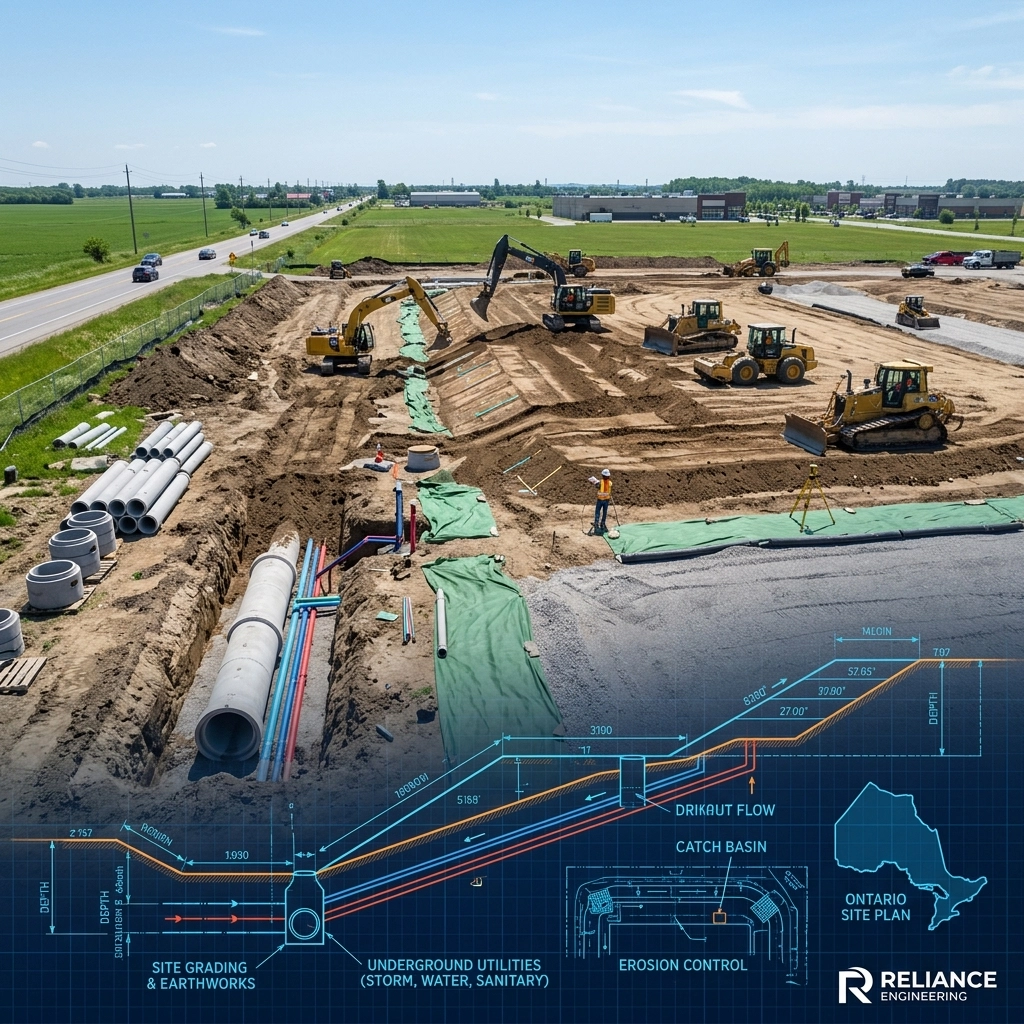
The Site Grading Plan is the most scrutinized document by municipal engineering departments. It demonstrates how your project will manage surface water drainage without impacting neighboring properties. A poor grading design leads to basement flooding or ice hazards, which is why Ontario building officials demand stamped plans from a P.Eng.
Step 3: Gather Required Documentation and Supporting Reports
A complete application requires more than just drawings. Depending on the scale of your development, the municipality will demand a suite of technical reports.
Functional Servicing Reports (FSR)
An FSR is mandatory for most site plan approvals and building permits. It proves that there is enough capacity in the existing municipal watermains and sewers to support your new building. It also covers fire flow requirements to ensure the local fire department has enough water pressure to protect the structure.
Stormwater Management Reports (SWMR)
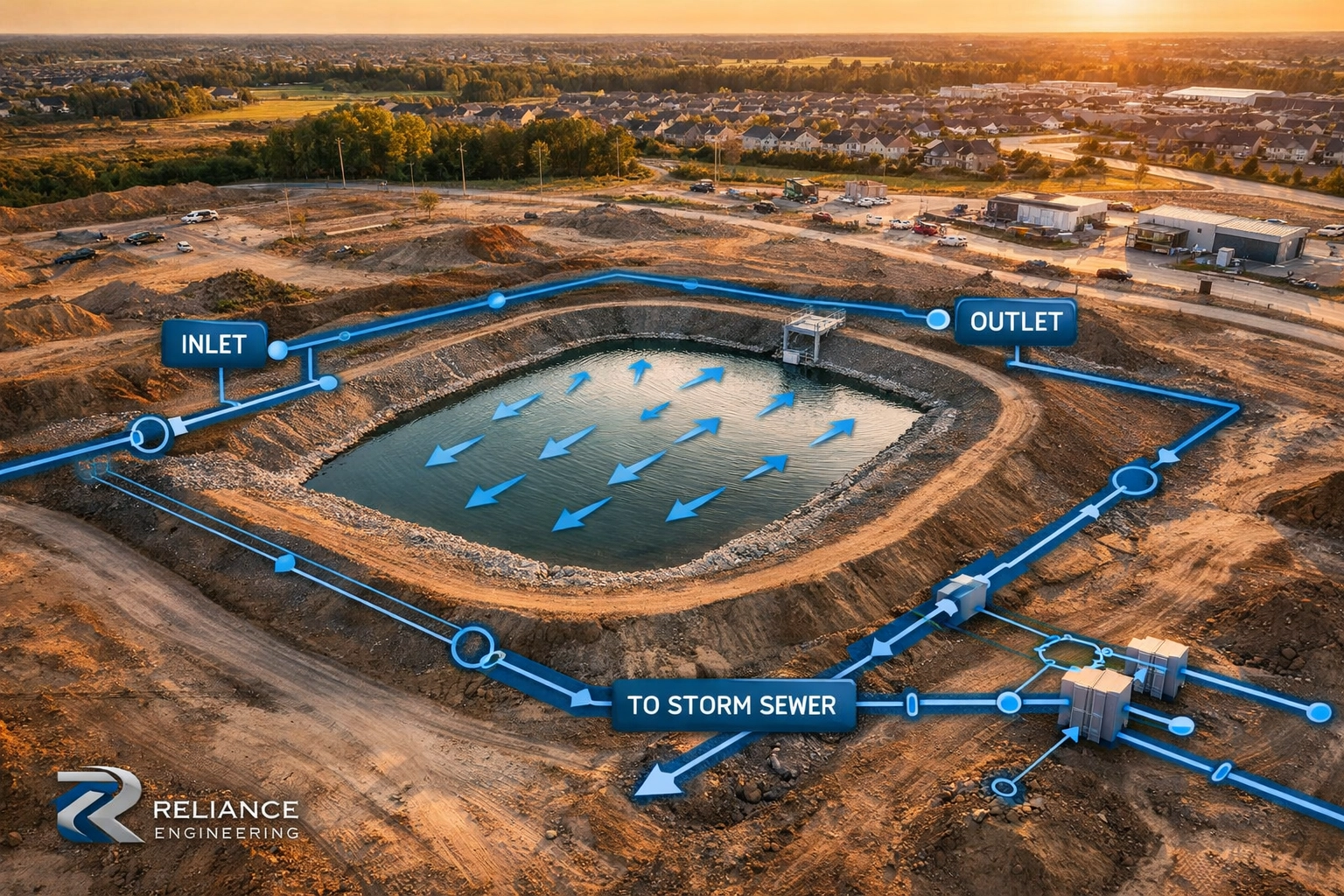
With increasing climate volatility, Stormwater Management has become a top priority for Ontario regulators. You must demonstrate how you will mitigate the "post-development" runoff. This often involves:
- Infiltration galleries.
- Oil-grit separators (OGS).
- On-site detention (dry ponds or underground tanks).
Erosion and Sediment Control (ESC)
During construction, you are responsible for ensuring that silt and debris do not enter the municipal storm system. An ESC plan outlines the measures (silt fences, mud mats, catch basin inserts) you will implement to protect Ontario’s water quality.
Step 4: Submit Your Complete Application and Fees
Once your reports and plans are finalized, it is time for submission. Most Ontario municipalities, including Toronto, Mississauga, and Brampton, have moved to digital portals for application intake.
Checklist for Submission:
- Completed Application Form: Signed by the owner or authorized agent.
- Application Fees: These are non-refundable and vary based on the square footage and type of construction.
- Survey: A current legal survey of the property.
- The Engineering Package: Site Servicing Plans, Grading Plans, and SWMR.
- Schedule 1 Designer Forms: Required for designers taking responsibility for the OBC compliance.
Pro-Tip: An incomplete application is the leading cause of delay. If you miss one form or one signature, the municipality will "deem it incomplete" and return it, costing you weeks of lead time.
Step 5: Respond to the Review Process and Any Revision Requests
Once submitted, your application undergoes a "Pre-Screen" and then a full technical review. In Ontario, the Building Code Act sets mandatory timeframes for initial reviews (e.g., 10 business days for a residential house), but this only applies to "complete" applications.
Managing Municipal Comments
It is rare for an application to be approved on the first pass. Municipal engineers or planners may provide "red-line" comments or requests for clarification.
- Speed is Essential: At Reliance Engineering, we prioritize rapid turnaround on revisions to keep the momentum going.
- Clear Communication: Sometimes, a phone call between your engineer and the municipal reviewer can resolve a technical disagreement that would otherwise take weeks of back-and-forth emails.
Inspections
Securing the permit is the start, not the end. You must schedule inspections at key stages:
- Footings/Foundation.
- Site Servicing (sewer and water connections).
- Framing and HVAC.
- Final Grading (to ensure the lot was graded exactly as per the approved Grading Plan).

Why Choose Reliance Engineering?
Navigating Ontario’s regulatory landscape requires a partner who understands both the engineering physics and the bureaucratic process. Reliance Engineering provides comprehensive civil engineering services tailored to secure your permits faster.
We specialize in:
- Rapid Turnaround: We aim to provide draft plans in days, not months.
- Permit-Ready Designs: Our plans are designed to meet the strict standards of Ontario municipalities.
- Cost-Effective Solutions: We optimize Sanitary Sewer Design and Storm System Design to save you construction costs.
From 35 Wabash Avenue to the redevelopment of Etobicoke General Hospital, our portfolio demonstrates our ability to deliver results across residential and ICI sectors.
Contact Information
Ready to secure your Ontario building permit? Contact us today for a consultation.
- Founder: Naresh Ochani, P.Eng. M.Eng.
- Address: 6850 Millcreek Dr, Mississauga, ON L5N 2H4
- Phone: 647-385-6418
- Email: [email protected]
- Website: www.relianceengineering.ca
Office Hours:
- Saturday: 12:00 PM – 2:00 PM
- Sunday: Closed
- Monday – Friday: By appointment.
Visit our Contact Page to book your project review. Whether you need a simple grading plan or a complex functional servicing report, Reliance Engineering is your trusted partner across Ontario.



Leave A Comment