
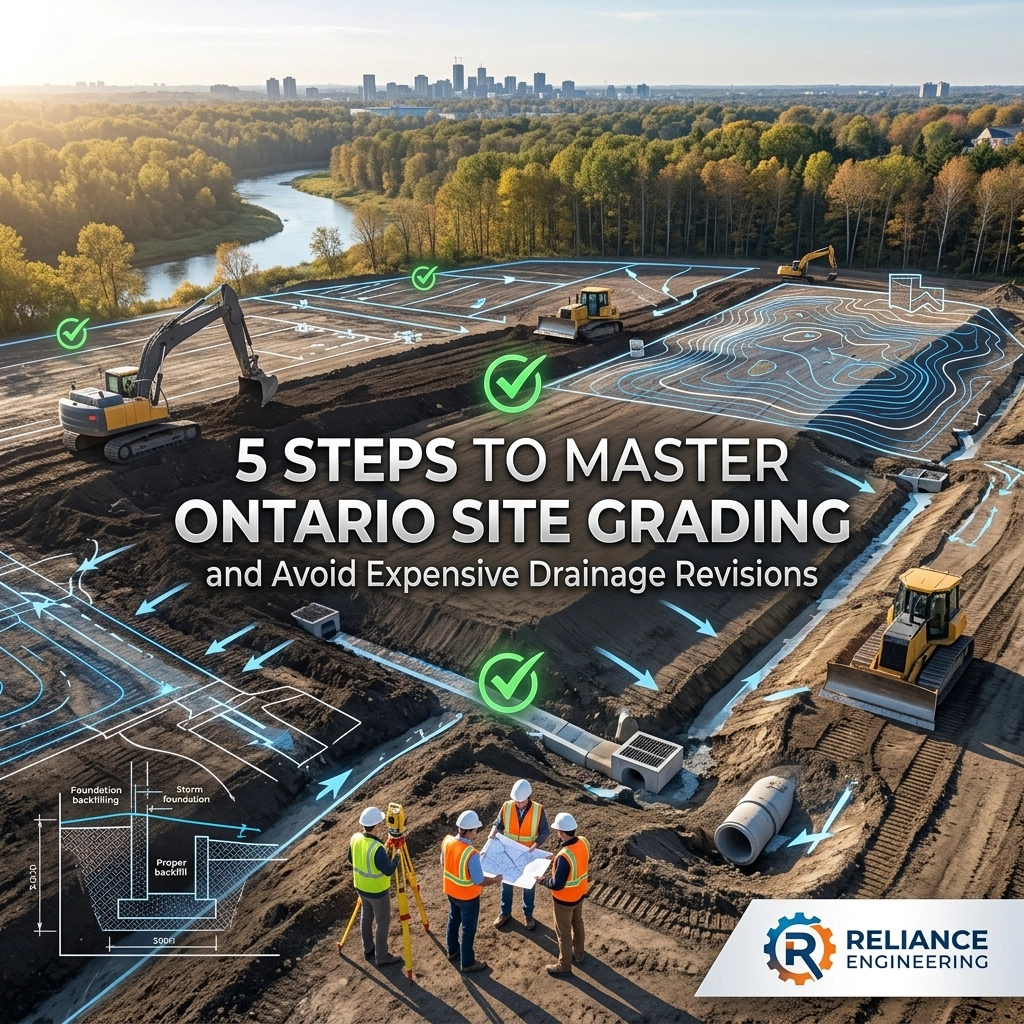
In the high-stakes world of Ontario land development, site grading is often the difference between a project that cruises through approvals and one that gets buried in expensive revisions. Site grading is the architectural backbone of your property’s drainage system. Done correctly, it ensures longevity and safety. Done poorly, it leads to basement flooding, foundation damage, and costly litigation from neighboring properties.
At Reliance Engineering, we bring over 20 years of expertise to the table, helping developers, builders, and homeowners across Ontario navigate the complexities of site grading, site servicing, and stormwater management. Whether you are working on a mid-rise in Toronto like our project at 35 Wabash Avenue or a commercial redevelopment in Newmarket like 345-351 Davis Drive, mastering the grading process is non-negotiable.
Here are the five critical steps to mastering Ontario site grading and avoiding the drainage pitfalls that derail projects.
1. Conduct a Thorough Site Assessment and Topographic Survey
You cannot design a grading plan in a vacuum. The first step is always a comprehensive site evaluation. Before a single shovel hits the dirt, you need to understand the existing lay of the land.
Mapping existing topography is essential. This involves hiring an Ontario Land Surveyor (OLS) to capture precise elevations, identify existing drainage patterns, and locate natural features such as trees, wetlands, or rock outcrops.
Why the Data Matters
- High and Low Points: These dictate where water naturally flows.
- Soil Composition: Is the ground clay-heavy or sandy? This significantly impacts infiltration rates and the design of your stormwater management systems.
- Property Boundaries: You must ensure that your grading does not negatively impact adjacent lots: a common cause of permit denials in Ontario.

2. Navigate Ontario Regulations and Design Standards
Ontario has some of the most stringent environmental and building regulations in North America. Navigating the regulatory landscape requires a professional engineer who understands the nuances of the Ontario Building Code, municipal by-laws, and the requirements of various Conservation Authorities.
For instance, if your project falls within a regulated area, you must comply with Ontario Regulation 41/24. This involves specialized permits and a deep understanding of flood hazards and erosion control.
Key Regulatory Considerations:
- Zoning By-laws: Each municipality has specific requirements for maximum slopes and minimum setbacks.
- Official Plan Amendments (OPA) and Zoning Amendments: If your project changes the land use, your grading plan must reflect the new intensity of the development.
- Site Plan Approval (SPA): Most commercial and multi-residential projects require a site grading plan as a core component of the SPA process.
3. Develop a Comprehensive Drainage and Engineering Strategy
This is where the engineering expertise of Reliance Engineering becomes your greatest asset. A "good enough" slope isn't enough. You need a detailed strategy that manages water from the moment it hits the roof until it leaves the property.
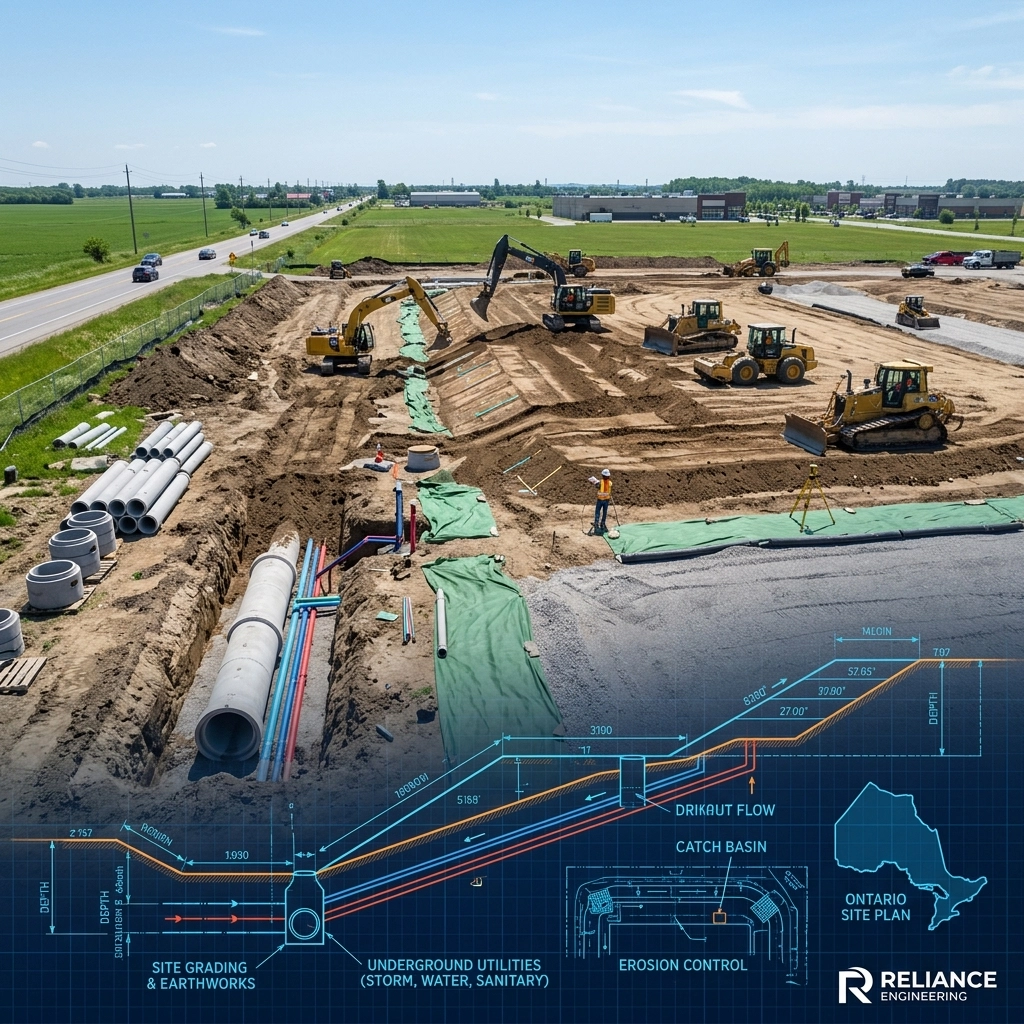
An effective design integrates site servicing with grading. We look at the interplay between:
- Swales: Shallow channels designed to direct runoff safely around structures.
- Catch Basins and Manholes: Strategic placement is vital to prevent ponding in parking lots or driveways.
- Sub-drains and Drainage Pipes: Necessary for managing subsurface water and protecting foundations.
For larger developments, this strategy is documented in a Functional Servicing Report (FSR) or a Stormwater Management Report (SWMR). These reports prove to the municipality that your project will not overwhelm existing infrastructure.

4. Secure Permits and Facilitate Municipal Approvals
Submission is often the bottleneck in land development. To avoid expensive revisions and delays, your submission must be "permit-ready" the first time. At Reliance Engineering, we pride ourselves on providing draft plans in days, not weeks, ensuring they meet the specific technical requirements of Ontario municipalities from St. Catharines to Etobicoke.
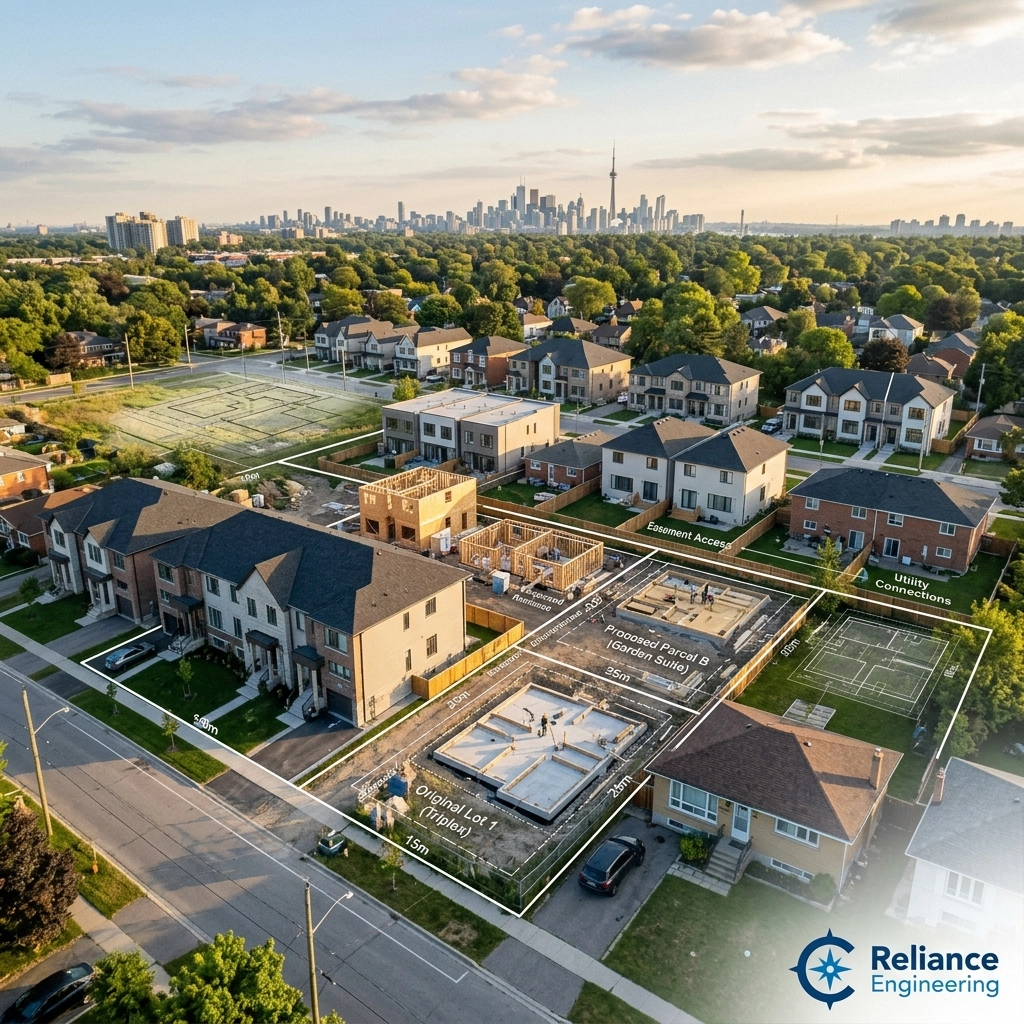
Whether you are applying for a Severance Application, a Building Permit, or navigating a complex redevelopment project, your grading plan must be clear, professional, and compliant.
The Approval Chain:
- Internal Review: We verify all slopes (typically 2% to 5% for grassed areas) and ensure positive drainage away from building envelopes.
- Municipal Submission: Dealing with planning and engineering departments to address comments.
- Agency Review: If applicable, coordinating with groups like the TRCA or the Ministry of Transportation.

5. Implementation, Oversight, and Final Certification
The best plan on paper can still fail in the field if execution is sloppy. Continuous oversight during the construction phase is mandatory to ensure the grading matches the approved design.
Erosion and Sediment Control (ESC)
During construction, the site is vulnerable. Implementing silt fencing, sediment traps, and rock check dams is essential to protect local water quality and comply with Ontario environmental standards. Failure to manage ESC can result in heavy fines and work-stop orders.
Final Check Grade
Once construction is complete, a final field review is performed. An engineer or surveyor confirms that the finished elevations match the design. This "as-built" verification is often a condition for the release of securities held by the municipality and is required to close out your building permit.

Why Precision in Grading Saves You Money
A revision requested by a municipality after construction has started is exponentially more expensive than a change made during the design phase. Re-grading a site can involve:
- Ripping up asphalt or concrete.
- Re-installing storm system designs.
- Potential legal claims from neighbors regarding water runoff.
By partnering with Reliance Engineering, you leverage 20+ years of experience in Ontario's regulatory landscape. We understand the technicalities of water distribution design and sanitary sewer design, ensuring your entire site works as a cohesive, efficient system.
Expert Consulting for Your Next Project
Don't leave your site grading to chance. Whether you are working on residential severance or a large-scale ICI (Industrial, Commercial, Institutional) project, Reliance Engineering provides the technical precision and regulatory insight needed to move your project forward.
Contact us today to discuss your site grading needs and ensure your next project is built on solid ground.
Contact Information
- Name: Naresh Ochani, P.Eng. M.Eng.
- Company: Reliance Engineering
- Address: 6850 Millcreek Dr, Mississauga, ON L5N 2H4
- Phone: 647-385-6418
- Email: [email protected]
- Website: www.relianceengineering.ca
Office Hours
- Saturday: 12:00 PM – 2:00 PM
- Sunday: Closed
- Monday – Friday: 9:00 AM – 5:00 PM
Ready to start? Visit our services page to see how we can assist with your next Ontario land development project. From 85 Bronte Road in Oakville to Queen Street in St. Catharines, we are the partners you need for engineering excellence.




Leave A Comment