
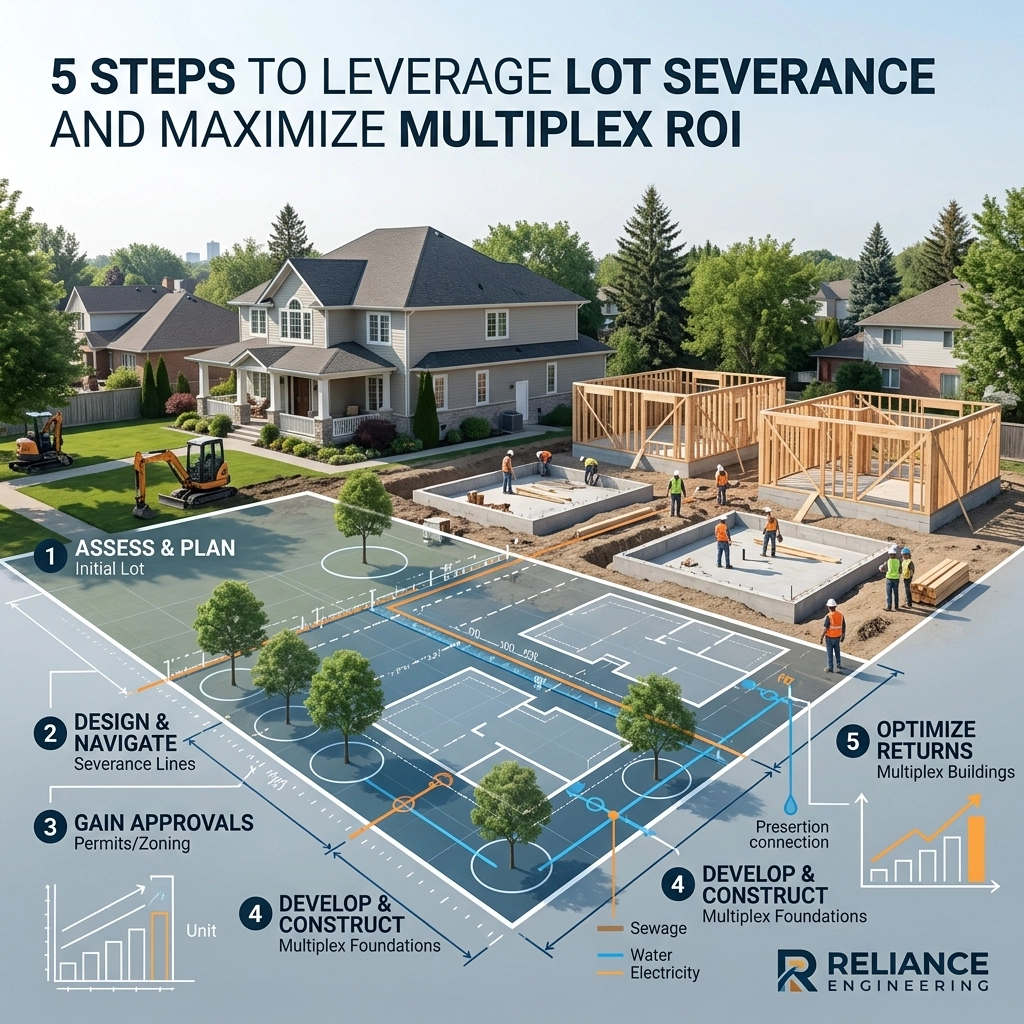
The Ontario real estate landscape is shifting. With the provincial government’s push for the "Missing Middle" housing, savvy investors are no longer looking at single-family flips as their primary strategy. The real money is in density.
Leveraging lot severance to build 4-plex or 5-plex multi-unit buildings is the most effective way to maximize Return on Investment (ROI) in the current market. However, density comes with complexity. You cannot simply draw lines on a map and start pouring concrete. You need a strategy that balances municipal policy with rigorous civil engineering.
At Reliance Engineering, we specialize in turning underutilized land into high-yield assets. This guide outlines the 5-step process to navigate severance and multiplex development across Ontario.
Step 1: Feasibility and Zoning Analysis
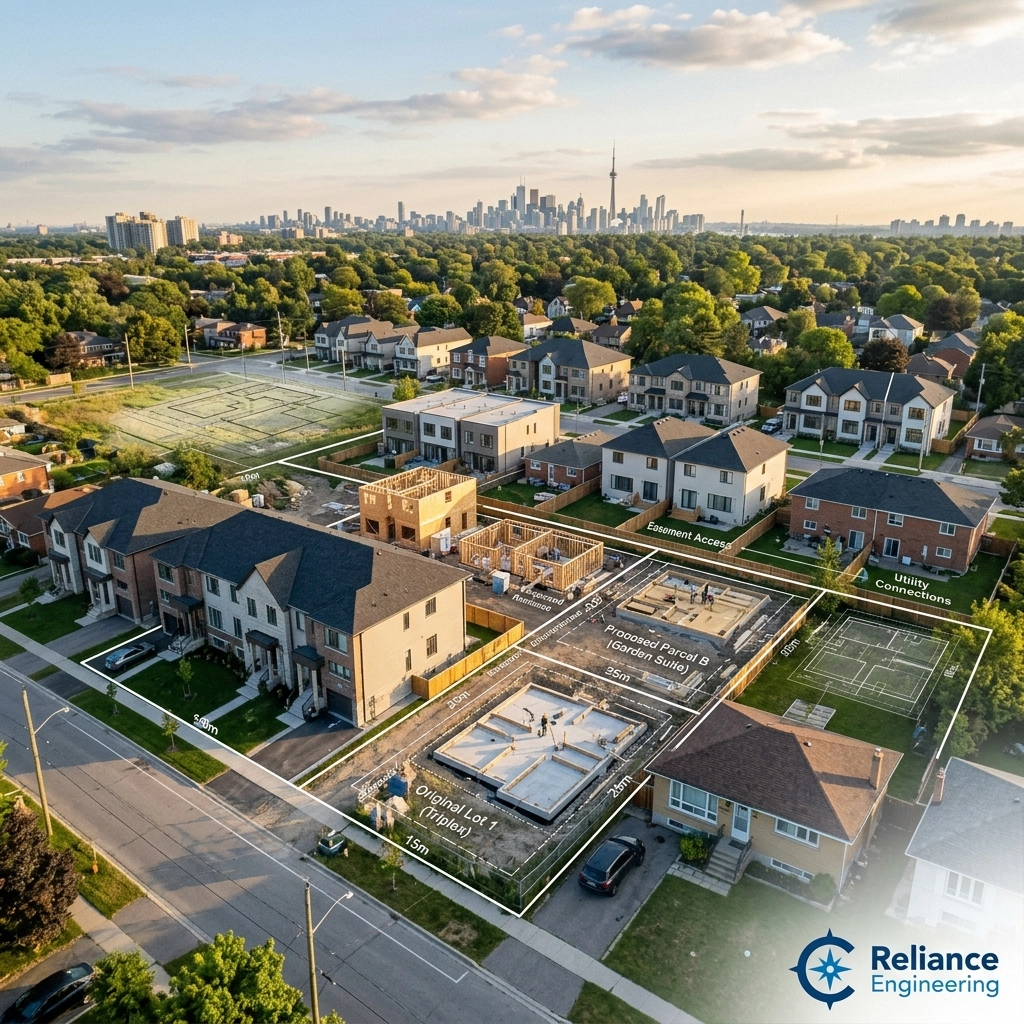
Before you purchase a property or sign a contract, you must determine if the land can support your vision. In Ontario, the "as-of-right" rules have expanded, but lot severance (subdividing one parcel into two or more) still requires a formal application to the Committee of Adjustment.
The Severance Strategy
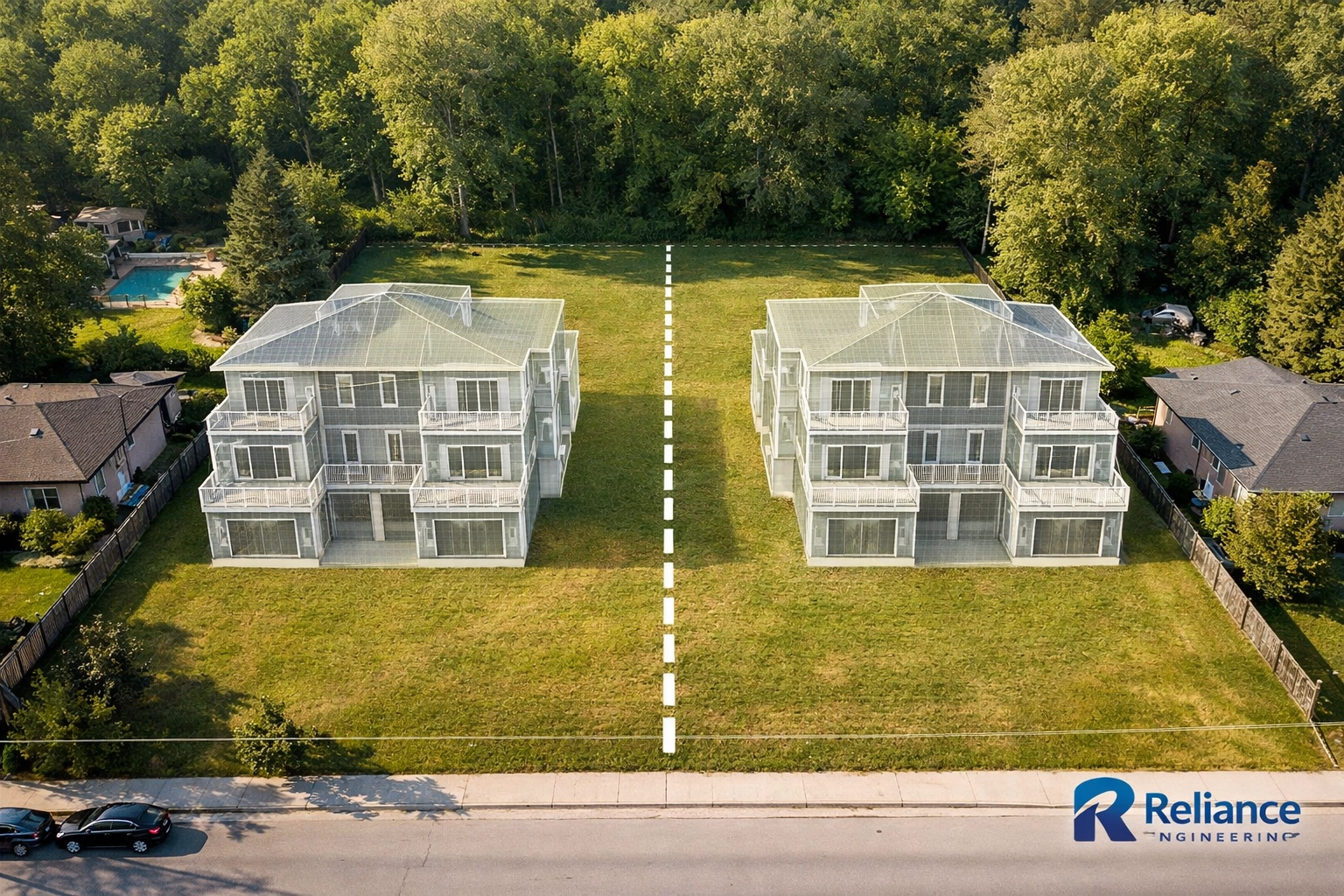
Severance allows you to "create" land out of thin air. By splitting a large lot into two, you double your development potential. If you can build a 4-plex on the original lot and another 4-plex on the severed lot, you have gone from a single-family dwelling to an 8-unit cash-flow machine.
Key considerations for investors:
- Frontage and Depth: Does the resulting lot meet the minimum requirements of the local zoning by-law?
- Official Plan Designation: Does the city’s long-term plan support increased density in this specific pocket?
- Pre-consultation: We highly recommend a pre-consultation meeting with municipal planners to identify any "deal breakers" early.
Step 2: Engineering – The Foundation of Your ROI
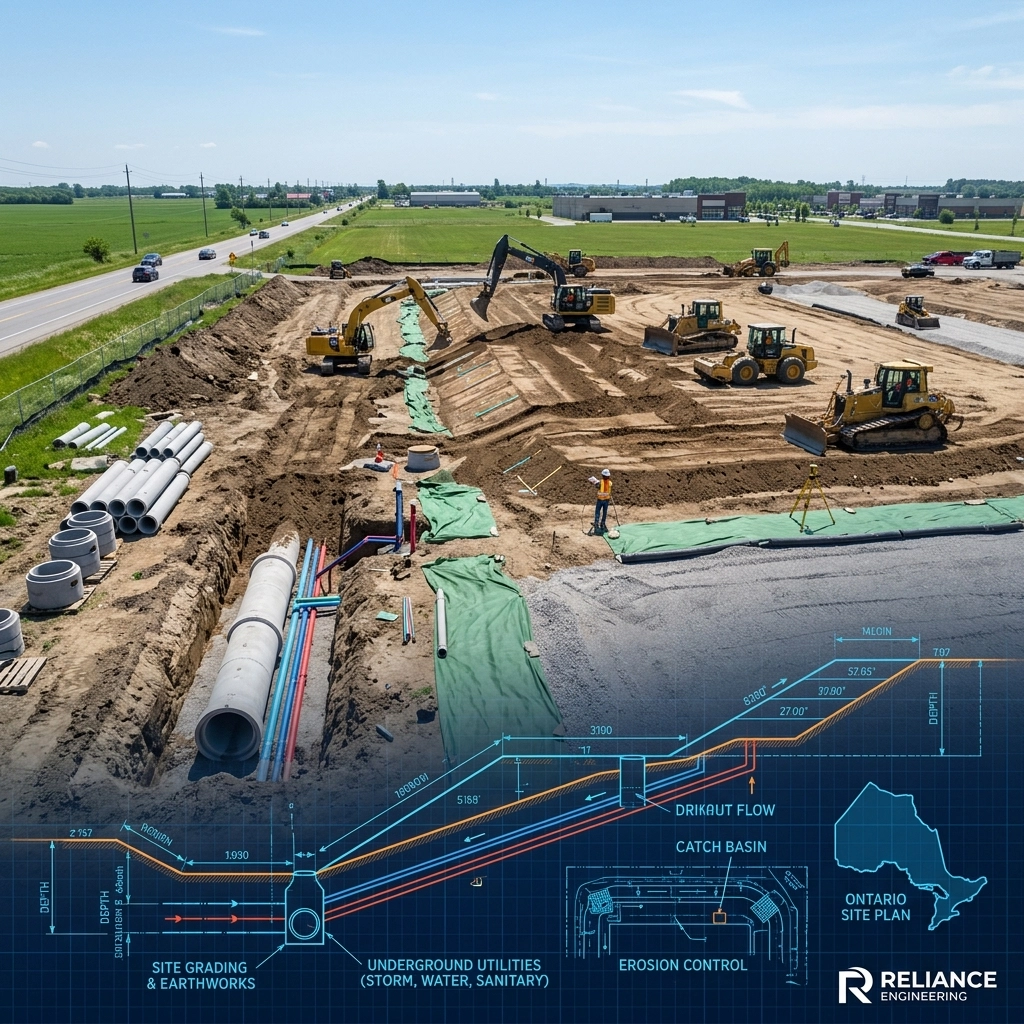
Investors often focus on the architectural "look" of a building, but the civil engineering makes or breaks the project's financial viability. If you cannot provide adequate water, manage stormwater, or ensure proper grading, the municipality will not issue a permit.
This is where many projects fail. At Reliance Engineering, we focus on high-efficiency site servicing plans that minimize costs while meeting strict provincial standards.
Functional Servicing Reports (FSR)
An FSR is mandatory for most multiplex developments and severance applications. It proves to the city that the existing infrastructure (sewers, water mains) can handle the increased load of your 4-plex or 5-plex.
- Sanitary Sewer Design: We calculate the peak flow to ensure the sanitary sewer design is compliant.
- Water Distribution: We verify that there is enough pressure for both domestic use and fire protection. Learn more about our water distribution design services.
- Stormwater Management (SWM): You are responsible for the water that falls on your roof and pavement. We design stormwater management systems that prevent flooding on neighboring properties, a critical requirement for severance approval.
Step 3: The Site Grading Plan
In Ontario, you cannot change the way water flows across your property without a permit. For multiplexes, where the building footprint is much larger than a traditional house, site grading becomes a complex puzzle.
A poor grading plan leads to:
- Basement Flooding: If the ground slopes toward the building instead of away.
- Neighbor Disputes: If you shed water onto the adjacent property, you face legal liability.
- Permit Delays: The city will reject any plan that doesn't show clear, safe drainage paths.
Reliance Engineering creates precise storm system designs that integrate seamlessly with your grading plan, ensuring a smooth path through the approval process.

Step 4: The Severance Application Process (Consent)
Once the engineering feasibility is established, you move to the formal severance application, also known as a "Consent" application.
The Committee of Adjustment
In Ontario, severances are typically handled by the Committee of Adjustment (CoA). You will need to present:
- A formal survey showing the new property lines.
- A planning justification report.
- Engineering drawings (Servicing and Grading) to prove the new lot is developable.
Pro-Tip for Investors: Municipalities often require "Development Charges" and "Parkland Dedication" fees upon severance. These can be significant. Incorporate these into your ROI calculations early.
Referencing successful projects like the 345-351 Davis Drive development can provide a blueprint for how density is successfully managed in growing Ontario corridors.
Step 5: Designing for Maximum Density (4-Plex and 5-Plex)
With the severance secured, the focus shifts to the building itself. To maximize ROI, you need to hit the "sweet spot" of unit count versus construction cost.
Why the 4-Plex?
The 4-plex is a favorite for investors because it often falls under residential building codes rather than more expensive commercial codes (though this varies by municipality). This saves on fire suppression systems and high-end structural requirements.
Why the 5-Plex?
A 5-plex increases your gross rent significantly, but it typically triggers "Site Plan Control" (SPC). This is a more rigorous municipal review process. While it takes longer, the long-term ROI of an additional unit often outweighs the upfront soft costs.
Projects like the 85 Bronte Road development highlight how proper site planning allows for high-density residential success in premium markets.

The Reliance Engineering Advantage
Navigating the intersection of land development and civil engineering requires a partner who understands the bottom line. We don't just provide drawings; we provide solutions that maximize your buildable area and reduce construction headaches.
Whether you are looking at a small infill project in Toronto or a larger redevelopment in St. Catharines (see our work at 16-20 Queen Street), our team ensures your engineering is permit-ready.
Our Services Include:
- Site Servicing & Grading Plans: Essential for any severance or multiplex.
- Stormwater Management Reports: Critical for municipal compliance.
- Functional Servicing Reports: Proving your project is viable.
- Construction Administration: We stay with you until the project is built. Learn more about Construction Administration.
Start Your Project Today
The window of opportunity for "Missing Middle" housing in Ontario is wide open. By combining lot severance with high-density multiplex construction, you can significantly outperform traditional real estate benchmarks.
Don't let engineering hurdles slow your momentum. Contact Naresh Ochani, P.Eng. M.Eng. at Reliance Engineering to discuss your next development.
Contact Information
- Name: Naresh Ochani, P.Eng. M.Eng.
- Company: Reliance Engineering
- Address: 6850 Millcreek Dr, Mississauga, ON L5N 2H4
- Phone: 647-385-6418
- Email: [email protected]
- Website: www.relianceengineering.ca
Office Hours
- Saturday: 12:00 PM – 2:00 PM
- Sunday: Closed
- Monday – Friday: 9:00 AM – 5:00 PM
Ready to maximize your land? Contact us today for a consultation on your lot severance or multiplex project. Let's build Ontario's future together.



Leave A Comment