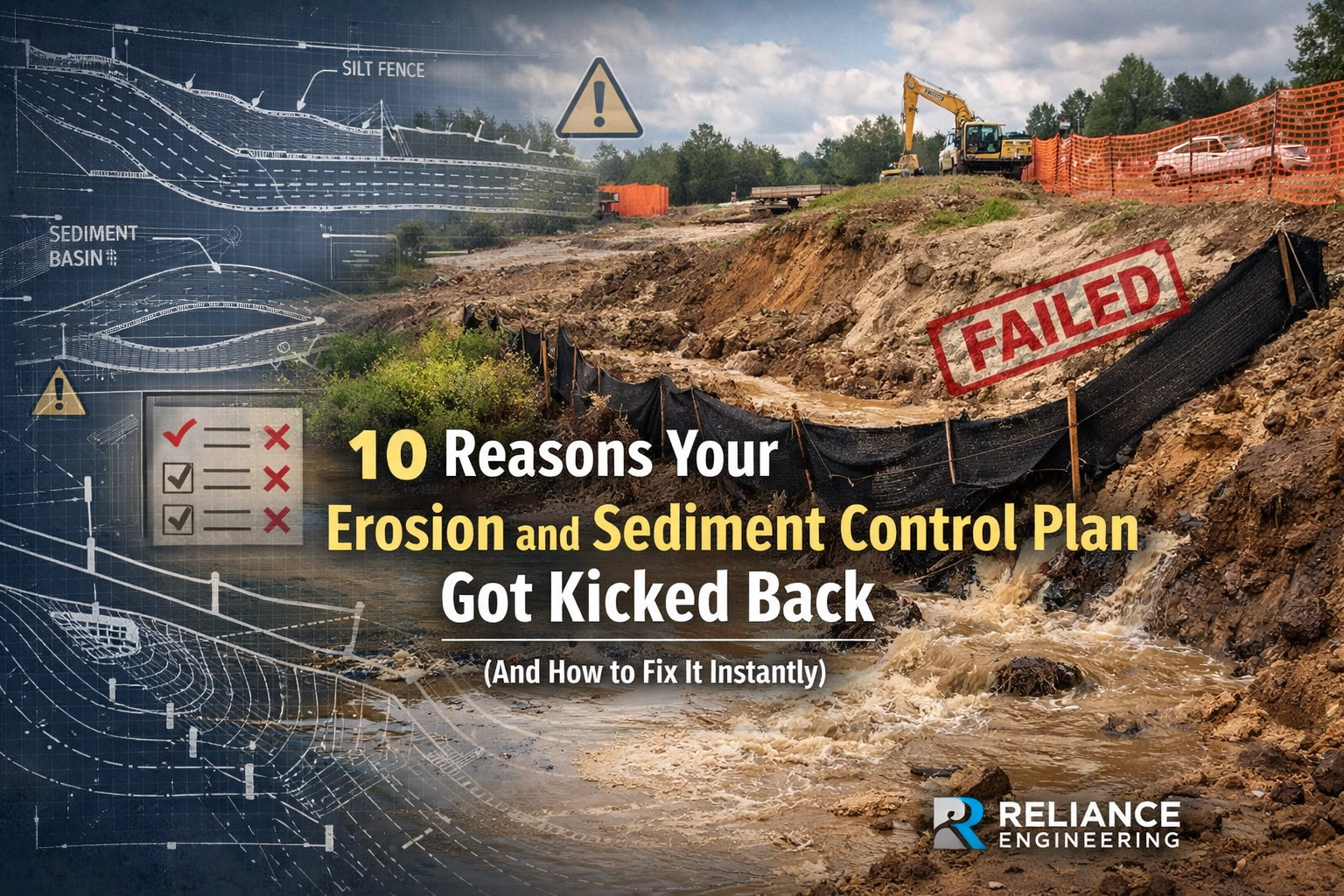
In the Greater Toronto Area (GTA), securing a site alteration permit or a building permit is often the most significant bottleneck in the development process. Among the various technical requirements, the Erosion and Sediment Control (ESC) Plan is frequently scrutinized by municipal reviewers and Conservation Authorities such as the TRCA (Toronto and Region Conservation Authority) or CVC (Credit Valley Conservation).
A rejected ESC plan doesn’t just mean a redline on a drawing; it means weeks of delays, missed construction windows, and mounting carrying costs. At Reliance Engineering, we have spent over 20 years refining our approach to land development. Our goal is always the "one-submission approval," leveraging our deep understanding of municipal standards to ensure your project moves forward without friction.
Below are the ten most common reasons your ESC plan might be rejected and the professional strategies we use to fix them.
1. Improper Placement of Silt Fences and Perimeter Controls
One of the most common mistakes is treating a silt fence as a "one size fits all" boundary. Reviewers often reject plans where silt fences are placed in areas of concentrated flow or where they are expected to withstand hydraulic pressure beyond their design capacity.
The Fix: Silt fences should be used for sheet flow only. If your site has concentrated water flow, you must implement rock check dams or temporary diversion swales. At Reliance Engineering, we analyze the topography of your site grading plan to ensure perimeter controls are placed exactly where they intercept sediment-laden runoff before it leaves the property.
2. Lack of Detailed Construction Phasing
Municipalities in the GTA, particularly in growing regions like Peel and Durham, now demand that ESC plans show how controls evolve as the project progresses. A "blanket" plan that shows the same controls for demolition, excavation, and vertical construction is a red flag for reviewers.
The Fix: Divide your ESC plan into distinct phases:
- Pre-Construction/Demolition
- Bulk Grading and Servicing
- Post-Construction/Stabilization
Showing this progression demonstrates a proactive approach to stormwater management and significantly increases your chances of immediate approval.
3. Inadequate Catch Basin Protection
Reviewers frequently reject plans that simply specify "filter fabric" under a catch basin grate. Standard filter fabric can quickly clog, causing localized flooding on the street: a major liability for developers.
The Fix: Specify high-quality, manufactured sediment traps or "curb inlet filters" that allow for overflow in heavy rain events. This ensures that while sediment is captured, the storm system design continues to function during peak storms, protecting both the environment and your site infrastructure.
4. Neglecting Seasonal Realities (The "Winter Plan")
Construction in Ontario doesn't stop for the winter, and neither does erosion. Plans that fail to account for frozen ground (which increases runoff) or snowmelt are often sent back for revision.
The Fix: Your ESC plan must include specific notes for winter maintenance. This includes the use of rock-lined entrances that won't turn into mud pits during a thaw and the strategic placement of snow storage areas away from sensitive watercourses or storm inlets.
5. Failure to Address Slope Stability
If your site has significant elevation changes, a standard perimeter fence won't suffice. GTA reviewers look for "slope interrupts" (like fiber rolls or silt socks) placed at regular intervals on slopes steeper than 3:1.
The Fix: We integrate the ESC strategy directly with the site-grading-plan. By calculating the exact gradient and length of slopes, we determine the necessary spacing for horizontal intercepts, preventing rill erosion before it starts.
6. Missing or Vague Inspection and Maintenance Schedules
An ESC plan is a living document. Many rejections stem from the absence of a clear maintenance schedule. If the reviewer doesn't see a commitment to post-rainfall inspections, they will likely deem the plan non-compliant.
The Fix: Include a formalized inspection log template directly on the drawing. Specify that inspections will occur weekly and within 24 hours of any rainfall event exceeding 10mm. This level of detail provides the municipality with the confidence that the developer is committed to ongoing construction administration.
 A professional consultant reviewing site plans on a tablet at a construction site with the Reliance Engineering logo visible.
7. Using Generic "Copy-Paste" Details
Every municipality in the GTA has slightly different standard details. Using a City of Toronto silt fence detail for a project in Oakville or St. Catharines is a fast track to a rejection.
The Fix: At Reliance Engineering, we maintain a comprehensive library of current standards for every jurisdiction we work in, from the redevelopment of Etobicoke General Hospital to high-density townhomes like 35 Wabash Avenue. We ensure every detail is "localized" to the specific requirements of the approving authority.
8. Inadequate Dewatering Protocols
If your project involves deep excavation: common in GTA condo developments: you will need to discharge groundwater. Failing to specify how this water will be filtered (e.g., through a sediment bag or filtration tank) is a major compliance gap.
The Fix: Coordinate your ESC plan with your functional servicing report. Clearly define the dewatering location, the type of filtration media, and the discharge point to ensure no turbid water enters the municipal sanitary sewer design or storm systems.
9. Omission of Stabilized Construction Entrances
"Mud tracking" onto public roads is the most visible sign of a failing ESC plan and often leads to stop-work orders. A plan that doesn't include a properly sized, clear-stone mud mat will be rejected immediately.
The Fix: Design the entrance based on the expected volume of heavy truck traffic. For larger projects like 85 Bronte Road in Oakville, we specify longer, wider entrances with a geotextile underlay to prevent the stone from sinking into the subgrade.
10. Non-Compliance with Source Water Protection
Certain areas in the GTA are designated as "Highly Vulnerable Aquifers" or "Significant Groundwater Recharge Areas." If your plan doesn't acknowledge these zones, the Ministry of the Environment, Conservation and Parks (MECP) may intervene.
The Fix: Conduct a preliminary check of Source Water Protection maps during the site servicing plan stage. If your site falls within a sensitive zone, we implement enhanced measures, such as non-toxic flocculants or double-row silt fencing, to ensure maximum protection.
The Reliance Engineering Difference: 20+ Years of Precision
Securing approval for an Erosion and Sediment Control plan requires more than just technical drawing skills; it requires an understanding of the unwritten expectations of municipal reviewers. With over two decades of experience in the GTA, Reliance Engineering has built a reputation for excellence. We don't just "draw lines"; we design systems that work.
Whether you are working on a boutique residential development or a massive institutional redevelopment, our team is equipped to handle your civil engineering needs.
Ready to get your project approved?
Don’t let a poorly designed ESC plan stall your progress. Partner with the experts who prioritize your timeline and your bottom line.
Contact Reliance Engineering today:
- Phone: 905-276-2300
- Email: [email protected]
- Location: 700 Burnhamthorpe Rd E, Unit 5, Mississauga, ON L4Y 2H1
- Hours: Monday – Friday, 9:00 AM – 5:00 PM