
In the rapidly evolving landscape of land development in Ontario, the margin for error has narrowed to an all-time low. As we navigate through 2026, the complexity of urban infrastructure and the tightening of environmental regulations have transformed the humble stormwater management report from a standard checklist item into the most critical document in your development application.
At Reliance Engineering, with over 20 years of experience serving the Greater Toronto Area (GTA), we have witnessed the shift firsthand. The question is no longer just "Do I need a report?" but rather, "Is my report precise enough to survive the first round of municipal review?"
The Rising Stakes of Stormwater Compliance in 2026
The regulatory environment in 2026 has introduced significant shifts in how municipalities and conservation authorities, such as the TRCA and CVC, evaluate development impacts. With the introduction of the 2026 Municipal Separate Storm Sewer System (MS4) frameworks and enhanced EPA oversight, the "approximate" calculations of the past are now grounds for immediate rejection.
Today, precision is the currency of progress. An imprecise stormwater management report does more than just delay a permit; it triggers a cascade of financial and operational setbacks. Regulatory bodies have moved toward automated reporting triggers. For instance, updated monitoring structures now require "AIM Triggering Event Reports" whenever data deviates from predicted benchmarks. If your initial report's modeling is flawed, you are setting your project up for a lifetime of unnecessary remediation and regulatory scrutiny.
Why "One-Submission Approval" is the New Standard
For developers and site owners, time is the most expensive commodity. In the GTA, where land costs and interest rates remain high, a three-month delay at the municipal review stage can cost tens of thousands of dollars in carrying costs.
Our philosophy at Reliance Engineering is centered on the "One-Submission Approval" goal. This objective requires a level of detail that anticipates the concerns of municipal engineers before they even open the file. A precise stormwater management report must address:
- Water Quantity Control: Ensuring post-development peak flow rates do not exceed pre-development levels for various storm events (from the 2-year to the 100-year storm).
- Water Quality Treatment: Implementing Low Impact Development (LID) features and oil-grit separators to meet stringent Total Suspended Solids (TSS) removal targets.
- Water Balance: Maintaining groundwater recharge rates to protect local aquifers and ecosystems.
- Erosion Control: Protecting downstream watercourses from increased flow volumes that could cause bank instability.

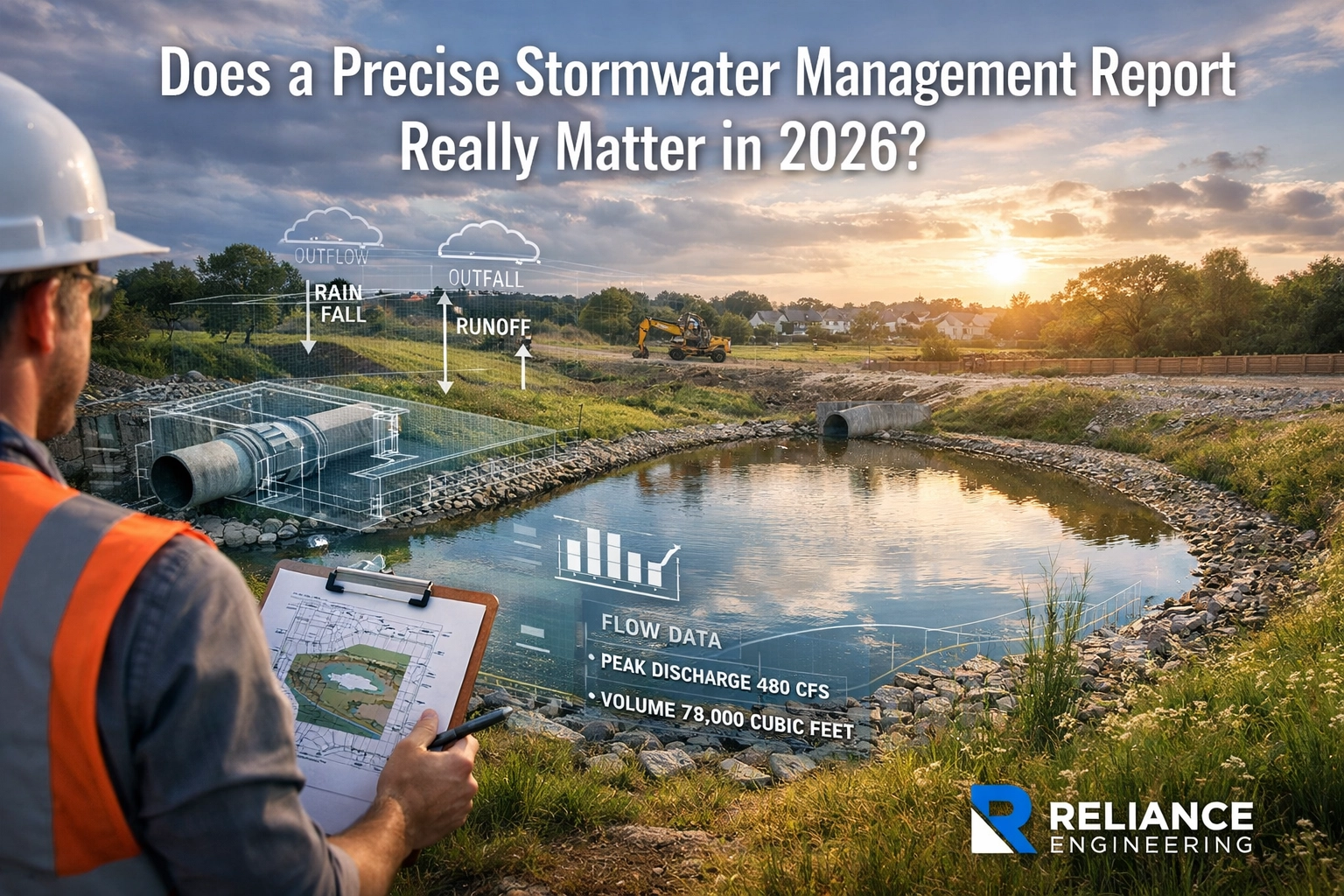
Caption: Technical modeling of stormwater runoff patterns is essential for meeting 2026 municipal criteria in the GTA.
The Technical Evolution: From Static to Dynamic Modeling
In 2026, the industry has moved beyond simple rational method calculations for all but the smallest sites. Municipalities now demand sophisticated hydrologic and hydraulic modeling. Whether it is SWMHYMO, PCSWMM, or other advanced software, the precision of the input data, slope, soil permeability, and impervious percentages, determines the validity of the output.
An error as small as a 5% miscalculation in impervious cover can lead to an undersized detention tank or an inadequate infiltration gallery. When the municipality identifies these gaps, the entire site grading plan and site servicing plan often need to be redesigned to accommodate the larger infrastructure. This "design-loop" is the primary cause of project stagnation.
The Financial Impact of Imprecision
We often see developers tempted by lower-cost engineering firms that promise "quick and dirty" reports. However, the true cost of a stormwater management report is not the fee on the invoice; it is the total cost of getting the permit in hand.
Consider the current fee structures of Ontario Conservation Authorities. In 2026, resubmission fees have increased to discourage poor-quality applications that clog the system. An imprecise report leads to:
- Multiple Resubmission Fees: Paying the municipality and conservation authority for second, third, and fourth reviews.
- Increased Construction Costs: Over-engineered solutions designed in a rush to satisfy a reviewer can cost significantly more to build than a precisely optimized system.
- Missed Construction Windows: Missing the summer grading season because of a late-spring permit delay can push a project's completion back by an entire year.
Integrating Stormwater with Functional Servicing
A stormwater management report does not exist in a vacuum. It must be perfectly synchronized with your Functional Servicing Report (FSR). At Reliance Engineering, we integrate these elements from day one. By ensuring that the sanitary sewer design and storm system design work in harmony with the SWM requirements, we eliminate the conflicts that often arise during the Site Plan Approval (SPA) process.

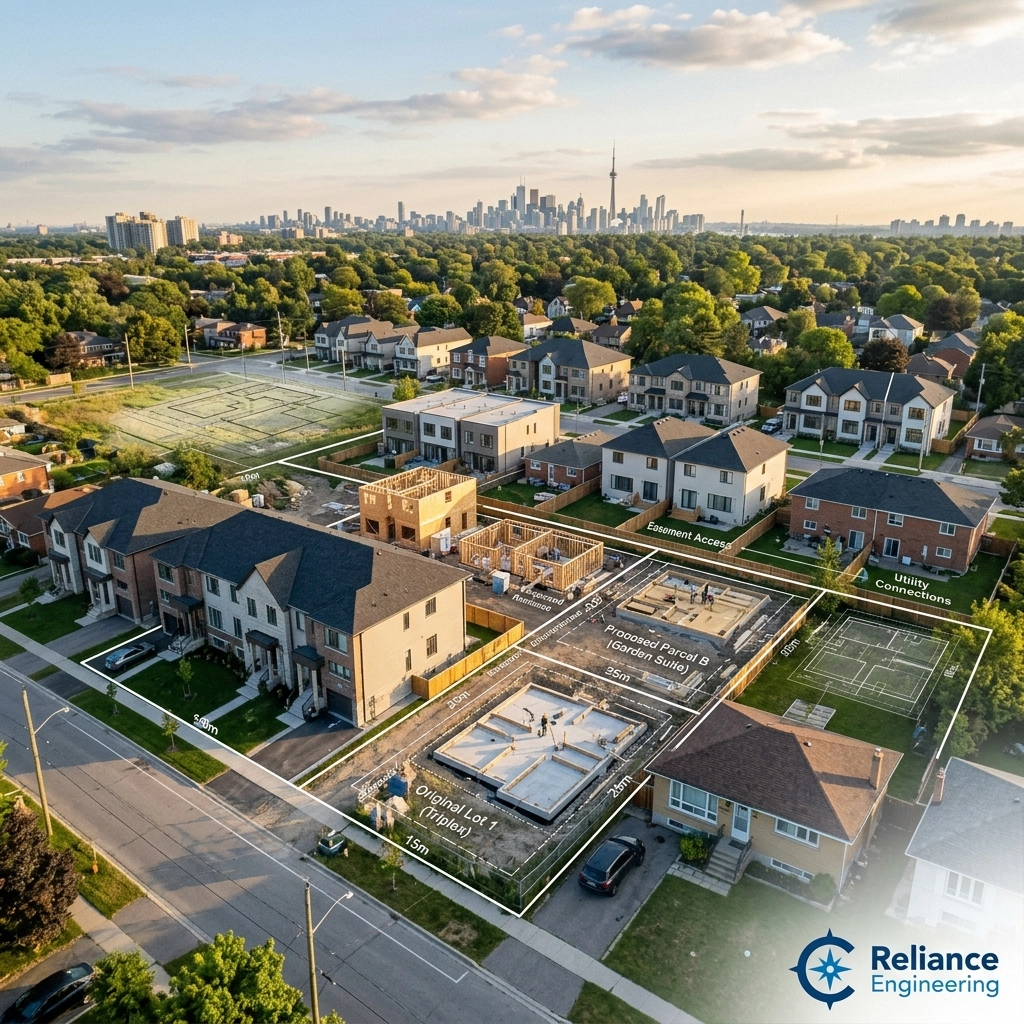
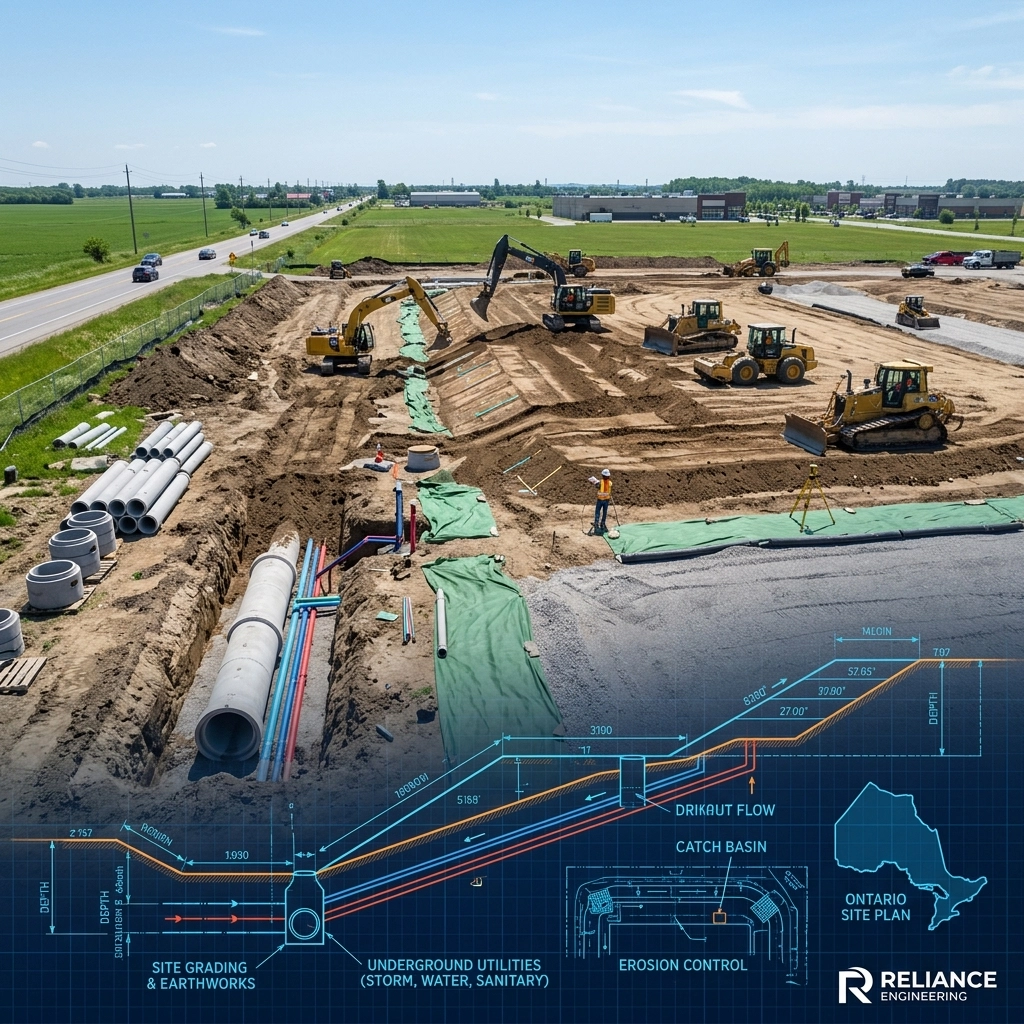
Caption: Integrated civil engineering services ensure that servicing, grading, and stormwater management work as a unified system.
The Reliance Engineering Advantage: 20+ Years of GTA Expertise
Reliance Engineering was founded by Naresh Ochani with a clear mission: to provide practical, compliant, and cost-effective solutions for the land development industry. Our two decades of experience in the GTA mean we have built relationships and trust with municipal reviewers across Toronto, Peel, York, Durham, and Halton regions.
When you submit a stormwater management report with the Reliance Engineering seal, the reviewer knows they are looking at a document that respects the technical standards of 2026. We don't just provide data; we provide a narrative of compliance that makes it easy for the municipality to say "Yes."
Our Process for Precision:
- Initial Site Assessment: Identifying constraints like high groundwater tables or tight setbacks early.
- Optimized Modeling: Using the latest software to minimize the footprint of SWM infrastructure, maximizing your developable land.
- Proactive Communication: Engaging with municipal staff during the pre-consultation phase to align on expectations.
- Rigorous Quality Control: Every report undergoes a multi-point internal review before it ever leaves our office.

Caption: Our team utilizes over 20 years of experience to navigate the complexities of GTA land development consulting.
Conclusion: Don't Leave Your Approval to Chance
Does a precise stormwater management report really matter in 2026? The answer is a resounding yes. It is the difference between a project that breaks ground on schedule and one that is buried under a mountain of municipal "Comments to be Addressed."
As the GTA continues to densify and climate patterns become more unpredictable, the engineering requirements will only become more stringent. Partnering with a firm that prioritizes precision and understands the local landscape is no longer a luxury: it is a business necessity.
If you are planning a development project and need a partner who values one-submission approval as much as you do, reach out to us. Let’s get your project moving.
Corporate Information & Contact
Reliance Engineering
Civil Engineering & Land Development Consulting
Address: [Refer to website for current office locations]
Website: www.relianceengineering.ca
Services: Land Development, Stormwater Management, Site Grading, Site Servicing.
Operational Hours:
Monday – Friday: 9:00 AM – 5:00 PM
Saturday – Sunday: Closed
Ready to start your project?
Contact Us Today for a consultation on your next development application. Our team is ready to provide the precision your project deserves.
Reliance Engineering is a leader in Civil Engineering Consulting in Ontario, specializing in cost-effective, permit-ready plans for residential, commercial, and industrial developments.




Leave A Comment