Article type: Technical explainer
Topic: Functional Servicing Reports and municipal approvals in Ontario
Published: October 29, 2026
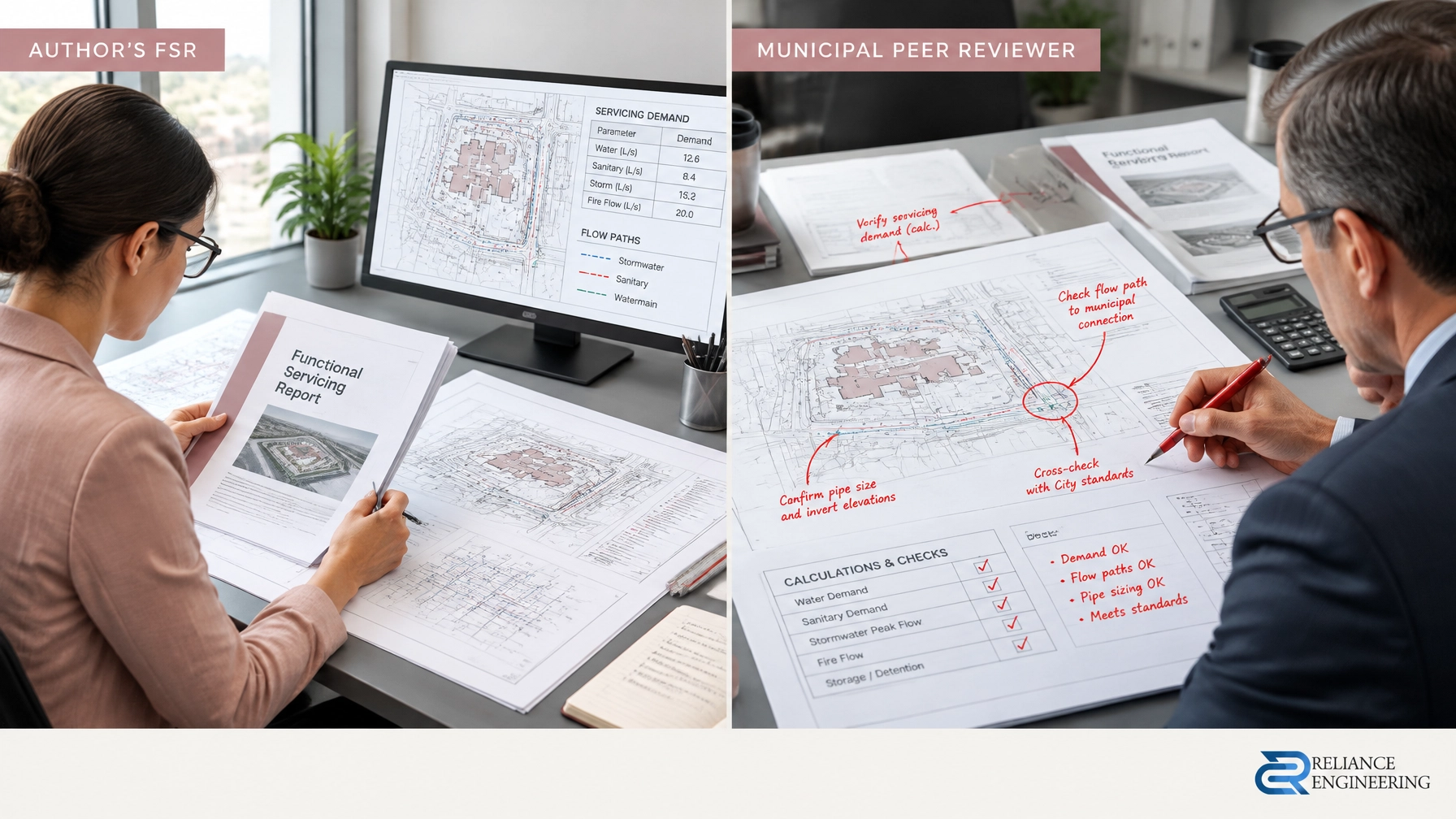
You hire an engineer to prepare a Functional Servicing Report (FSR). The municipality may then hire a second engineer to review it, and charge the review cost to the applicant.
That review is not a formality. It is a technical audit gate. The reviewer may test the assumptions, calculations, servicing strategy and supporting evidence behind the report before the application advances.
When can a municipality require a peer review?
The City of Barrie’s 2026 FSR Terms of Reference states: “Please note that a peer review may be required. The cost of the peer review will be borne by the applicant.” It also says requirements may vary with the proposal and be determined through pre-consultation and consultation with external agencies.
The City of Waterloo’s FSR Terms of Reference similarly reserves the right to require peer review by an appropriate agency or qualified professional, at the applicant’s cost.
There is no single province-wide trigger list. A peer review may be considered for a complex or precedent-setting proposal, concerns about capacity or downstream impacts, unresolved differences between the applicant’s analysis and municipal staff’s review, an external agency request, or a submission that has required repeated correction. These are possible circumstances, not a universal rule.
The key point: a municipality can seek independent technical advice when it needs more confidence in the servicing conclusions.
How is the review funded?
The applicant generally pays when the municipality requires a peer review. The exact process and costs depend on the municipality.
Woolwich Township’s 2026 Development Engineering fees, By-law 58-2025, Schedule C, provide one municipal example. Where the Director determines peer and/or legal review costs will be incurred, Woolwich requires an applicant deposit of $10,000 or $25,000, depending on the anticipated extent of the review, plus a 15% administration fee. If costs exceed the deposit, the applicant must replenish it to the amount determined by the Director. If costs are lower, the balance is reimbursed.
Woolwich’s fee schedule also lists $530 per site plan resubmission beyond the third review, plus peer-review costs. For site alteration peer review, the schedule lists actual costs plus a 15% administration fee. These are Woolwich’s fees, not a provincial standard.
Repeated submissions do not automatically mean that an FSR will receive a peer review. But Woolwich’s fee schedule shows how resubmissions and peer-review costs can both affect an application budget.
What does the peer reviewer test?
A reviewer checks whether the report supports its conclusions with applicable criteria, credible inputs, clear calculations and coordinated plans. Municipal requirements vary, but official guidance shows the types of checks an FSR may face.
- Water demands and boundary conditions: Barrie’s TOR asks for estimated water consumption and current system capacities, plus a hydrant flow test to confirm boundary conditions and meet City standards.
- Wastewater flows and downstream systems: Barrie asks for estimated discharge, current trunk capacities, and conformance with its Sanitary Sewage Collection System Policies and Design Guidelines (2017) and Sewer Use By-law (2021-002).
- Storm drainage and supporting analysis: Barrie calls for conformance with its Storm Drainage and Stormwater Management Policies and Design Guidelines (2017) and Low Impact Development Guideline (2023). It also asks for enough detail to assess the financial and infrastructure implications, including reports, plans, computer-modelling results and design calculations for proposed services and upgrades.
- Municipal model checks: Richmond Hill’s FSR Requirements require an FSR prepared by a professional engineer qualified in municipal engineering, with drawings stamped, signed and dated by an Ontario-licensed P.Eng. They also call for conformity with the City’s 2023 Urban Master Environmental Servicing Plan (UMESP). After acceptable demand inputs are submitted, City staff assess downstream water, wastewater and stormwater capacity using the City’s own computer models. Applicant demand inputs can therefore be checked against municipal models.
- Servicing-plan conformity and wastewater criteria: Halton Region’s Development Engineering Review Manual (August 2022) directs engineers to reference the applicable Area Servicing Plan (ASP) and the Region’s Master Servicing Plan. Its conformity hierarchy places the FSR in relation to the ASP and the Regional Master Servicing Plan. For wastewater capacity analysis, the manual expressly says not to use Ontario Building Code (OBC) flow rates; use Regional design standards instead.

Conformity hierarchy concept based on Halton Region’s Development Engineering Review Manual.
What happens if the report does not pass review?
A weak submission can affect both completeness and schedule. Barrie states that if a study is incomplete, prepared by an unqualified individual or lacks adequate analysis, the application is considered incomplete and returned to the applicant.
Woolwich’s fee schedule makes the potential cost of repeated site plan resubmissions explicit. In any municipality, peer review comments may also lead to revisions, additional calculations or a revised servicing strategy. Those tasks take time, and review cycles can delay the approval schedule. The duration depends on the project and municipality; there is no single timeline that applies across Ontario.
How to reduce the risk of a costly review cycle
Prepare the FSR for verification, not just for submission. Check the applicable TOR line by line. Cite the municipal and regional design criteria used for water and wastewater calculations. Where required, document boundary conditions with hydrant flow test evidence. Reference the relevant MESP, ASP and master servicing plan directly.
Include the modelling results, assumptions and clear calculations needed to follow the analysis. Coordinate the report with the proposed site servicing plans and any stormwater management reports so the drawings and narrative tell the same story. Use clean layouts, constructible routing and practical controls.
Barrie also specifies how to document a revised proposal: update the report, or provide a letter from its author confirming that the recommendations and conclusions remain the same. Agree on that revision-letter protocol with the report author before changes are made. When municipal comments arrive, respond quickly and traceably: identify each comment, the response, and where the revision appears.
A coordinated design and concise, well-supported response can help staff and any peer reviewer follow the work efficiently. It cannot guarantee approval, but it can reduce avoidable questions.
Six checks before submitting an FSR

- TOR cross-check: Confirm each applicable requirement is addressed.
- Criteria sources cited: Identify the municipal and regional standards used.
- Boundary conditions evidenced: Include required flow-test information and inputs.
- Models included: Provide relevant model results, calculations and assumptions.
- Conformity statements: Address applicable MESP, ASP and master servicing plans.
- Revision-letter protocol agreed: Confirm how the author will document proposal changes.
Prepare your FSR for technical scrutiny
An FSR peer review tests whether a servicing proposal is supported by defensible assumptions, applicable criteria and coordinated documentation. Reliance Engineering prepares functional servicing reports and related civil engineering documents with municipal experience, clear calculations and practical designs that support Ontario approvals.
Request a consultation to discuss your project, applicable requirements and the supporting documentation needed for review.
Professional credentials and contact
Naresh Ochani, P.Eng., M.Eng.
Principal Engineer, Reliance Engineering Canada Limited
PEO Certificate of Authorization: 100548882
6850 Millcreek Dr, Mississauga, ON L5N 2H4
Phone: 647-385-6418
Email: [email protected]
Office hours: Monday–Friday, 9:00 AM–5:00 PM; Saturday, 12:00 PM–2:00 PM; Sunday, Closed.
Sources and related services
- City of Barrie: Functional Servicing Report Terms of Reference, 2026
- City of Waterloo: Functional Servicing Report Terms of Reference
- City of Richmond Hill: Functional Servicing Report Requirements
- Township of Woolwich: By-law 58-2025, Schedule C fees
- Halton Region: Development Engineering Review Manual
- Reliance Engineering: Functional Servicing Reports
- Reliance Engineering, Site Servicing Plans
- Reliance Engineering, Stormwater Management Reports