Article type: Engineering guidance
Focus: Ontario Grading & Drainage
Service area: Ontario-wide
Primary services: Site Grading Plans; Erosion and Sediment Control Plans
Published: October 12, 2026
Commercial parking lots with ponding, failed asphalt edges, or poor driveway connections should be assessed before winter. A new asphalt layer may improve appearance, but it will not correct low spots, blocked drainage, or a road tie-in that directs water back onto the property.
A drainage-focused approach starts with existing elevations and the complete route water takes across the site. That helps property owners plan practical designs, coordinate approvals, and avoid paving over problems that will return with freeze-thaw weather.
Why standing water needs attention before winter
Water collects where the asphalt has settled, slopes are inconsistent, or catchbasins sit above the surrounding pavement. When water enters cracks and pavement joints, repeated freezing and thawing can widen defects, loosen aggregate, and contribute to potholes and heaving. Water can also saturate the granular base, weakening support under vehicle loads.
This is why commercial property grading fixes should be assessed before repaving. New asphalt placed over a poorly draining surface may reproduce the same low areas, or move water toward a building, sidewalk, neighbouring property, or roadway. The right repair may involve pavement removal, base correction, catchbasin rim adjustments, or redesigned grades, not simply another asphalt lift.
Survey the asphalt, not just the visible puddles
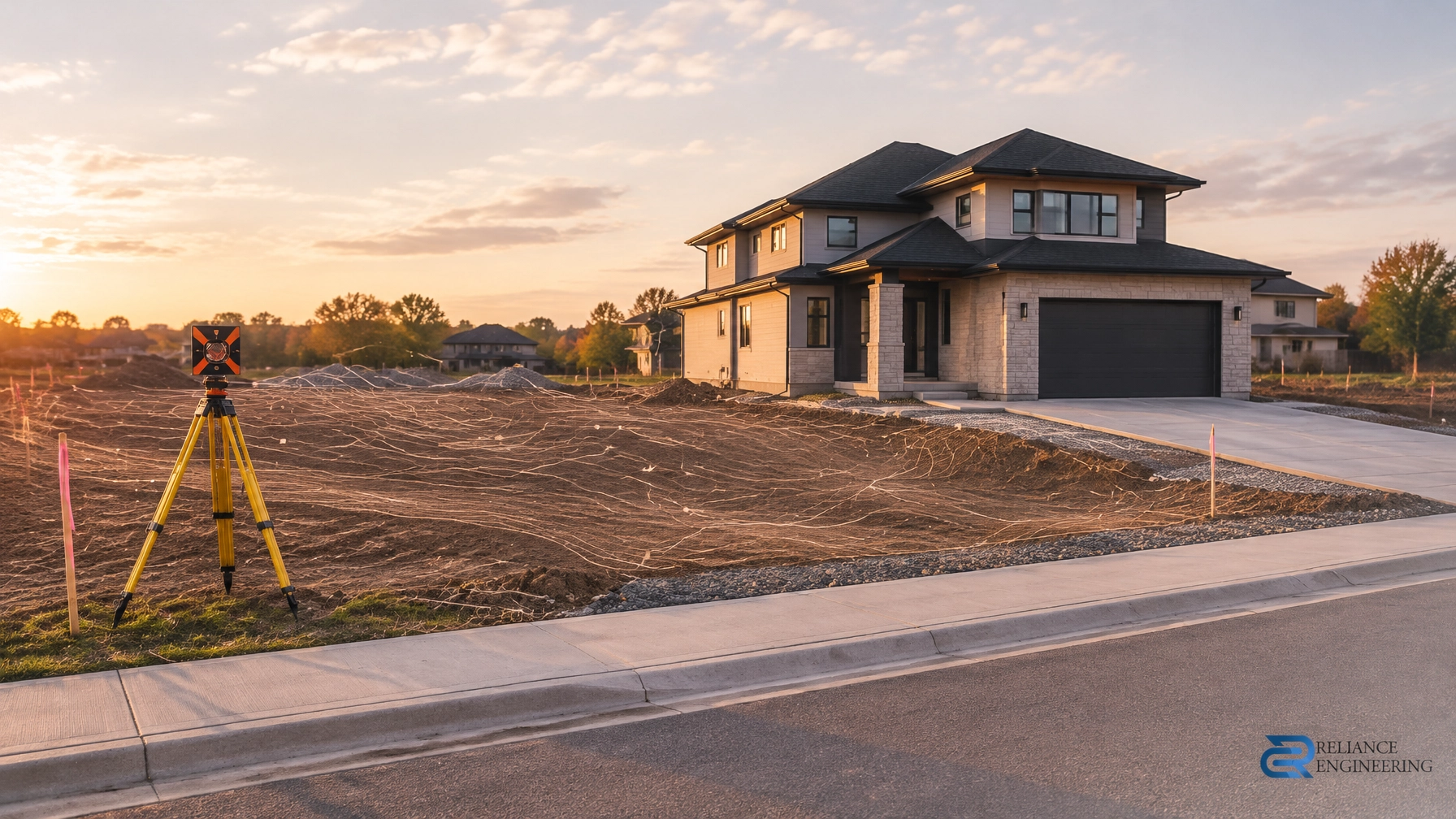
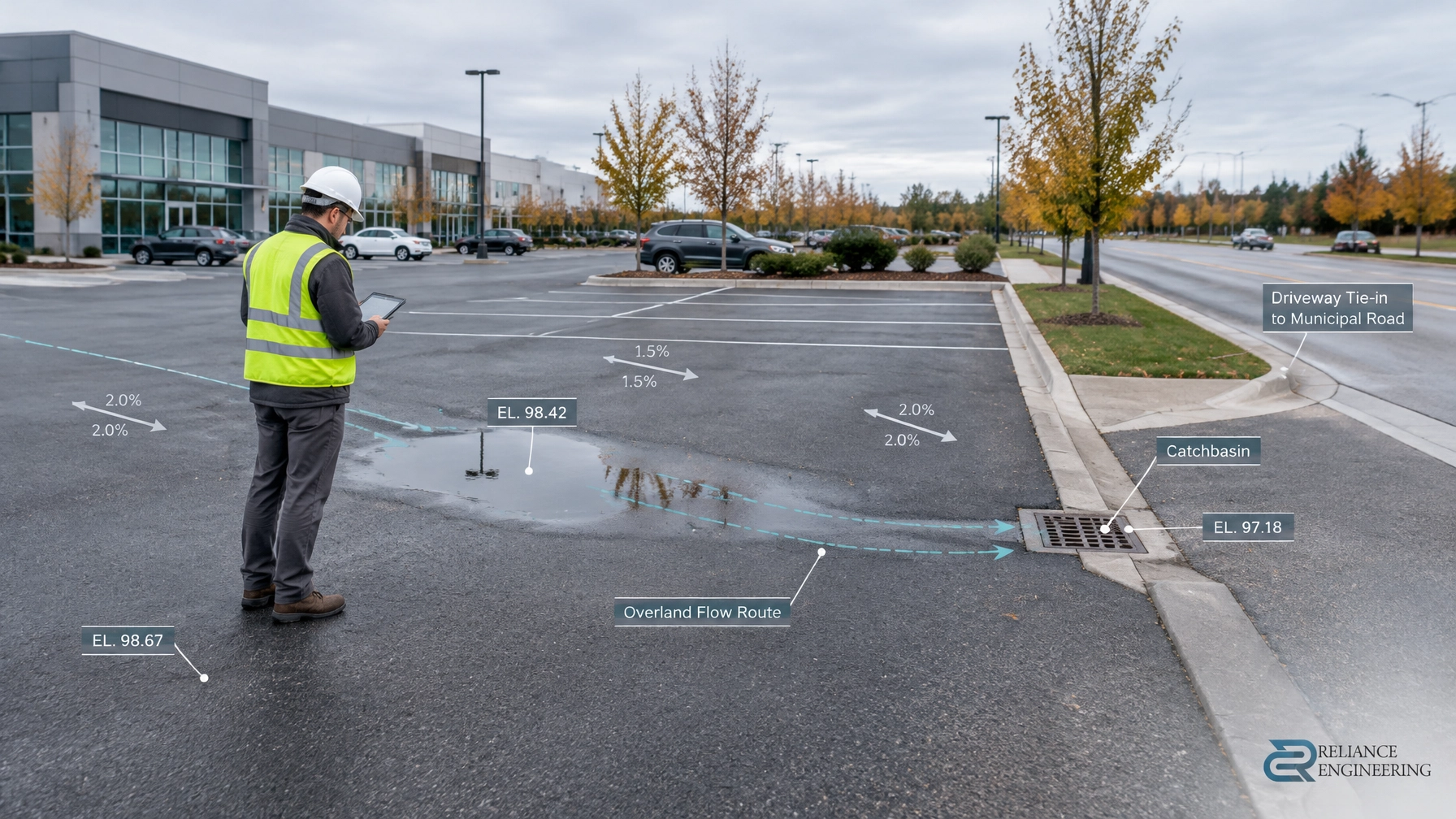
A site-specific design begins with surveying existing asphalt elevations and relevant site features. This typically includes pavement highs and lows, catchbasin rims, curbs, building entrances, sidewalks, driveway limits, property boundaries, and the connection to the municipal road or ditch.
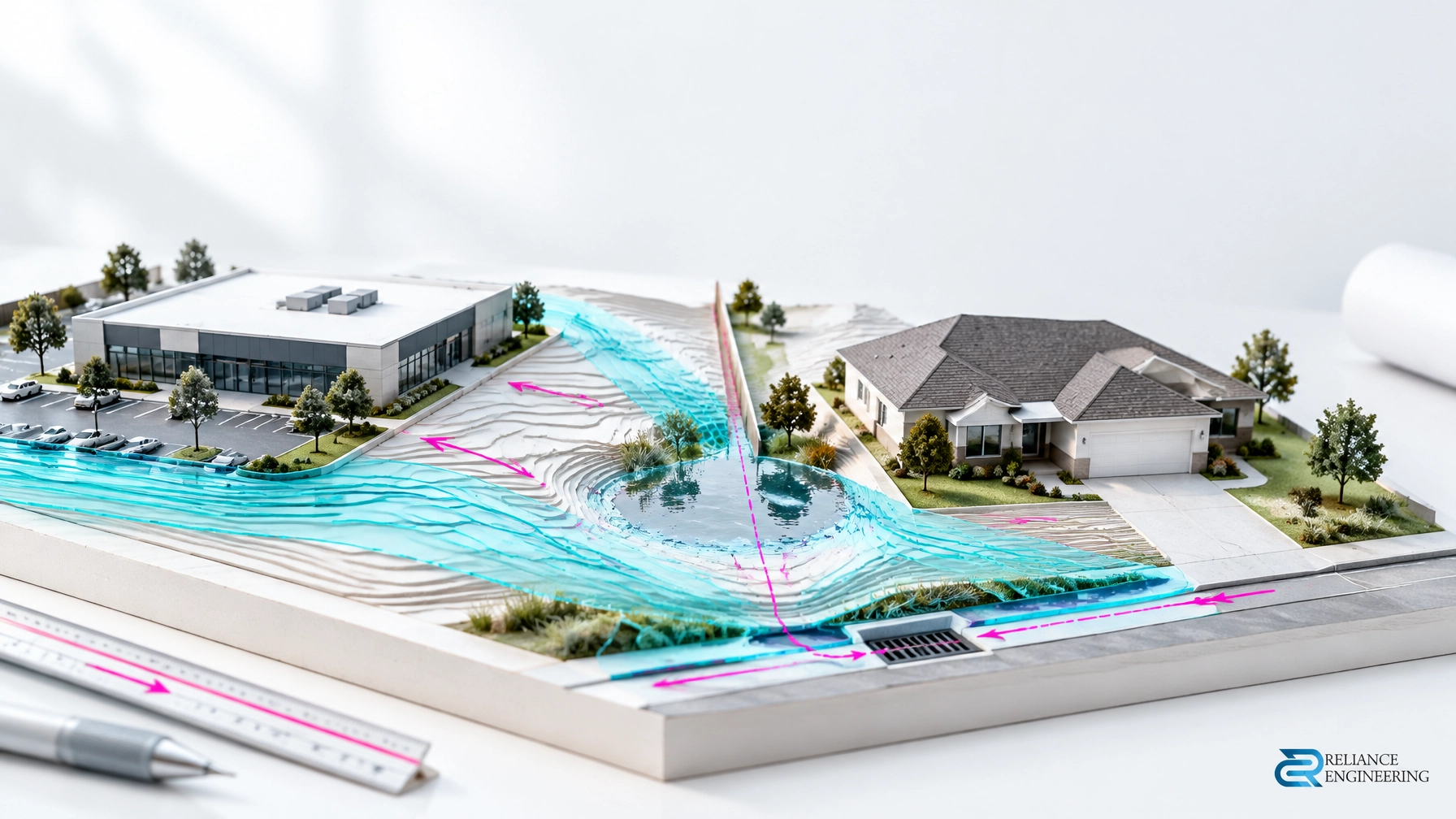
The survey helps distinguish a surface depression from a broader drainage problem. It also gives the engineer a basis for proposed spot elevations, slope arrows, swales, and overland flow routes. Reliance Engineering’s Site Grading Plans service uses survey data to prepare clear drawings showing existing and proposed elevations, parking lot grades, drainage routes, and tie-ins to roads, ditches, and storm systems.

Illustrative grading-plan reference only. Site grades, drainage connections, and municipal criteria must be confirmed for each project.
Design positive drainage and check the outlet
A grading design sets cross-slopes and longitudinal grades so water reaches a suitable collection point without creating new problems. A minimum cross-slope is not a single province-wide value: requirements depend on municipal standards, site conditions, accessibility, pavement use, and the approved drainage design. For reference, Barrie’s Lot Grading and Drainage Infrastructure Design Standard identifies 1% as a recommended minimum for parking areas, with 2–4% described as desirable. Confirm the governing criteria with the municipality for the property.
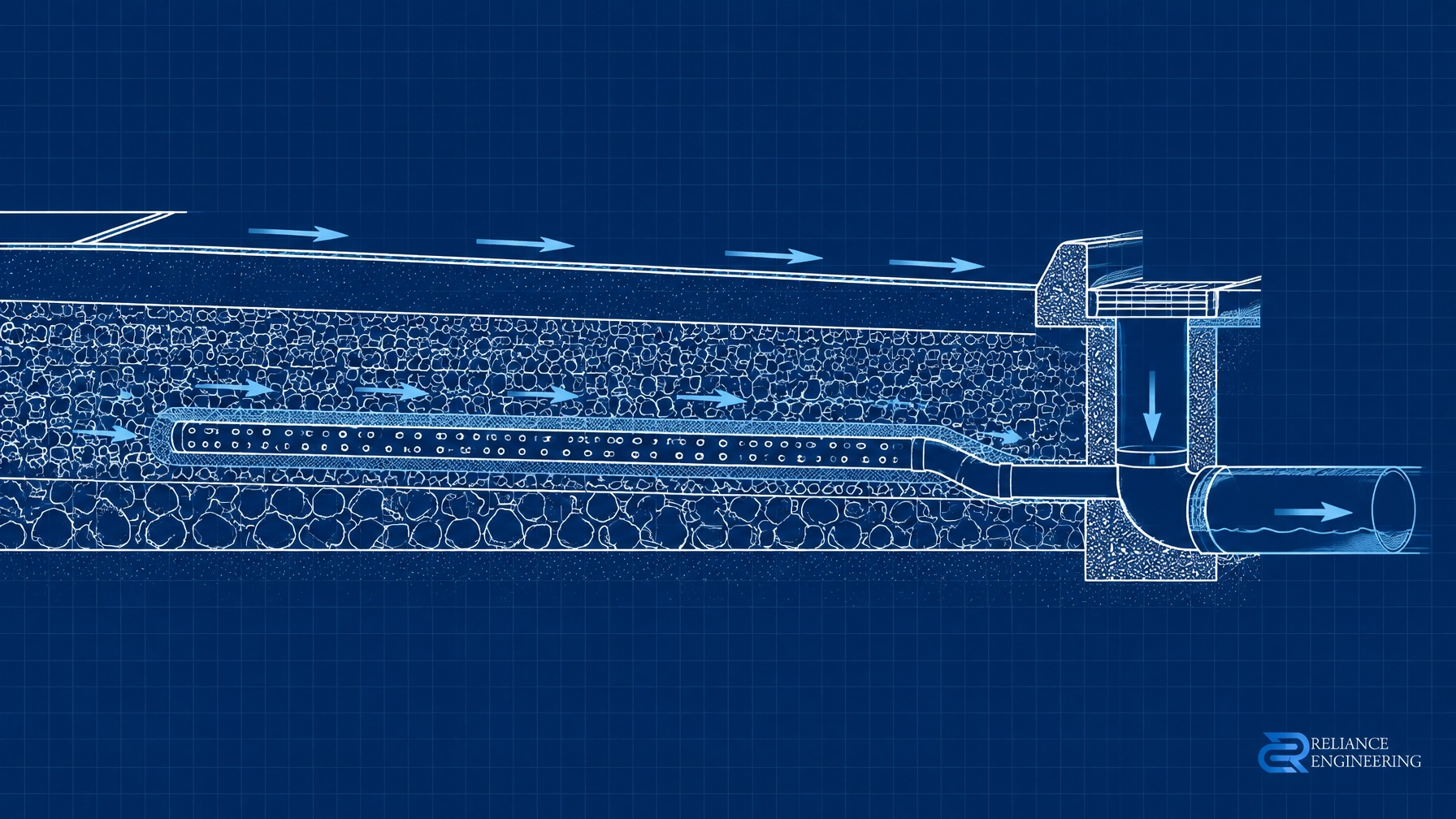
Catchbasin rim resets can help align the inlet with the proposed pavement surface, but changing a rim does not by itself resolve inadequate pipe capacity or a restricted outlet. The design should review the storm outlet, connections, and available system capacity, as well as where runoff will go if the inlets cannot accept all flows during a larger storm.
Overland flow routes need equal attention. They should direct water safely away from buildings and avoid sending runoff onto neighbouring land or into an unsafe pedestrian or vehicle area. Where work changes the existing drainage pattern or discharge, confirm the applicable municipal requirements and any approved site plan or stormwater conditions.
Get the road tie-in right
A driveway connection can be a persistent source of ponding when the private lot, sidewalk, gutter, and municipal road do not meet at compatible elevations. Survey and design should check the curb cut, depressed curb, gutter line, sidewalk crossing, and edge of pavement as one coordinated tie-in.
The goal is a smooth, buildable connection that maintains positive drainage and does not create a lip, trap water, or redirect runoff across the sidewalk. Work within the municipal right-of-way may require separate municipal review or a permit. Confirm responsibility and approval requirements with the local municipality before construction.
Confirm permits and protect storm systems
Municipal grading and drainage requirements vary across Ontario. Depending on the property and scope, regrading may trigger a site alteration permit, site-plan review, or other municipal approvals. For example, the Town of Milton’s site alteration permit guidance identifies changes such as altering grades or drainage among activities to check. The local rules, not another municipality’s example, determine the application path.
A separate Conservation Authority review may also apply when work is within a regulated area. Ontario’s Conservation Authority permit guidance explains when permission may be required. Check the applicable authority and municipal requirements before grading, filling, changing drainage, or working near a watercourse, wetland, shoreline, or valley.
Construction controls are part of the design, not an afterthought. An erosion and sediment control plan may show silt fence, a mud mat at the access, catchbasin protection, sediment traps or check dams, protected stockpiles, dewatering notes where required, construction-limit fencing, and maintenance and inspection notes. These measures help prevent sediment from entering municipal storm sewers and nearby drainage systems. See Reliance Engineering’s Erosion and Sediment Control Plans.
Plan asphalt work around fall conditions
Asphalt placement depends on the specified mix, site conditions, and applicable municipal requirements. The Ontario Ministry of Transportation hot-mix asphalt specification sets minimum ambient temperatures for binder and surface courses and requires the granular grade to be free of saturation and standing water. Toronto’s TS 310 paving specification likewise addresses dry, unfrozen conditions and minimum temperatures.
October work should leave time for approvals, base repairs, inspections, and paving within the governing specification. Do not pave over wet or frozen surfaces simply to meet a calendar deadline. Confirm the required conditions with the project engineer and paving contractor; if final surfacing cannot meet them, agree on an appropriate temporary condition rather than sealing in a drainage or base problem.
A practical phased sequence
- Survey and setout: Record existing elevations, identify low spots, and set proposed grades and construction limits.
- Drainage and base work: Correct the granular base, address drainage connections, and reset catchbasin rims to the design.
- Grade verification: Check grades, tie-ins, and flow routes before paving.
- Binder course: Place the binder course when specified site and weather conditions are met.
- Surface course: Place the final course under the applicable temperature and surface requirements.
- Final inspection: Check pavement transitions, catchbasin access, drainage performance, and erosion-control removal or maintenance.
A coordinated design links grading, storm drainage, road tie-ins, ESC measures, and municipal review. Reliance Engineering prepares permit-ready drawings and provides approval support for site-specific projects across Ontario.
Request a regrading consultation
Planning to repave before winter? Request a regrading and drainage consultation before construction begins. We can review the survey, low spots, storm outlet, road tie-in, and approval requirements, then advise on a practical path forward.
Contact Reliance Engineering to discuss commercial parking lot drainage in Ontario, ponding solutions, or asphalt regrading.
Contact and Professional Credentials
Reliance Engineering
6850 Millcreek Dr, Mississauga, ON L5N 2H4
Phone: 647-385-6418
Email: [email protected]
Office hours
Monday to Friday: 9:00 AM–5:00 PM
Saturday: 12:00 PM–2:00 PM
Sunday: Closed
Principal Engineer: Naresh Ochani, P.Eng. M.Eng.
PEO Certificate of Authorization: 100548882
Reliance Engineering is authorized by the Association of Professional Engineers of Ontario to offer professional engineering services.